
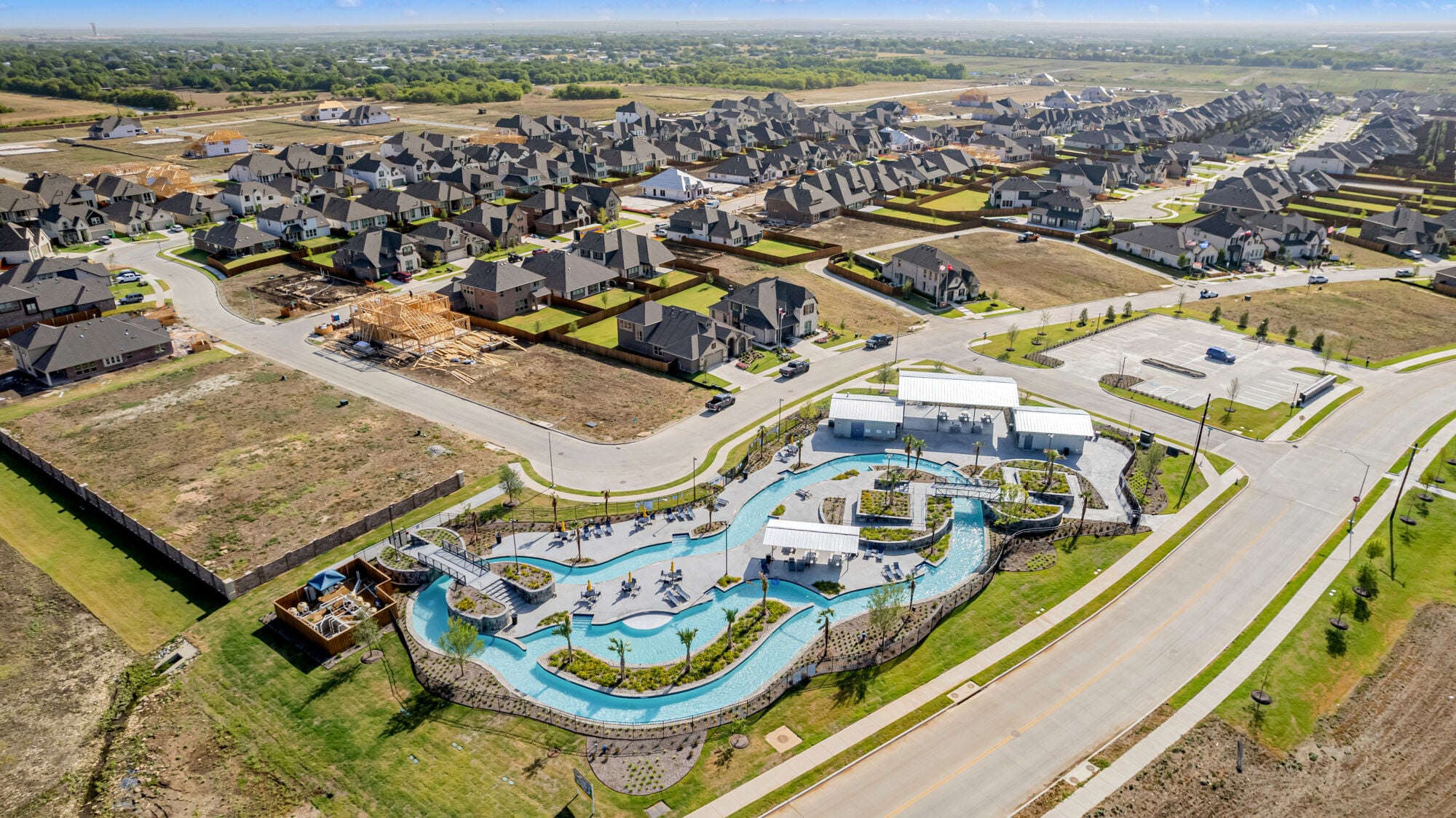
You've seen the photos of Wildflower Ranch's resort-style pool and lazy river. You know the homes are new. But before you fall in love with the community, do you actually understand what you're buying into — the real costs, the school situation, the builder options, and whether this is the right move for your family right now? That's not a rhetorical question. It's the most important thing you can ask before signing a builder contract in one of Denton County's fastest-growing master-planned communities.
This guide exists to answer it honestly. Not to sell you on Wildflower Ranch, and not to talk you out of it either. Just to give you the clear, complete picture so you can make a decision that actually makes sense for your family — without pressure, without confusion, and without any nasty surprises after closing.
Let's slow this down and look at everything.
Key Takeaways: What You Need to Know About Wildflower Ranch Justin TX
- Home prices range from $395,990 to $617,990 depending on builder and floor plan — but your true monthly cost includes property taxes (~2.29% effective rate), HOA dues (~$69/month), and MUD assessments that can add $400–$500+/month beyond your mortgage.
- Seven active builders are currently selling in Wildflower Ranch: Bloomfield, Highland, Ashton Woods, D.R. Horton, RockWell, Beazer, and UnionMain — each with different price points, incentives, and buyer demographics.
- MUD taxes are unavoidable and can last 20+ years. For a $500,000 home, the MUD portion alone adds approximately $417/month to your tax bill. Most first-time buyers don't see this coming.
- School zoning is actively shifting as the community grows. Verify current assignments directly with your builder and Northwest ISD before making any decisions based on school location.
- Builder incentives expire — Highland Homes' $20K closing cost offer ends June 30, 2026; Ashton Woods' FHA/VA rate promotion closes May 29, 2026. Compare these against independent lender options before committing.
- Builder sales agents represent the builder, not you. A licensed buyer's agent who understands new construction is your most important protection in this process.
- Justin, TX is growing at 8.2% annually, driven by AllianceTexas job corridor access and Highway 114/I-35W proximity — genuine growth signals, not marketing hype.
Why Wildflower Ranch Is Growing So Fast (And What That Means for You)
Justin, TX isn't growing by accident. The city's population is expanding at approximately 8.2% annually — a rate that significantly outpaces the broader DFW metroplex — and the reasons are structural, not speculative. The AllianceTexas development corridor, one of the largest master-planned business parks in the country, sits just minutes from Wildflower Ranch's front entrance. Logistics companies, manufacturing facilities, and corporate campuses have been expanding along this corridor for years, creating a steady stream of professional households looking for quality housing nearby.
Denton County is one of Texas's fastest-growing counties overall, and Wildflower Ranch is positioned as a major residential hub for that expansion. Highway 114 and I-35W provide reasonable access to both Fort Worth (approximately 25–30 minutes without traffic) and the broader metroplex, making this corridor attractive for households that need to commute but can't justify the price premiums in closer-in suburbs.
That's the other key driver: affordability relative to established suburbs. Families relocating from Southlake, Keller, and Flower Mound are finding that Wildflower Ranch offers new construction with modern amenities at price points $100,000–$200,000 lower than comparable product in those markets. That value gap is real, and it's driving consistent demand.
The presence of seven active builders in a single community is also a meaningful signal. Developers don't commit to large-scale master-planned communities without significant market research and confidence in sustained demand. When Bloomfield, D.R. Horton, Highland, Ashton Woods, RockWell, Beazer, and UnionMain are all actively selling in the same community, that's not coincidence — it reflects genuine developer confidence in the long-term trajectory of this market.
Infrastructure investments reinforce this picture. The AllianceTexas expansion continues to add employment, and the proposed Justin Town Square commercial development would bring retail, dining, and municipal services closer to the community — reducing the "I have to drive 20 minutes for everything" friction that can dampen enthusiasm for outer-suburb living.
If you want to explore what the Justin area looks like from a broader real estate perspective before diving into Wildflower Ranch specifically, TK Realty's Justin, TX area guide gives you a grounded overview of the local market. And if you want to understand how Wildflower Ranch fits into the wider North Fort Worth new construction landscape, this guide to new home communities in Justin TX covers the broader competitive picture.
What does all of this mean for you as a buyer? It means you're looking at a community with genuine growth momentum — not a speculative development hoping the market catches up. That's a meaningful distinction. But growth momentum doesn't automatically mean it's the right move for your family. That requires a much more specific analysis of costs, schools, and lifestyle fit — which is exactly what the rest of this guide covers.
The Real Cost of Homeownership in Wildflower Ranch (Beyond the Sticker Price)
Here's where most buyers get into trouble. They see a base price of $420,000, run the mortgage numbers, and think they understand what they're signing up for. They're not even close. In Wildflower Ranch, the gap between the sticker price and your true monthly cost is significant — and it's critical that you understand every component before you fall in love with a floor plan.
Base home prices currently range from $395,990 (Ashton Woods) to $617,990 (Bloomfield), depending on builder, floor plan, and lot selection. The median sale price in Wildflower Ranch over the last 12 months (as of March 2026) is $519,990, with an average sale price of $527,237 — representing a 5% year-over-year increase. That appreciation trend is encouraging for long-term value, but it also means waiting costs you money.
But the base price is only the beginning. Here's what your actual monthly cost looks like for a $500,000 home in Wildflower Ranch:
- Property taxes at ~2.29% effective rate: approximately $954/month
- HOA dues: approximately $69/month (~$825/year)
- Homeowner's insurance (estimated): $150–$250/month
- Routine maintenance reserve (1% annually): approximately $417/month
- Total non-mortgage monthly costs: approximately $1,590–$1,690/month
That's before a single dollar of mortgage principal or interest. On a $500,000 home with 10% down at a 6.5% rate, your principal and interest payment is approximately $2,844/month. Add the costs above, and your true all-in monthly housing cost approaches $4,400–$4,500/month. That's a very different number than what the builder's sales sheet suggests.
⚠️ The Hidden Cost Most Buyers Miss
MUD taxes are separate from regular property taxes and can add $400–$500+ per month to your housing costs for decades. Many first-time buyers focus only on the base home price and mortgage payment, then are shocked by the true cost of ownership when their first tax bill arrives. Don't let that be you — understand the full picture before you sign anything.
Why MUD Taxes Matter More Than You Think
MUD stands for Municipal Utility District — a special taxing entity created specifically to fund water, sewer, drainage, and road infrastructure in newly developed areas where the existing municipal system can't yet support new construction. When a developer builds a master-planned community on what was previously farmland, someone has to pay for all that infrastructure. That someone is you, the homeowner, through MUD taxes.
Here's what makes MUD taxes particularly important to understand: they are unavoidable and they last a long time. You cannot opt out of MUD taxes as long as the bonds issued by the MUD district are outstanding. Those bonds typically run 20–30+ years. In Wildflower Ranch, MUD taxes contribute approximately 1% to the overall 2.29% effective tax rate. On a $500,000 home, that's $5,000/year — or about $417/month — added to your property tax bill purely from the MUD assessment.
MUD rates can also increase if infrastructure costs exceed projections or if additional improvements are required. This makes them a variable cost in a way that most buyers don't anticipate. You budget for $417/month today; in five years, that number could be higher.
To understand how MUD taxes impact your long-term investment in a community like Wildflower Ranch, it's worth having a direct conversation with someone who knows the specific district structure — not just the general concept.
Builder Upgrades & Lot Premiums: Where Costs Explode
The base price assumes standard finishes. That means builder-grade flooring, standard countertops, basic appliances, and no lot premium. If you want the kitchen that looks like the model home, you're going to the design center — and that's where costs can escalate quickly.
Design center upgrades (flooring, countertops, appliances, fixtures, cabinetry) routinely add $15,000–$40,000 to the final price. Greenbelt-backing, pond-view, and cul-de-sac lots command premiums of $5,000–$20,000+ depending on their position within the community. Exterior upgrades — upgraded siding, roofing materials, extended patios, outdoor kitchens — add thousands more. Landscaping, window blinds, and fencing are almost never included in the base price and represent another $5,000–$15,000 in typical buyer spending.
The reason this catches buyers off guard is that these costs are presented as "options" — things you choose, not things that are required. But in practice, most buyers end up spending significantly above the base price because the base-price home doesn't look like the model home they fell in love with. Budget for upgrades as part of your total purchase price, not as an afterthought.
If these numbers feel overwhelming or you want to walk through your specific budget with someone who understands Wildflower Ranch's tax structure, that's exactly what a consultation is designed to do. No pressure — just clarity.
Schedule a Free ConsultationWhich Builders Are Selling in Wildflower Ranch (And What Sets Them Apart)
Seven major builders are currently active in Wildflower Ranch, and choosing the right one matters more than most buyers realize. Builder selection affects your warranty coverage, design flexibility, upgrade pricing, financing incentives, and long-term resale appeal. Here's an honest look at each builder's positioning in the community.
💡 Pro Tip: Get Pre-Approved Before You Shop
Getting pre-approved for a mortgage gives you clarity on your actual buying power and shows builders you're a serious buyer. It also protects you from falling in love with a home you can't actually afford once you factor in taxes, HOA, and MUD assessments. Visit our buyer resources page for guidance on navigating the pre-approval process.
Bloomfield Homes: $418,990–$617,990
- Price range: $418,990–$617,990, with homes starting at 1,840+ sq ft
- Known for: Diverse floor plan selection and customizable designs across multiple price tiers — one of the widest ranges in the community
- Buyer fit: Entry-level to premium buyers; families of various sizes and lifestyle preferences
- Current incentives: Check NewHomeSource.com and Livabl for current promotions, as these change frequently
- Honest consideration: The wide price range means options at multiple budget levels, but research specific floor plan quality and design center pricing before committing
Highland Homes: Competitive Pricing on 50ft Lots
- Price range: Starting from mid-$300s to $500s+ depending on lot size and floor plan
- Known for: Specialization in 50ft lot designs with efficient floor plans optimized for smaller homesites
- Current incentives: $20,000 towards closing costs or rate buydown when financing with Highland HomeLoans — valid April 1–June 30, 2026
- Buyer fit: Strong option for buyers wanting new construction on smaller lots without sacrificing square footage
- Honest consideration: Evaluate whether 50ft lot designs meet your lifestyle needs; smaller lots can feel more compact, especially with neighbors close on both sides
Ashton Woods: $395,990 Starting Price (Entry-Level Focus)
- Price range: Starting from $395,990 — among the lowest entry points in Wildflower Ranch
- Known for: Customizable designs with a strong focus on first-time homebuyers and value-conscious buyers
- Current incentives: 5.99% fixed FHA/VA rate for loans closing by May 29, 2026 — requires use of affiliated lenders Velocio Mortgage or Trailblazer Mortgage
- Buyer fit: Excellent option for first-time buyers or those prioritizing affordability over premium finishes
- Honest consideration: Lower base price often means fewer standard finishes; budget for design center upgrades if you want higher-end materials
D.R. Horton: National Scale with Local Presence
- Price range: Competitive pricing across multiple collections, including the 50s Collection in Wildflower Ranch
- Known for: National builder with extensive inventory, quick move-in options, and strong financing partnerships
- Current incentives: Main Street Stars℠ incentive for select professions; promotions valid through 12/31/2026
- Buyer fit: Buyers who need quick closings or want the stability of a large national builder's warranty infrastructure
- Honest consideration: As a national builder, quality and customer service can vary by community and construction crew; research specific Wildflower Ranch reviews and warranty claim responsiveness
RockWell Homes: Premium Positioning with Incentives
- Price range: Mid-range to premium (verify current pricing directly)
- Known for: Quality construction and design-forward floor plans
- Current incentives: Promotional rate for contracts written for a limited time, closing by May 29, 2026
- Model home: Located at 913 Russo Lane — worth a walkthrough before deciding
- Honest consideration: Visit the model home to evaluate finishes and design quality; compare their incentive terms carefully against other builders
Beazer Homes & UnionMain Homes: Additional Options
- Beazer Homes: Active in Wildflower Ranch with competitive pricing; research their specific floor plans and current incentives directly with their sales team
- UnionMain Homes: Emphasizes quick move-in homes available now — a strong option if you need a faster closing timeline
- Both builders: Less publicly detailed information available; contact directly for current pricing, floor plans, and incentive structures before drawing conclusions
For a broader look at how these builders compare across other Justin-area communities, TK Realty's North Fort Worth real estate resources can give you additional context on the competitive new construction landscape.
Schools, Amenities & Community Lifestyle: What You're Actually Buying
A home in Wildflower Ranch isn't just a structure — it's an investment in a specific lifestyle and educational environment. Understanding both of those dimensions clearly is essential before you commit.
📋 Why School Zoning Changes Matter
As Wildflower Ranch grows and new schools open — like Justin Elementary in the 2025–2026 school year — the schools serving the community may shift. Homes previously zoned to Perrin Elementary may now feed into Pike Middle School for the 2026–2027 school year. Always verify current zoning with your builder and the school district directly. Don't assume zoning will remain the same as what the builder's website showed six months ago.
Northwest ISD: Highly-Rated But Growing Fast
Wildflower Ranch is zoned to Northwest Independent School District — one of the more highly-regarded districts in the North Fort Worth corridor. The district carries an A-rating with strong academic performance across its campuses, which is a genuine draw for families making location decisions based on school quality.
However, Northwest ISD is experiencing rapid enrollment growth driven by residential development across Justin, Argyle, and surrounding areas. That growth creates two realities you need to understand. First, the district is proactively managing capacity — a new Justin Elementary is opening in the 2025–2026 school year specifically to absorb enrollment increases in this corridor. Second, that same growth means school assignments can shift as new campuses come online and attendance boundaries are redrawn.
This is not a reason to avoid Wildflower Ranch. It's a reason to verify. Call Northwest ISD directly, confirm the current zoning for the specific lot you're considering, and ask whether any boundary changes are anticipated in the next 1–2 years. Don't rely solely on what a builder's sales agent tells you — they may not have the most current information, and school zoning is too important to get wrong.
For current TEA ratings and school performance data, check TEA's accountability ratings and GreatSchools.org for the specific campuses serving Wildflower Ranch. These resources are updated regularly and give you an objective picture beyond marketing language.
Amenities That Define the Wildflower Ranch Lifestyle
The amenity package at Wildflower Ranch is genuinely extensive — and it's one of the primary reasons this community attracts buyers who might otherwise choose a less expensive, less amenitized neighborhood. Here's what's included:
- Resort-style lazy river and multiple pools — the signature feature that creates the vacation-at-home atmosphere the community markets
- 4+ miles of concrete and natural trails — designed for walking, jogging, biking, and family recreation throughout the community
- Parks and playgrounds distributed throughout the community for neighborhood gathering and children's play
- Clubhouse (opening 2025) serving as a community hub for events, meetings, and resident gatherings
- Dog park, pavilion, and event lawn supporting community events and social connection
- Concession stand adding convenience for pool and trail users during peak season
This amenity package is comparable to or exceeds what competing master-planned communities in the DFW area offer, and it's a meaningful driver of long-term property value. Communities with maintained, high-quality amenities consistently attract more buyers and support stronger resale prices than comparable neighborhoods without them. The $825/year HOA dues that fund this infrastructure are, in that context, a reasonable investment.
The honest question to ask yourself: will your family actually use these amenities? If you have young children who will spend summers at the pool, teenagers who will use the trails, and a dog who needs a dedicated park, the lifestyle value is real. If you work long hours, travel frequently, and rarely use community amenities, the HOA dues are a cost without a corresponding benefit. Be honest with yourself about which category you fall into.
To discuss how school zoning and community fit align with your family's priorities, connecting with a local agent who has current, detailed information is the most reliable next step.
School zoning changes as communities grow, and it's critical to verify current assignments before you commit. A local agent can provide the most current information and help you evaluate whether Wildflower Ranch's schools align with your family's needs.
Schedule a Free ConsultationFinancing Your Wildflower Ranch Home: Builder Lenders vs. Independent Options
Builder financing incentives are one of the most misunderstood parts of the new construction purchase process. They look like gifts — $20,000 toward closing costs, a below-market interest rate, special FHA/VA programs — but they're actually marketing tools designed to move inventory and create urgency. That doesn't make them bad. It just means you need to evaluate them clearly, not emotionally.
For a deeper understanding of how to compare lender options in the DFW market, this guide on mortgage brokers vs. lenders for DFW homebuyers explains the key differences and how to make an informed comparison.
Current Builder Financing Incentives (2026)
Here are the active incentive programs as of 2026, with their specific expiration dates:
- Highland Homes: $20,000 towards closing costs or rate buydown when financing with Highland HomeLoans — valid April 1–June 30, 2026. This is a significant incentive, but it requires using their affiliated lender.
- Ashton Woods: 5.99% fixed FHA/VA rate with Velocio Mortgage or Trailblazer Mortgage for loans closing by May 29, 2026. Conditions apply; requires affiliated lender use.
- D.R. Horton: Main Street Stars℠ incentive for select professions; promotions valid through 12/31/2026 — the longest timeline currently available.
- RockWell Homes: Promotional rate for contracts written by a specific date, closing by May 29, 2026. Verify current terms directly.
All of these incentives are time-limited and contingent on specific conditions. Verify current offers directly with builders before making any decisions based on this information, as terms change frequently.
How to Compare Builder Lender Offers to Independent Lenders
The only way to know whether a builder's incentive is actually the best deal for you is to compare it against independent lender options using the same information. Here's how to do that systematically:
- Get a Loan Estimate from the builder's preferred lender showing the interest rate, points, closing costs, and any incentives applied. This is a standardized document lenders are required to provide.
- Get Loan Estimates from 2–3 independent lenders — credit unions, online lenders, and local banks — showing the same loan amount, term, and down payment.
- Calculate the total cost of each loan over the full term, not just the rate. A lower rate with higher closing costs might cost more overall than a slightly higher rate with lower costs.
- Consider the lender's responsiveness and reputation. Who will service your loan? Will you be able to reach someone when you have a payment question or need to modify your escrow? This matters for the life of the loan, not just closing day.
- Don't assume the builder's incentive makes their lender the best choice. Sometimes an independent lender's rate is so much better that it outweighs the incentive. Sometimes the builder's deal is genuinely superior. The only way to know is to compare.
"The builder's preferred lender incentive is a starting point for negotiation, not the finish line. Get competing offers. Do the math. Then decide."
Property Taxes, MUD Districts & Long-Term Cost Impact
Let's look at the tax structure in detail, because this is where the most significant financial surprises happen for Wildflower Ranch buyers — especially those coming from established neighborhoods with lower effective tax rates.
The effective property tax rate in Wildflower Ranch is approximately 2.29% of home value annually. That's meaningfully higher than older, established neighborhoods in the DFW area, and it's the result of several overlapping tax entities that compound quickly. Here's how that 2.29% breaks down:
- Denton County base rate: Contributes to the overall assessment
- City of Justin rate: $0.70 per $100 valuation for 2025–2026 — a 16.64% increase from the prior year. For a $500,000 home, this is approximately $3,500/year in city taxes alone.
- Northwest ISD rate: $1.0841 per $100 valuation — the largest single component of your tax bill
- MUD tax: Approximately 1% — the component most buyers underestimate
For a $500,000 home at the 2.29% effective rate, you'll pay approximately $11,450/year ($954/month) in property taxes. That's in addition to your mortgage payment, HOA dues, insurance, and maintenance. If you're budgeting based on the mortgage payment alone, you're missing nearly $1,000/month in your housing cost calculation.
To get clarity on how these tax rates affect your specific budget, working through the numbers with a local agent who understands Wildflower Ranch's specific tax structure is the most reliable approach.
Understanding MUD Taxes: The Cost That Lasts Decades
MUD districts are created by the Texas Commission on Environmental Quality to finance public infrastructure in newly developed areas. When a developer builds a master-planned community on undeveloped land, they issue MUD bonds to fund water lines, sewer systems, drainage infrastructure, and roads. Those bonds are then repaid over time through MUD taxes levied on property owners within the district.
The critical facts buyers need to understand:
- MUD taxes are unavoidable as long as bonds are outstanding — you cannot opt out
- Bonds typically run 20–30+ years, meaning MUD taxes will be part of your property tax bill for the foreseeable future
- MUD taxes can increase if infrastructure costs exceed projections or additional improvements are needed
- In Wildflower Ranch, the MUD portion contributes approximately 1% to the 2.29% effective rate — roughly $5,000/year on a $500,000 home
- This is a variable cost that many buyers treat as fixed — it's not
How the City of Justin's Recent Tax Increase Affects You
The City of Justin approved a tax rate of $0.70 per $100 valuation for 2025–2026, representing a 16.64% increase from the previous year. This increase reflects the city's need to fund services and infrastructure to support rapid population growth — more residents means more demand for police, fire, roads, and municipal services, and those costs have to be funded somewhere.
This is not a one-time adjustment. As Justin continues to grow, the city will face ongoing pressure to fund expanding services. Tax rates can increase annually based on budget needs, and buyers in rapidly growing cities like Justin should budget for potential future increases rather than assuming today's rate is permanent.
The comparison to older neighborhoods is stark. A home in an established Keller or Southlake neighborhood might carry an effective tax rate of 1.7–1.9%. The same home in Wildflower Ranch carries 2.29%. On a $500,000 home, that difference is approximately $2,000–$3,000/year — or $167–$250/month — in additional taxes. Over a 10-year period, that's $20,000–$30,000 in additional tax payments. Factor this into your long-term financial planning.
The Home Inspection & Warranty Reality: What Protects You After Closing
New construction doesn't mean problem-free construction. Understanding what protections exist — and how to use them — is essential for any Wildflower Ranch buyer.
Your Right to an Independent Inspection
During the option period (typically 7–10 days after contract execution), you have the right to hire a third-party, licensed home inspector to evaluate the property's condition. This inspection is entirely separate from the builder's internal quality control inspections and the municipal building inspections conducted by city officials. Those inspections protect the city's interests; your independent inspection protects yours.
A pre-drywall inspection — conducted before the walls are closed — is particularly valuable for new construction. This is your only opportunity to see the framing, electrical rough-in, plumbing, and HVAC systems before they're hidden behind drywall. Issues caught at this stage are far easier and less expensive to correct than problems discovered after the walls are closed and finishes are installed.
Use your inspection findings to negotiate with the builder for repairs before closing. Builders are significantly more willing to address issues before you own the home than after. Document everything in writing, and don't skip this step to save a few hundred dollars on inspection fees — it's the best protection money you'll spend in this entire process.
Understanding Builder Warranties & the RCLA Process
Texas law provides meaningful protections for new home buyers. Builder warranties typically cover structural defects for 10 years, major systems (HVAC, plumbing, electrical) for 2–5 years, and finishes for 1 year — but specific terms vary by builder and are detailed in your purchase agreement. Read those terms carefully before signing.
Beyond the written warranty, Texas recognizes implied warranties — including the warranty of habitability (that the home is safe and suitable for living) and the warranty of good and workmanlike performance. These apply even if the builder's written warranty is limited.
The Residential Construction Liability Act (RCLA) governs how construction defect disputes are handled in Texas. If you discover a defect after closing, the RCLA requires you to notify the builder in writing and give them a reasonable opportunity to repair — typically 30–45 days — before you can pursue legal action. This process is mandatory, not optional, and failing to follow it can jeopardize your legal rights. Keep all documentation: photos, written notices, repair invoices, and correspondence with the builder's warranty department.
Choosing the Right Real Estate Agent for Your Wildflower Ranch Purchase
This is the part many first-time buyers skip — and it's one of the most consequential decisions in the entire process. When you walk into a builder's sales office without your own agent, you're negotiating against a trained professional whose entire job is to close the sale at the best terms for the builder. That's not a fair fight.
💙 It's Normal to Feel Overwhelmed
Buying a new construction home involves more moving parts than buying an existing home — builder contracts, upgrade selections, financing options, tax structures, school zoning, and warranty terms. Feeling confused or overwhelmed is completely normal. That's exactly why having a buyer's agent who specializes in new construction matters. You shouldn't have to figure this out alone.
A licensed buyer's agent represents your interests — not the builder's. They can review the builder's contract and explain every term in plain language, advise on which upgrades offer genuine value versus which ones are overpriced, compare financing options across multiple lenders, negotiate terms on your behalf, and slow you down if you're not ready to move forward. That last point matters more than most buyers realize. A good agent will tell you "not yet" if the numbers don't make sense for your situation — even if that means they don't earn a commission that month.
To connect with an experienced buyer's agent who understands Wildflower Ranch and the new construction process in North Fort Worth, reach out to discuss your specific situation and timeline. You can also explore why choosing a local Realtor makes a meaningful difference in a market like this one.
What to Look for in a New Construction Buyer's Agent
- TREC License: Verify they hold a current Texas real estate license at trec.texas.gov — this takes 60 seconds and is non-negotiable
- New Construction Experience: Ask specifically how many new construction homes they've represented buyers on in the last 12 months, and with which builders
- Builder Knowledge: Do they have direct experience with Bloomfield, Highland, Ashton Woods, D.R. Horton, or the other builders active in Wildflower Ranch?
- Contract Fluency: Will they carefully review the builder's contract — which is NOT a standard TREC form — and explain every term before you sign?
- Local Tax Knowledge: Do they understand Wildflower Ranch's specific MUD structure, HOA governance, and school zoning situation?
- Patience: Will they slow you down if you're not ready, or do they pressure you to move forward to close a deal?
Red Flags: Questions to Ask & Answers to Avoid
- Red Flag: Vague answers about experience ("I've done a few"). You want specific numbers and recent examples from the last 12 months.
- Red Flag: Lack of knowledge about MUD taxes or school zoning changes. This indicates they haven't done their homework on Wildflower Ranch.
- Red Flag: Pushing you to use the builder's preferred lender without exploring other options. This suggests they're prioritizing the builder's interests over yours.
- Red Flag: Discouraging independent inspections. A good agent will actively encourage you to hire an inspector — not discourage it to speed up the closing.
- Red Flag: Rushing you to make a decision. Real estate decisions should feel calm and informed, not pressured.
- Green Flag: They ask questions about your timeline, budget, and priorities before discussing specific homes or floor plans.
- Green Flag: They're willing to say "not yet" if you're not ready to buy — even if that costs them a commission.
If you're ready to explore Wildflower Ranch with an agent who specializes in new construction and understands the market dynamics shaping this community, let's talk about your situation and timeline. No pressure — just an honest conversation.
Schedule a Free ConsultationComparing Wildflower Ranch to Other Master-Planned Communities in Denton County
Wildflower Ranch doesn't exist in a vacuum. There are several competing master-planned communities in the Justin/Denton County corridor, and understanding how they compare is essential for making a confident decision. Here's an honest comparison.
💡 Compare Total Cost, Not Just Base Price
A home with a lower base price but higher taxes and HOA dues may cost more over time than a home with a higher base price but lower ongoing costs. Calculate the total monthly cost — mortgage + taxes + HOA + insurance + maintenance — for each community to make a true apples-to-apples comparison. The community with the lowest sticker price is not always the most affordable option over time.
| Community | Price Range | Effective Tax Rate | HOA Dues/Year | School District | Key Differentiator |
|---|---|---|---|---|---|
| Wildflower Ranch | $395,990–$617,990 | ~2.29% (incl. 1% MUD) | ~$825 | Northwest ISD | Lazy river, 7 builders, 4+ mi trails |
| Treeline (Hillwood) | Competitive | Varies; PID overlay in some areas | Up to $1,975 (front-yard maint.) | Northwest ISD | ~2,700 homes planned; large scale |
| Timberbrook (Bloomfield) | Competitive | ~2.55% (PID overlay) | ~$825 | Northwest ISD | ~1,000 homes; Bloomfield-focused |
| The Preserve | Competitive | ~1.88% (lowest in corridor) | Varies | Northwest ISD | Lower tax rate; simpler amenities |
Wildflower Ranch: Resort-Style Amenities, Established Community
Wildflower Ranch's primary strengths are its extensive amenity package, multiple builder options, and established community momentum. The lazy river and resort-style pools are genuinely differentiating features — not every master-planned community in this corridor offers this level of lifestyle infrastructure. The seven-builder lineup also gives buyers meaningful choice in price point, floor plan philosophy, and design flexibility.
The primary considerations are the higher effective tax rate (2.29% including MUD) and the school zoning variability as the community grows. These are manageable realities, not dealbreakers — but they need to be factored into your budget and planning.
Treeline (Hillwood Development): ~2,700 Homes Planned
Treeline is Wildflower Ranch's most direct competitor in terms of scale and ambition. With approximately 2,700 homes planned, it's a large-scale development with significant infrastructure investment. However, HOA dues in some sections can reach $1,975/year — more than double Wildflower Ranch's $825 — due to front-yard maintenance requirements. Some sections also carry PID (Public Improvement District) tax overlays that can increase the effective tax burden beyond Wildflower Ranch's MUD structure. Verify the specific section's cost structure carefully before committing.
Timberbrook (Bloomfield): ~1,000 Homes Planned
Timberbrook is a smaller, Bloomfield-focused community with comparable HOA dues to Wildflower Ranch but a higher effective tax rate (~2.55%) due to a PID overlay. If you prefer Bloomfield's product but want to compare options, Timberbrook is worth evaluating — but run the full cost comparison before deciding that the lower base price (if applicable) outweighs the higher tax burden.
The Preserve: Comparable Alternative with Lower Taxes
The Preserve carries the lowest effective tax rate among comparable communities in this corridor — approximately 1.88%. For cost-conscious buyers, that difference is meaningful. On a $500,000 home, the gap between The Preserve's 1.88% and Wildflower Ranch's 2.29% is approximately $2,050/year ($171/month). Over 10 years, that's $20,500 in additional taxes for the Wildflower Ranch buyer. The trade-off is a less extensive amenity package and fewer builder options. Whether that trade-off makes sense depends entirely on how much you value the lifestyle amenities.
How to Choose Between Communities
- Calculate total monthly cost for each community: base price + property taxes + HOA dues + estimated insurance + maintenance. This is the only honest comparison.
- Evaluate amenities against your actual lifestyle — not the lifestyle you imagine having. Will your family genuinely use a lazy river and 4 miles of trails? Or would you prefer lower ongoing costs?
- Verify school zoning directly with Northwest ISD for each community — don't rely on builder marketing materials.
- Visit each community at different times of day — weekday mornings, weekend afternoons. Walk the trails. See the amenities in use. Talk to residents if possible.
- Compare builder options in each community against your floor plan and price point preferences.
For additional perspective on the broader North Fort Worth new construction market, this overview of Roanoke's housing community gives you a sense of what comparable communities look like in adjacent markets.
Timeline, Incentives & Market Timing: When Should You Buy?
This is the question every buyer eventually asks, and the honest answer is: it depends on your specific situation, not on market timing. But there are real financial considerations around timing that are worth understanding clearly.
Current Builder Incentives & Expiration Dates
Builder incentives are marketing tools designed to create urgency and move inventory. That doesn't make them worthless — a genuine $20,000 in closing cost assistance is real money. But understanding them as marketing tools helps you evaluate them clearly rather than emotionally.
- Highland Homes: $20K towards closing costs or rate buydown — expires June 30, 2026
- Ashton Woods: 5.99% FHA/VA fixed rate — expires May 29, 2026
- D.R. Horton: Promotions valid through 12/31/2026 — longest current timeline
- RockWell Homes: Promotional rate for contracts by specific date, closing by May 29, 2026
These incentives will likely be replaced with new offers as they expire — builders rarely stop offering incentives entirely. But there's no guarantee the next round of incentives will be as attractive as the current ones. If you're genuinely ready to buy and the numbers work for your budget, waiting to see if better incentives emerge is a gamble, not a strategy.
The Cost of Waiting: Price Escalation, Lot Depletion & Rate Risk
In rapidly growing markets like Wildflower Ranch, waiting 6–12 months has historically resulted in higher base prices, depleted lot inventory, and potentially higher mortgage rates. Wildflower Ranch has shown 5% year-over-year price appreciation as of March 2026. On a $500,000 home, 5% appreciation equals $25,000 in additional cost over 12 months — significantly more than most buyers save by waiting.
Premium lots — greenbelt-backing, cul-de-sac, pond views — sell first. If you're waiting for the right moment, you may find that the lot you wanted is no longer available, and the remaining inventory is less desirable or priced higher due to its premium features.
Mortgage rate risk is real but unpredictable. If rates increase 0.5–1% over the next 6–12 months, your monthly payment on a $500,000 home could increase $200–$400+ — far exceeding any savings from waiting. If rates decrease, waiting benefits you. No one can reliably predict which direction rates will move.
Is Now the Right Time for You?
You're ready to buy if: You have a stable income, a down payment saved, good credit, a clear understanding of your total monthly budget (including taxes, HOA, and MUD), and a genuine desire to live in this specific community for at least 3–5 years.
You should wait if: You're still saving for a down payment, your income is uncertain, you're not sure whether Wildflower Ranch is the right community for your family, or you haven't yet compared it against other options.
Don't let urgency drive your decision. If you're feeling pressured by an expiring incentive or a sales agent's timeline, slow down and reassess. Real estate decisions made under pressure rarely turn out as well as decisions made with calm clarity. For additional perspective on the rent vs. buy decision in this market, this guide on renting vs. buying a home walks through the key financial considerations.
Frequently Asked Questions About Wildflower Ranch Justin TX
Yes — Wildflower Ranch is designed specifically with families in mind. The resort-style lazy river, multiple pools, 4+ miles of trails, parks, playgrounds, and dog park create a lifestyle environment that genuinely supports family life, not just the marketing version of it. The community is zoned to the highly-rated Northwest ISD, which adds meaningful educational value to the location. That said, there are two important caveats. First, verify current school zoning directly with your builder and Northwest ISD before making any decisions based on school assignments, as zoning can shift as new campuses open and attendance boundaries are redrawn. Second, the higher property tax rate (approximately 2.29% including MUD) means your ongoing monthly costs will be higher than in older, established neighborhoods — factor this into your long-term financial planning rather than treating it as a minor detail.
MUD stands for Municipal Utility District — a special taxing entity created to fund water, sewer, drainage, and road infrastructure in newly developed areas like Wildflower Ranch. When a developer builds on previously undeveloped land, MUD bonds are issued to finance that infrastructure, and those bonds are repaid through MUD taxes levied on property owners within the district. In Wildflower Ranch, MUD taxes contribute approximately 1% to the overall 2.29% effective tax rate. For a $500,000 home, this adds roughly $5,000/year — or approximately $417/month — to your property tax bill. These taxes are unavoidable as long as the MUD bonds are outstanding (typically 20–30+ years), and they can increase if infrastructure costs exceed projections. Many first-time buyers focus only on the base home price and mortgage payment, then are genuinely shocked by their first tax bill. Understanding MUD taxes before you sign is one of the most important things you can do to protect yourself financially.
You can negotiate directly with the builder's sales agent, but it's important to understand what you're working with: that sales agent represents the builder's interests, not yours. They are trained, experienced professionals whose job is to close the sale at the best possible terms for the builder. Using your own licensed buyer's agent is strongly recommended for any new construction purchase. Your agent can review the builder's contract in detail (which is not a standard TREC form and can include terms that significantly favor the builder), negotiate on pricing, upgrades, and closing terms, advise on which financing options genuinely serve your interests, and help you understand the true cost of ownership before you commit. A good buyer's agent will also slow you down if you're not ready — which is exactly the kind of guidance that prevents costly mistakes. Builder sales agents are not bad people, but they do not work for you. Your agent does.
Current HOA dues are approximately $825/year (~$69/month), which covers maintenance of the community's amenities — pools, trails, parks, clubhouse, and common areas. HOA dues can increase over time as maintenance costs rise, as the community matures and amenities require more intensive upkeep, or if the HOA board determines that additional services or improvements are needed. Special assessments — one-time charges for major unforeseen projects — can also be levied, though well-managed communities with adequate reserve funds minimize this risk. Before you close, request and review the HOA's financial statements, governing documents, and reserve fund status. A healthy reserve fund indicates the HOA is planning ahead for major expenses rather than relying on special assessments. An underfunded reserve is a yellow flag worth investigating before you commit.
Master-planned communities with extensive amenities like Wildflower Ranch generally show strong value retention and appreciation over time, driven by their lifestyle appeal, maintained community standards, and HOA governance that prevents the property condition deterioration common in non-HOA neighborhoods. Wildflower Ranch has demonstrated 5% year-over-year price appreciation as of March 2026, which is a positive indicator of market confidence in the community's long-term value trajectory. However, there are two important nuances. First, the higher property taxes and HOA dues mean your total cost of ownership is higher than in older neighborhoods, which affects your actual return on investment when you eventually sell. Second, new construction communities can face value pressure if the broader market softens or if oversupply develops in the corridor — neither of which appears imminent given current demand, but both of which are worth monitoring. Plan to own for at least 3–5 years to allow appreciation to outpace transaction costs.
The right answer depends entirely on your timeline, budget, and design priorities. Spec homes — homes that are already started or completed — offer quicker move-in timelines (sometimes 30–90 days versus 6–12 months for a custom build) and may include builder incentives or discounts to clear inventory. If you need to move by a specific date or want to avoid the uncertainty of a construction timeline, a spec home is often the better choice. Building from scratch gives you control over finishes, floor plan selection, and lot location — but it comes with a longer timeline, the risk of construction delays, and the potential for design center costs to exceed your initial budget. Evaluate your priorities honestly: if you need speed and certainty, spec is likely better. If you want specific finishes and are willing to wait, custom may be worth it. Either way, have a buyer's agent review the contract terms before you commit to either path.
Ready to Make a Confident Decision About Wildflower Ranch?
Buying a home in Wildflower Ranch should feel calm, informed, and confident — not rushed or pressured. You now have the full picture: the real costs, the school situation, the builder options, the tax structure, and how this community compares to its competitors. If you're ready to move forward or just want to explore your options without any pressure, we're here to help you understand the process and make a decision that genuinely makes sense for your family — on your timeline, not ours.
TK Realty | 311 S Oak St, Roanoke, TX 76262 | Serving the Dallas–Fort Worth area
Schedule a Free ConsultationCheck out this article next