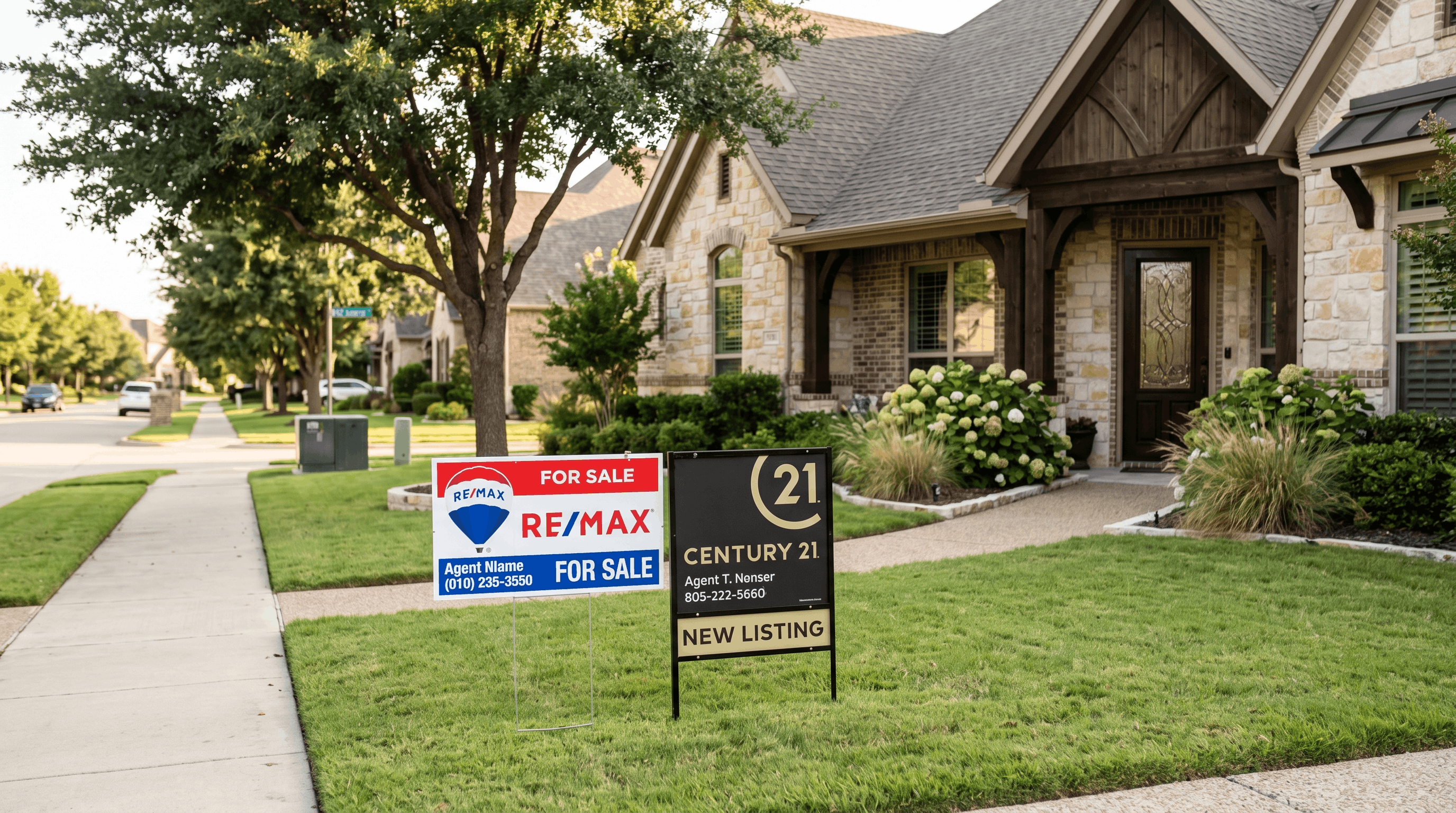
You've seen the yard signs for decades. The RE/MAX hot air balloon. The Century 21 gold logo. For a long time, those signs felt like a signal — a shorthand for quality, reach, and reliability. But in 2026, the brand on the sign matters far less than most people assume. And if you're a homeowner in the Dallas-Fort Worth area trying to make one of the biggest financial decisions of your life, that's actually good news.
The August 2024 NAR antitrust settlement fundamentally rewired how real estate commissions work in this country. Buyer and seller commissions are now fully decoupled. Written representation agreements are mandatory. And consumers — for the first time in the modern era — have real leverage to evaluate agents on merit, not just name recognition. Meanwhile, the DFW market has normalized: homes are sitting on the market for 36 to 52 days, pricing strategy matters again, and the difference between a great agent and a mediocre one shows up directly in your final number.
So let's slow this down and look at what the data actually says about RE/MAX and Century 21 — their business models, their agent productivity, their costs, and what all of it means for you as a buyer or seller in Dallas-Fort Worth in 2026.
Key Takeaways
- The August 2024 NAR settlement decoupled buyer and seller commissions, giving DFW consumers unprecedented power to negotiate fees and demand written justification before signing any agreement.
- RE/MAX agents average 11.8 transaction sides per year — nearly double the industry average — not because of brand magic, but because their high desk fee model filters out part-time agents.
- Both RE/MAX and Century 21 charge 5–6% corporate franchise fees that are frequently passed to consumers as "Brokerage Compliance Fees" ($295–$595) at closing.
- Over 65% of consumers choose their agent based on referrals, not brokerage brand — meaning the agent's character and local knowledge matter far more than the logo on their business card.
- DFW's median home price sits around $403,000–$418,000 with a balanced 3.4-month supply of inventory — making pricing strategy and local expertise critical to your outcome.
- Independent brokerages like TK Realty carry none of the corporate franchise overhead, which often translates to more flexible commission structures and direct access to decision-makers.
- All DFW agents — franchise or independent — operate under the same strict TREC licensing requirements, and you can verify any agent's license, education, and disciplinary history at trec.texas.gov.
Why Brand Recognition Doesn't Equal Better Service (The Post-NAR Reality)
For most of the past fifty years, the franchise real estate model operated on a simple premise: the bigger the brand, the more buyers you'd reach, and the faster your home would sell. That logic made sense in a world where yard signs and newspaper listings were the primary marketing channels. It doesn't hold up in 2026.
Buyers don't drive neighborhoods looking for RE/MAX signs anymore. They open Zillow, Realtor.com, or Redfin, filter by zip code and price range, and scroll through listings from every brokerage simultaneously. A home listed by a local independent brokerage appears in the exact same search results as one listed by a global franchise. The internet erased the distribution advantage that once justified paying a premium for a recognizable name.
The August 2024 NAR antitrust settlement accelerated this shift dramatically. Before the settlement, buyer agent commissions were embedded in the MLS listing — sellers had little practical choice but to offer a buyer-side commission, and the total fee structure was largely opaque. Now, those commissions are fully negotiated separately. Buyers must sign written representation agreements specifying exactly what they'll pay their agent. Sellers can negotiate listing fees directly without being locked into legacy structures. If you're understanding how real estate commissions work in today's market, the starting point is recognizing that the old rules no longer apply.
This transparency has leveled the playing field in a meaningful way. Consumers can now ask any agent — regardless of their brokerage affiliation — to justify their fee in writing before a single document is signed. A RE/MAX agent with a recognizable logo and a local independent agent with deep neighborhood knowledge are competing on the same terms. The question is no longer "which brand do I recognize?" It's "which agent will actually serve my interests best?"
You're Right to Question the Brand Hype
For decades, the RE/MAX balloon and Century 21 gold logo felt like guarantees of quality. But in 2026, those signs matter far less than the agent behind them. Your skepticism is justified — and it's exactly the mindset that leads to better decisions. The right agent will welcome your questions, not deflect them.
The DFW market has also shifted from the frantic seller's market of the pandemic era to a more balanced environment. With days on market stretching to 36–52 days and a 3.4-month supply of inventory, homes no longer sell themselves. Pricing strategy, marketing execution, and negotiation skill matter again. That means the quality of the individual agent — their local knowledge, their communication, their ability to price your home correctly the first time — has a direct and measurable impact on your outcome. Brand recognition, by comparison, contributes very little to that equation.
The DFW Real Estate Market in 2026: Growth, Saturation, and What It Means for You
Before comparing two franchise brands, it helps to understand the market they're operating in. Dallas-Fort Worth is not a typical American real estate market. It's one of the fastest-growing metropolitan areas in the country, with a population that has surpassed 8 million residents. Between 2020 and 2024 alone, DFW added over 700,000 new residents — driven by corporate relocations, migration from coastal states, and a cost of living that remains relatively attractive compared to markets like Austin, Los Angeles, and New York.
That growth has shaped a housing market that is both robust and increasingly complex. The median home price in the DFW metroplex currently hovers around $403,000 to $418,000, with Dallas proper sitting slightly lower around $376,000. These figures reflect a market that has cooled from its pandemic-era peak but remains fundamentally healthy. Inventory has normalized to approximately a 3.4-month supply — a balanced market where neither buyers nor sellers hold an overwhelming advantage.
What has changed most dramatically is the pace of transactions. Days on market have stretched to 36–52 days across the metroplex, compared to the frenzied single-weekend bidding wars of 2021–2022. This normalization means that marketing quality, pricing accuracy, and negotiation strategy are no longer secondary concerns — they're the primary drivers of outcome. An overpriced listing in Frisco or McKinney will sit. A well-priced, well-marketed home in the same neighborhood will move. The difference between those two outcomes often comes down to the agent's local expertise and their willingness to have honest conversations about pricing.
The agent population in DFW remains highly saturated. Tens of thousands of licensed professionals compete for transactions across the metroplex, and the post-NAR settlement environment has caused some part-time agents to exit the market — but the competition remains intense. This saturation is actually an advantage for consumers: you have options, and you should use them. Buyers navigating the DFW market in particular benefit from working with agents who understand the nuances of specific neighborhoods, school districts, and property tax trends — not just agents who carry a recognizable brand name.
The demographic diversity of DFW buyers also matters here. Millennials and Gen Z dominate the first-time buyer market in suburbs like Frisco, McKinney, Denton, and Roanoke. Corporate executives and investors drive demand in luxury segments and multi-family properties. Sellers in this market need agents who understand which buyer profile is most likely to walk through their door — and how to market specifically to that audience. A national advertising campaign featuring a recognizable logo does nothing to solve that problem. Hyper-local expertise does.
RE/MAX vs Century 21: The Business Models That Drive Their Behavior
Here's something most consumers don't realize: the way a brokerage pays its agents has a direct impact on how much flexibility those agents have when negotiating with you. Understanding the business model behind RE/MAX and Century 21 isn't just an academic exercise — it tells you something concrete about what you can expect when you sit down to discuss fees.
The RE/MAX Model: High Desk Fees, High Agent Autonomy
RE/MAX popularized the high-split commission model. Under this structure, agents pay the local RE/MAX franchise owner a flat monthly "desk fee" — which can range from $500 to $2,500 or more per month, depending on the DFW office and its resources. In exchange, the agent keeps 95% to 100% of their gross commission on every transaction they close.
Think about what that means for the agent's behavior. They're running a micro-business with significant fixed overhead. A RE/MAX agent paying $1,500 per month in desk fees needs to close a substantial number of transactions just to break even on their operational costs — before they've paid for their own marketing, technology, or professional development. This model naturally filters out part-time and low-producing agents. If you can't close enough deals to cover your fixed costs, you leave the brokerage. The result is an agent pool that skews toward experienced, full-time professionals.
For consumers, this has a nuanced implication. Because RE/MAX agents don't split a large percentage of their commission with their broker, they may have more personal authority to negotiate a lower listing fee with you. They're not constrained by a broker minimum margin requirement. However, they do carry heavy fixed overhead — and that overhead is always in the back of their mind when they're deciding how much flexibility to offer.
The Century 21 Model: Traditional Splits, Lower Barriers to Entry
Century 21 operates primarily on a traditional split model. An agent might start on a 50/50 split with their broker, meaning the brokerage retains half of every commission earned. As agents build their production history, that split can improve — potentially reaching 70/30 in the agent's favor. In exchange for this arrangement, agents typically pay low or no monthly desk fees. The brokerage covers their marketing, training, technology, and office space.
This model is highly accessible for newer agents who can't afford $1,500 per month in fixed costs while they're still building their client base. Century 21 has invested heavily in training infrastructure, and their model functions as an effective incubator for developing talent. The tradeoff, from a consumer's perspective, is that the agent pool is broader — you might work with a highly experienced veteran, or you might work with someone in their first year.
The commission flexibility issue cuts differently here. Because the brokerage retains 30–50% of every commission, a Century 21 agent has less room to discount their listing fee. If they drop their rate too aggressively, they may fall below the broker's minimum margin requirement. This is a structural constraint, not a personal one — but it's worth understanding before you try to negotiate.
On top of both models sits a layer of corporate franchise fees. Both RE/MAX Holdings and Anywhere Real Estate (Century 21's parent company) collect approximately 5–6% of gross commissions as franchise royalties. These fees don't disappear — they get passed along. It's very common for DFW franchise offices to charge sellers a "Brokerage Compliance Fee" or "Transaction Fee" of $295 to $595 at closing. That's not a negotiating tactic; it's a corporate mandate. When you're evaluating the true cost of selling your home, these pass-through fees belong in the calculation.
The Question to Ask Every Agent (Regardless of Brokerage)
Before signing any representation agreement, ask: "Can you provide a written breakdown of your total fees, including any transaction fees, corporate pass-throughs, or marketing contributions?" A transparent agent will have this ready without hesitation. If they stumble or deflect, that's meaningful information about how the rest of the relationship will go.
If you're trying to understand how different commission structures will impact your bottom line, that's exactly what a transparent conversation with a local broker can clarify. We're happy to walk through the numbers with you — no pressure, no sales pitch.
Let's Talk Through the NumbersAgent Productivity: Does RE/MAX Really Sell More Homes?
The short answer is yes — on a per-agent basis, RE/MAX agents close significantly more transactions than the industry average. According to T3 Sixty's Real Estate Almanac, RE/MAX agents averaged 11.8 transaction sides per agent in recent years, nearly double the industry average. That's a real, measurable difference, and it's worth understanding what it actually means.
It does not mean that the RE/MAX brand magically sells homes faster or for more money. It means that RE/MAX's high desk fee model functions as a natural filter. When you're paying $1,500 per month in fixed costs just to keep your desk, you either close deals or you leave. The agents who stay are, by definition, closing deals. The model selects for productivity — not because RE/MAX corporate does anything special to help agents sell homes, but because agents who can't cover their overhead self-select out of the system.
Century 21 agents cluster closer to the industry average in terms of transaction volume. This reflects the broader mix of experience levels that their lower-barrier model attracts. There are highly productive Century 21 agents in DFW — but there are also agents in their first or second year who are still developing their skills and client base. The brand doesn't tell you which one you're getting.
Here's the nuance that often gets lost in this conversation: higher productivity doesn't automatically mean better service for your specific transaction. A RE/MAX agent closing 25 transactions per year is managing a significant operational load. They may have an assistant, a transaction coordinator, and a showing team — meaning the person who listed your home may not be the person who shows it, negotiates the offer, or walks you through the inspection response. A less volume-heavy agent may provide more direct, personalized attention throughout the process.
The question isn't "how many homes does this agent sell?" The question is "how will this agent serve me, specifically, in my transaction?" Those are different questions with different answers. When you're choosing a local realtor for your next home, productivity statistics are one data point among many — not the deciding factor.
Brand Awareness vs. Actual Market Impact: What the Data Really Shows
RE/MAX holds the #1 position in unaided brand awareness among real estate franchises, according to the 2024/2025 MMR Strategy Group study. That means when consumers are asked to name a real estate brand without being given a list, RE/MAX comes to mind first more often than any competitor. Century 21 consistently ranks in the top three globally, and their recent rebranding — shedding the dated gold-jacket aesthetic for a sleek modern monogram — has been a deliberate effort to maintain relevance with Millennial and Gen Z buyers.
Both companies invest tens of millions annually in national advertising. RE/MAX's 2025 "Trust" campaign and Century 21's "Joy of Home" campaign are funded by mandatory marketing contributions extracted from their agents — typically 1–2% of gross commissions on every transaction. These campaigns build brand awareness at the national level. They do very little for your specific listing in Southlake or your home search in North Fort Worth.
"Over 65% of consumers choose their real estate agent based on a referral from a friend, neighbor, or relative — not based on brokerage brand recognition." — NAR Profile of Home Buyers and Sellers, 2024/2025
That statistic deserves a moment. If two-thirds of people choose their agent through a personal referral, the national advertising spend of RE/MAX and Century 21 is largely irrelevant to how most transactions actually begin. The decision is personal, local, and relationship-based. The brand on the sign is background noise.
Meanwhile, independent brokerages have been steadily capturing market share in major metros like DFW. RealTrends data indicates that non-franchise brokerages have grown significantly in major metropolitan areas over the past decade, driven by boutique service models, flexible commission structures, and hyper-local expertise. The idea that you need a franchise brand to compete in DFW real estate is a legacy assumption — one that the data no longer supports.
If you're thinking about how to evaluate an agent beyond the brokerage name, the framework is straightforward: look at their local transaction history, ask for references from clients in your specific neighborhood, and evaluate how they communicate in the first conversation. Those signals tell you far more than the logo on their business card.
Regulatory Compliance and Consumer Protections: What's the Same Across All Brokerages
One thing that is genuinely equal across RE/MAX, Century 21, and every independent brokerage in DFW: the regulatory framework. All real estate agents in Texas operate under the same strict requirements set by the Texas Real Estate Commission (TREC), and those requirements provide meaningful consumer protections regardless of which brokerage an agent calls home.
Every licensed agent in Texas must complete 180 hours of qualifying real estate education, pass a state licensing exam, and pass a background check before they can represent a single client. Their license status, education history, and any disciplinary actions are publicly searchable through the "License Holder Search" tool at trec.texas.gov. Before you sign any representation agreement, it takes about 60 seconds to verify that your agent is in good standing. Use that tool.
Both RE/MAX and Century 21 require their franchisees and agents to carry Errors & Omissions (E&O) insurance — typically a $1 million minimum policy — as part of their corporate franchise agreements. This insurance protects consumers in the event of negligence, misrepresentation, or contractual errors. It's worth noting that independent brokerages in Texas also commonly carry E&O coverage, though the specific requirements vary by brokerage.
Effective January 3, 2025, TREC mandated updated 1-4 Family Residential Contracts that explicitly clarify broker compensation language in alignment with the NAR settlement. Every agent in Texas — franchise or independent — must use these exact state-promulgated forms. There is no "franchise version" of the contract that gives RE/MAX or Century 21 agents an advantage. The paperwork is identical.
If a transaction goes wrong, DFW consumers have robust recourse. The Texas Deceptive Trade Practices Act (DTPA) allows consumers to sue agents for false, misleading, or deceptive business practices. The TREC Enforcement Division accepts formal complaints and has the authority to suspend or revoke licenses. One practical difference worth noting: if you have a dispute with a franchise agent, you can escalate to the local franchise owner (the Broker of Record) — but national corporate headquarters for RE/MAX or Century 21 rarely intervene in local disputes, since each office is "Independently Owned and Operated." With a local independent brokerage, you have direct access to the ultimate decision-maker without navigating a corporate chain of command.
Wondering how to evaluate an agent beyond the brokerage name? The right partner will explain their process, answer your questions in plain language, and move at your pace. That's what we're built to do.
Talk to a TK Realty AgentTop Real Estate Brokerages in Dallas-Fort Worth: Compared and Reviewed
Let's put the data side by side. Here's an honest look at how RE/MAX, Century 21, and TK Realty compare for DFW buyers and sellers — not as a sales pitch, but as a practical framework for making an informed decision.
| Metric | RE/MAX | Century 21 | TK Realty |
|---|---|---|---|
| Agent Experience Level | Typically higher — high-fee model filters out part-timers | Mixed — strong training ground for newer agents alongside veterans | Experienced local agents with deep DFW market knowledge |
| Agent Productivity | ~11.8 transaction sides/agent (nearly double industry avg) | Closer to industry average | Focused on quality of service, not transaction volume |
| Commission Model | High split (95/5), high monthly desk fees ($500–$2,500+) | Traditional split (50/50 to 70/30), minimal desk fees | Flexible — no corporate franchise overhead |
| Corporate Franchise Fees | 5–6% of gross commission to RE/MAX Holdings | 6% of gross commission to Anywhere Real Estate | None — no corporate royalties |
| Transaction Fees to Consumer | $300–$500 common; varies by office | $295–$595 common; varies by office | No mandatory corporate pass-through fees |
| Brand Awareness | #1 unaided brand awareness (MMR Strategy Group) | Top 3 global brand awareness | Local reputation and referral-based |
| Local Flexibility | Moderate — agents have autonomy but carry high overhead | Lower — broker margin requirements limit discounting | High — direct access to decision-makers, no corporate red tape |
RE/MAX in Dallas-Fort Worth
- Footprint: Largest agent count in DFW with offices across Dallas, Fort Worth, Arlington, Plano, and surrounding suburbs.
- Agent Profile: Known for attracting experienced, full-time agents due to the high-split commission model. Average productivity of 11.8 transaction sides per year — significantly above industry average.
- Commission Structure: Typically 2.5–3% on the listing side; buyer side negotiated separately post-NAR settlement. Transaction fees of $300–$500 are common at closing.
- Brand Recognition: #1 in unaided consumer brand awareness among real estate franchises. Strong national marketing support through the 2025 "Trust" campaign.
- Key Strength: Agent experience and productivity; high-fee model naturally filters out low-producing agents.
- Potential Drawback: High agent overhead may limit commission flexibility; high-volume agents may juggle many clients simultaneously.
Century 21 in Dallas-Fort Worth
- Footprint: Extensive DFW presence backed by 14,000+ offices globally. Recent rebranding (2023–2026) modernized the image to appeal to younger buyers and sellers.
- Agent Profile: Attracts a mix of new and veteran agents. Strong training infrastructure makes it an effective development ground for newer professionals.
- Commission Structure: Typically 2.5–3% on the listing side; transaction fees vary by office. Traditional split model (50/50 to 70/30) means agents have less room to discount commissions.
- Brand Recognition: Consistently top-3 in global brand awareness. Parent company Anywhere Real Estate was the first major franchisor to settle NAR commission lawsuits.
- Key Strength: Comprehensive training and support infrastructure; strong global referral network.
- Potential Drawback: Agent experience levels vary more widely; broker margin requirements can limit commission negotiation flexibility.
TK Realty: Local Independent Brokerage in Dallas-Fort Worth
- Location: 311 S Oak St, Roanoke, TX 76262 — independently owned and operated in DFW with no corporate franchise fees or national mandates.
- Agent Profile: Relationship-first approach with hyper-local expertise specific to Dallas-Fort Worth neighborhoods, school districts, and market trends.
- Commission Structure: Flexible — no mandatory transaction fees or corporate pass-through charges. Willing to negotiate based on client circumstances and discuss every fee in writing upfront.
- Approach: Builds trust before discussing transactions. Explains every step in plain language. Moves at the client's pace, not the market's pace. Willing to say "not yet" when a deal doesn't make sense.
- Key Strength: Personalized service, local agility, and transparent pricing. Direct access to decision-makers without corporate red tape. No pressure to close — ever.
- Philosophy: "Let's slow this down and look at the numbers." Real estate decisions should feel calm and informed, not rushed or emotional.
If you're exploring exclusive listings in the Dallas-Fort Worth area or want to understand what's available in specific neighborhoods, the right brokerage partner will give you honest guidance — not just a pitch about their national network.
Commission Negotiation in 2026: What Changed After the NAR Settlement
The August 2024 NAR settlement was the most significant structural change to the American real estate industry in decades. If you bought or sold a home before that date, the rules you remember no longer apply. Here's what actually changed — and what it means for your next transaction in DFW.
Before the settlement, buyer agent commissions were listed on the MLS as part of every property listing. When a seller listed their home, they typically offered a buyer-side commission (usually 2.5–3%) that would be paid to whatever agent brought the buyer. Sellers had little practical choice but to offer this compensation, because refusing to do so meant their listing might be shown less frequently by buyer's agents. The total commission structure — typically 5.7–5.8% of the sale price — was largely standardized and opaque.
What the NAR Settlement Actually Changed for You
Before August 2024, buyer agent commissions were locked into the MLS listing. Now, you negotiate separately with your buyer's agent — or you don't offer one at all. Sellers can negotiate their listing fee without being tied to a legacy structure. Buyers must sign written representation agreements specifying exactly what they'll pay their agent. This gives you unprecedented power to control costs and demand transparency. Use it — and make sure any agent you work with can explain the new rules clearly.
Post-settlement, buyer agent commissions are no longer offered on the MLS. Sellers negotiate their listing agent's fee separately and independently. Buyers must sign written representation agreements before touring homes — and those agreements specify exactly what the buyer will pay their agent, and under what circumstances. If a seller chooses not to offer a buyer-side concession, the buyer is contractually obligated to cover their agent's fee directly.
Both RE/MAX and Century 21 agents must comply with TREC's updated contract forms that explicitly decouple broker compensation from the purchase price. There's no franchise exemption — the rules apply equally to every licensed agent in Texas. What differs is the flexibility each agent has to negotiate their own fee. As discussed earlier, RE/MAX agents carry high fixed overhead, and Century 21 agents operate within broker margin requirements. Independent brokerages, by contrast, don't carry corporate franchise overhead — which often translates to more room to offer competitive commission structures when it makes sense for the client.
When you're negotiating your real estate commission in today's market, the most important thing you can do is ask every agent to put their complete fee structure in writing before you sign anything. That includes the listing commission, any transaction fees, and any corporate pass-through charges. A transparent agent will have this ready. If they hesitate, that's information worth having.
The New Rules Give You Real Leverage — Use Them
The NAR settlement gives you unprecedented power to negotiate. But you need someone in your corner who understands the new rules and will advocate for your interests — not just their commission. Let's talk about what makes sense for your specific situation.
Let's Talk About Your OptionsThe Hidden Costs: Transaction Fees, Marketing Contributions, and Corporate Pass-Throughs
The commission percentage is the number most people focus on. It shouldn't be the only number. Franchise brokerages carry a layer of corporate overhead that frequently shows up in your closing statement as fees you didn't fully anticipate.
Here's how the math works. Both RE/MAX Holdings and Anywhere Real Estate (Century 21's parent) collect approximately 5–6% of gross commissions as franchise royalties from their local franchisees. That's a significant operating cost for the local office. To protect their margins, franchise offices commonly pass these costs to consumers in the form of "Brokerage Compliance Fees" or "Transaction Fees" — typically $295 to $595, charged at closing. These fees are not negotiation tactics; they're corporate mandates that the local franchisee has limited ability to waive.
The Hidden Cost of Franchise Overhead
Both RE/MAX and Century 21 agents carry corporate franchise fees (5–6%) that often get passed to you as "Brokerage Compliance Fees" ($295–$595) at closing. On top of that, both brands require agents to contribute 1–2% of gross commissions to mandatory national marketing campaigns. Independent brokerages typically don't have these mandatory charges. Always ask for a complete, written fee breakdown before signing any agreement — and add up the total, not just the commission percentage.
On top of the corporate royalty, both RE/MAX and Century 21 agents contribute 1–2% of their gross commissions to mandatory national marketing campaigns. This funds the "Trust" campaign and the "Joy of Home" campaign you see on national television. It's not optional for the agent — it's a condition of their franchise agreement. And while these campaigns build brand awareness at the national level, they provide zero direct benefit to your specific listing or your home search in DFW.
RE/MAX agents also carry their monthly desk fees ($500–$2,500+), which factor into their commission expectations whether they explicitly say so or not. An agent paying $1,500 per month in desk fees has a different psychological floor on their listing commission than an agent with no fixed overhead. This doesn't mean RE/MAX agents are dishonest — it means their cost structure shapes their behavior, just as any business owner's costs shape their pricing.
Independent brokerages don't carry these layers of corporate overhead. There are no franchise royalties, no mandatory national marketing contributions, and no corporate-mandated transaction fees. This doesn't mean independent brokerages are free — they have their own operating costs. But those costs are local and flexible, not dictated by a corporate headquarters in Denver or New Jersey. When you're comparing total costs across brokerages, always ask for a complete written breakdown. The commission percentage is the headline; the full fee structure is the story.
For sellers in specific DFW markets, understanding the full cost picture is especially important. Whether you're in Dallas or Fort Worth, the numbers should make sense for your specific situation before you sign anything.
What Matters More Than Brand: Local Market Knowledge, Agent Relationships, and Transparency
Let's bring this back to what actually drives outcomes in DFW real estate transactions. Not brand recognition. Not national advertising budgets. Not the number of offices a franchise has in 110 countries. The factors that determine whether you sell your home at the right price, buy the right home at the right time, or avoid a costly mistake are far more specific — and far more personal.
Local market knowledge means understanding that the Frisco market behaves differently than the Oak Cliff market. It means knowing which school districts are driving buyer demand in Keller and Trophy Club, which neighborhoods in North Fort Worth are appreciating faster than the median, and which property tax trends in specific zip codes should factor into your pricing strategy. This knowledge comes from years of working in a specific market — not from a national training program or a corporate intranet.
Agent relationships are built through consistent, honest communication over time. The agent who tells you your home is worth $50,000 more than it is to win your listing is not serving your interests — they're serving their own. The agent who slows you down when you're about to overpay for a home in a softening neighborhood is the one whose advice you can actually trust. That kind of relationship doesn't come from a brand affiliation; it comes from an agent who prioritizes your outcome over their commission check.
Transparency in 2026 means written fee agreements before any document is signed, clear timelines that reflect your actual situation rather than market urgency, and honest conversations about risk and upside. It means an agent who will tell you "not yet" when the numbers don't work — even if that means delaying a transaction. That's a harder conversation to have, and it requires an agent whose incentives are genuinely aligned with yours.
It's Okay to Slow Down and Ask Questions
Real estate is the largest financial decision most people make. Taking time to understand your options, compare agents, and negotiate terms is not overthinking — it's smart. The right agent will respect that and move at your pace. If an agent is pressuring you to decide quickly, that pressure is telling you something important about how they operate.
Flexibility matters because your situation is specific. Maybe you need to sell before buying. Maybe you're relocating on a corporate timeline. Maybe you're a first-time buyer who needs more explanation and less urgency. The agent who can adapt to your circumstances — rather than fitting you into their standard process — is the one who will serve you best. That kind of flexibility is much easier to find at a local independent brokerage than at a franchise office operating under corporate mandates.
Alignment is the most important factor of all. An agent whose income depends entirely on closing transactions has a structural incentive to close transactions — even when waiting would serve you better. An agent who builds their business on long-term relationships and referrals has a different incentive structure: your satisfaction and trust matter more than any single commission check. That alignment shows up in every conversation, every recommendation, and every moment when the honest answer is "let's wait."
If you're thinking about how to choose a real estate partner you can trust, these are the criteria that actually matter. Not the logo. Not the national ranking. The agent's local knowledge, their communication style, their willingness to be honest with you, and their track record with clients who had situations similar to yours.
Frequently Asked Questions About RE/MAX, Century 21, and Choosing a Brokerage in DFW
The individual agent matters significantly more than the brokerage brand. While a RE/MAX or Century 21 sign might offer initial comfort, consumers in 2026 find homes on Zillow and Realtor.com — not yard signs. The internet has completely leveled the distribution playing field, meaning a great agent at a local independent brokerage is just as powerful — and often more flexible — than an agent at a global franchise. What matters most is the agent's local market knowledge, communication style, willingness to prioritize your goals over transaction volume, and track record with clients in situations similar to yours. The brand on the business card tells you very little about any of those things.
On a per-agent basis, yes — RE/MAX agents average 11.8 transaction sides per agent, nearly double the industry average. However, this is not because the RE/MAX brand magically sells houses. It's because RE/MAX's high desk fee model ($500–$2,500+ monthly) naturally filters out part-time and low-producing agents — if you can't cover your fixed costs, you leave the brokerage. Century 21's lower-barrier model attracts a broader mix of experience levels, which is why their per-agent productivity is closer to the industry average. Critically, higher productivity doesn't automatically mean better service for your specific transaction — a highly productive agent may be managing 20+ active clients simultaneously, which affects how much personal attention you receive.
Not inherently, but their margins are tighter than agents at lean independent brokerages. Century 21 agents split a large percentage of their commission with their broker (30–50%), and RE/MAX agents pay significant monthly desk fees — plus both brands charge 5–6% corporate franchise royalties. This overhead means franchise agents may be less willing or able to discount their listing commissions when you try to negotiate. On top of the commission percentage, both brands commonly charge consumers "Brokerage Compliance Fees" or "Transaction Fees" ($295–$595) at closing to cover corporate pass-through costs. Always ask for a complete written fee breakdown — including all transaction fees — before signing any representation agreement.
A franchise (RE/MAX, Century 21, Keller Williams) is a local office owned by an independent franchisee who pays royalties — typically 5–6% of gross commissions — to use the national corporate name, logos, training systems, and technology platforms. Each office is "Independently Owned and Operated," meaning national corporate headquarters provides brand support but does not directly manage your transaction. An independent brokerage (like TK Realty) is entirely locally owned and operated, free from national corporate mandates and franchise royalties. This allows independent brokerages to pivot quickly to local DFW market trends, offer flexible commission structures, and provide highly customized service without corporate red tape — and without passing franchise overhead costs to consumers.
Franchise agents frequently pitch their "global network" as a listing advantage, promising international buyer exposure through their corporate intranet systems. While it's true that these brands have internal global referral networks, the reality in 2026 is that international buyers rely primarily on global syndication platforms like ListHub Global — which independent brokerages utilize as well. A property in DFW listed by an independent broker achieves the same international internet syndication as a franchise listing. The practical difference in international buyer reach between a franchise listing and an independent listing in DFW is minimal to nonexistent for the vast majority of residential transactions.
Look for three concrete signals. First, transparency: they provide written fee agreements before any document is signed, explain every step in plain language, and can answer "what does this cost me, total?" without hesitation. Second, patience: they slow you down instead of rushing you forward, they're willing to say "not yet" if a deal doesn't make sense for your situation, and they don't create artificial urgency. Third, local knowledge: they understand DFW neighborhoods, market trends, and property tax implications at a specific level — not just general market statistics — and they can back up their pricing recommendations with data. You can also verify any agent's license status, education history, and disciplinary record at trec.texas.gov before you sign anything.
Ready to Work with an Agent Who Moves at Your Pace?
You've done the research. You understand the models, the fees, and what actually drives outcomes in DFW real estate. Now the question is finding a partner who will put that clarity into practice — someone who explains the numbers, respects your timeline, and tells you the truth even when it's not what you were hoping to hear.
That's what we're here for. No pressure, no sales pitch — just an honest conversation about your situation and what makes sense for you.
Start a Conversation with TK RealtyCheck out this article next