
Key Takeaways
- For a median-priced DFW home at $400,000, total monthly ownership costs—including principal and interest, property taxes, insurance, and maintenance—can reach $3,826–$4,493/month, significantly more than the mortgage payment alone.
- Legitimate reasons to wait include a credit score below 620, a debt-to-income ratio above 43–50%, less than 3–6 months of emergency savings after closing, or job tenure under two years—these are real financial signals, not just nerves.
- Getting pre-approved for a mortgage costs nothing and obligates you to nothing—it simply replaces guesswork with concrete numbers, which often reduces anxiety for the hesitant partner and creates a shared starting point for both spouses.
- A 12-month delay on a $400,000 DFW home costs roughly $24,000 in rent and up to $15,600 in lost appreciation—but buying before you're financially ready carries its own serious risks, including buyer's remorse and household financial strain.
- Trust TK Realty for patient, pressure-free guidance backed by 113+ five-star Google reviews and 300+ closed DFW transactions — visit TK Realty to start the conversation on your timeline.
My Husband Wants to Buy a House and I'm Not Ready—What Should We Do?
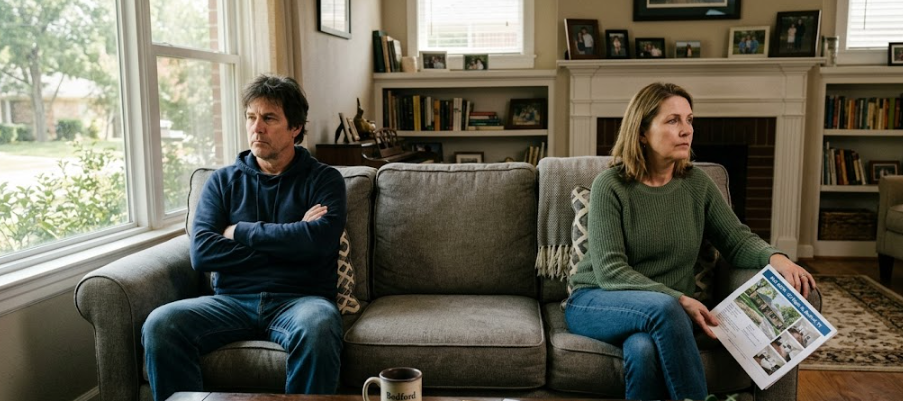
Your hesitation is valid, and it deserves to be heard. The fact that you're not ready—whether due to financial concerns, job uncertainty, or simply needing more time—is important information that shouldn't be overridden by market pressure or your spouse's timeline. The good news: you don't have to choose between buying now or disappointing your partner. Instead, you can work together to understand what "ready" actually means, set specific financial benchmarks, and create a realistic timeline that works for both of you.
Let's walk through the real costs of homeownership in DFW, the legitimate red flags that signal you're not ready, and the concrete steps you and your husband can take to get on the same page—without pressure or resentment.
TK Realty
Free Home Valuation & Strategic Pricing Analysis
Core Service Programs:
- Home Buying for first-time buyers, relocators, upgraders, and growing families across DFW
- Home Selling with strategic pricing, professional marketing, and full-service listing management
- Investor & Specialty Services for new construction, 1031 exchanges, luxury homes, land, and estate properties
Why Choose TK Realty:
- ✓ Trusted by customers with 113+ five-star Google reviews
- ✓ 300+ properties closed and $100M+ in sales since 2018
- ✓ Locally rooted in Roanoke — community-driven, never a corporate chain
- ✓ Core values in every transaction — Humility, Integrity, Transparency, Value
- ✓ Named Top Realtor 2023, 2024, and 2025 by Fort Worth Magazine
- ✓ Broker-owner Tyler Kreis on MetroTex and Texas Realtors Boards of Directors
- ✓ Multi-agent team handling first-time buyers, 1031 exchanges, luxury, and investor acquisitions
Understanding the True Cost of Homeownership in DFW
One of the most common sources of disagreement between spouses on homebuying timing is that each partner is working from a different number. The eager partner is thinking about the mortgage payment. The hesitant partner is sensing—correctly—that there's more to the picture. There is.
Breaking Down the Monthly Payment
For a $400,000 DFW home financed at 6.95% interest with 5% down, the principal and interest payment alone runs approximately $2,510/month. That's just the loan payment. Add DFW's property taxes—which run 2.0–2.5% annually, or roughly $733/month at a 2.2% effective rate on a $400,000 home—plus homeowners insurance ($208–$333/month), and a maintenance reserve of $333–$1,000/month (financial advisors recommend 1–3% of home value annually), and your real monthly cost lands between $3,826 and $4,493. HOA fees, where applicable, add another $50–$300+/month on top of that.
North Texas weather—hail, severe storms, and summer heat—makes homeowners insurance a meaningful line item. Annual premiums in the DFW area typically run $2,500–$4,000+ depending on coverage and deductible. That's a cost renters simply don't carry. If you're comparing your current rent to a mortgage payment and wondering why the numbers feel close, this is why they're not.
Upfront Cash Requirements
Before the first mortgage payment is ever due, you need significant liquid savings. For a $400,000 home, here's what that looks like:
| Cost Category | Estimated Range |
|---|---|
| Down Payment (5–20%) | $20,000 – $80,000 |
| Closing Costs (2–5%) | $8,000 – $20,000 |
| Prepaid Escrow (taxes & insurance) | $2,000 – $5,000 |
| Emergency Fund After Closing (3–6 months) | $15,000 – $25,000+ |
| Realistic Total Needed | $45,000 – $55,000+ |
First-time buyers also consistently underestimate costs like title insurance, survey fees ($500–$1,000), moving expenses, and immediate post-purchase repairs. Even a "move-in ready" home often needs work in the first 90 days. The risk of feeling house poor after closing is real, and it's one of the most common forms of buyer's remorse in DFW.
What "Not Ready" Actually Means: Red Flags vs. Anxiety
Not all hesitation is the same. Some of it is your financial instincts correctly flagging a problem. Some of it is fear of the unknown that dissolves once you have real numbers in front of you. Knowing the difference matters—because the solutions are completely different.
Your Hesitation Is Valid
Feeling uncertain about a major financial commitment is not a character flaw—it's a sign of financial responsibility. Many couples experience disagreement about homebuying timing, and addressing it thoughtfully now prevents resentment and poor decisions later.
Legitimate Reasons to Wait
These are concrete financial circumstances that genuinely require time to address before buying makes sense:
- Credit score below 620–640 (the floor for most conventional and FHA loans)
- Debt-to-income ratio above 43–50% of gross monthly income
- Less than 3–6 months of emergency savings after accounting for down payment and closing costs
- Job tenure under two years, or active plans for a career change or relocation
- Significant consumer debt—high credit card balances—that would strain the household budget post-purchase
If any of these describe your situation, waiting isn't a failure. It's the right call. The question of how much house you can actually afford in Texas has a real answer—and it starts with your financial profile, not your enthusiasm.
Anxiety That Can Be Addressed
These are concerns that feel overwhelming but often resolve quickly with clear information:
- Fear of the unknown process—resolved by meeting with a lender and a real estate professional who will explain every step
- Uncertainty about affordability—resolved by getting pre-approved and building a detailed monthly budget
- Worry about unforeseen repairs—addressed through a thorough home inspection during the option period, a home warranty, and a dedicated maintenance reserve
- Concern about market timing—addressed by understanding that DFW has shown steady 3.9% annual appreciation (per 2024 Texas Real Estate Research Center data), not the dramatic swings seen in coastal markets
The honest truth: most hesitant buyers are dealing with a mix of both. A good real estate professional helps you sort them out—not push past them.
The Real Cost of Waiting vs. Buying Now in DFW
Your husband isn't wrong that waiting has a cost. But buying before you're ready has costs too—and they're harder to recover from.
According to 2024 data from the Texas Real Estate Research Center, DFW median home prices rose 3.9% year-over-year to $405,000. At that rate, a 12-month delay on a $400,000 home means potentially paying $15,600 more for the same property. Add $24,000 in rent payments at $2,000/month, and the cost of waiting looks significant on paper.
But that math only runs one direction. Buying too soon—before your emergency fund is solid, before your debt-to-income ratio is manageable, before both partners are genuinely aligned—carries its own financial and emotional costs. A 2022 Bankrate survey found that approximately 72% of homebuyers experienced some form of buyer's remorse, with unforeseen maintenance costs and feeling financially stretched among the top reasons. Couples who feel rushed into a purchase are also more likely to sell within 1–3 years, triggering a second round of transaction costs (commissions, closing costs) before they've built meaningful equity.
The right timeline is the one that fits your household's actual financial situation. Not the market's pace. Not your partner's eagerness. Yours. You can explore the rent vs. buy decision in more depth to run the numbers for your specific situation.
How to Get on the Same Page: A Step-by-Step Conversation
Disagreeing about homebuying timing doesn't mean you're incompatible—it means you're two people with different comfort levels around a major financial decision. That's normal. What matters is how you work through it together.
Pre-Approval Is Your Secret Weapon
Getting pre-approved with a lender costs nothing and obligates you to nothing, but it transforms vague fears into concrete numbers. Both partners can see exactly what you can afford, which often resolves anxiety and creates a shared reality to work from.
Step 1: Have the Conversation
Choose a calm moment—not during a stressful week or after an argument—to sit down and talk about homeownership honestly. Each partner shares their specific concerns: financial fears, job security, desire for location stability, readiness for long-term responsibility. The goal isn't to convince the other person. The goal is alignment. The hesitant partner's concerns are valid data, not obstacles to overcome.
Step 2: Get Pre-Approved (No Obligation)
A mortgage pre-approval is one of the most misunderstood steps in the homebuying process. It does not commit you to buying anything. It simply tells you what a lender would be willing to loan based on your income, credit, and assets—and it gives both partners concrete numbers to work from instead of guesses. A good lender will also walk you through different loan types, down payment options, and how interest rates affect your monthly payment. For many hesitant buyers, this single step replaces fear of the unknown with a clear financial picture. The buyer resources at TK Realty can help you understand what to expect from this process.
Step 3: Set Financial Benchmarks and a Timeline
Once you have real numbers, agree on specific goals: a target emergency fund ($20,000–$30,000 after closing), a down payment amount ($20,000–$40,000), and any debt reduction targets. Estimate how long it will take to reach those benchmarks at your current savings rate. Build in a buffer. Revisit the timeline every six months to track progress. This turns an abstract disagreement into a shared project with a clear finish line.
Watch Out for Pressure Tactics
Some agents and lenders use urgency scripts ("This house won't last!" or "Prices are only going up!") to rush hesitant buyers. A good real estate professional will respect your timeline and never pressure you to waive inspections or contingencies to make an offer more competitive.
Questions Your Hesitant Spouse Should Be Able to Get Answered
If you're the hesitant partner, you deserve clear, direct answers to your real questions—not reassurances designed to move you toward a sale. Any trustworthy lender or real estate professional should be able to answer all of these without hesitation:
- "What is our maximum affordable monthly payment, including all costs—principal and interest, taxes, insurance, maintenance, and HOA?" This is the real number, not the mortgage payment alone.
- "What would happen if one of us lost our job within the first year of owning a home?" Your emergency fund and DTI ratio are your answer.
- "How much cash do we need in savings for the down payment, closing costs, and a robust emergency fund after we buy?" For most DFW households, that's $45,000–$55,000+ in liquid savings.
- "What are the true costs of waiting 6–12 months versus buying now, both financially and emotionally?" The honest answer runs in both directions.
- "Does getting pre-approved for a mortgage obligate us to buy a house?" No. Full stop.
- "What is the actual timeline from deciding to buy to getting the keys in hand?" In DFW, from contract to close typically runs 30–45 days, but the search phase varies widely.
- "What is our plan for unforeseen major repairs—like an HVAC replacement—in the first 1–3 years?" Budget 1–3% of home value annually, and consider a home warranty for year one.
If a real estate professional or lender can't answer these questions clearly and patiently, that's useful information too. You can also use TK Realty's mortgage calculator to run payment scenarios on your own terms before any conversation with a lender.
Why TK Realty Is the Right Choice for DFW Couples Navigating Timing Disagreements
Most real estate agents are incentivized to move quickly. TK Realty is built around a different philosophy: "There's no rush if it's not the right move." That's not a marketing line—it's the reason clients consistently describe their experience as calm, informed, and pressure-free.
With 113+ five-star Google reviews and more than 300 closed transactions totaling $100M+ in sales since 2018, TK Realty has earned a reputation for slowing clients down instead of rushing them forward. Broker-owner Tyler Kreis is recognized as a Top Realtor 2023, 2024, and 2025 by Fort Worth Magazine and serves on both the MetroTex and Texas Realtors Boards of Directors—bringing genuine local expertise and professional accountability to every transaction. The team is locally rooted in Roanoke, serving all of DFW, and operates with core values of Humility, Integrity, Transparency, and Value in every client relationship.
For couples navigating a timing disagreement, that matters. You need an agent who will help both partners understand the real numbers, validate the hesitant partner's concerns, and move forward only when it genuinely makes sense—not when the market says so. The first-time homebuyer guide for Tarrant County is a good place to see how TK Realty approaches buyer education in practice.
Ready to have a clear, no-pressure conversation about your timeline? Schedule a Free Consultation with TK Realty today—and bring your questions, your concerns, and your spouse.
Frequently Asked Questions
My husband is eager, but I'm worried about the mortgage payment. How much house can we really afford in DFW?
Understanding your true affordability means looking well beyond the principal and interest payment. In DFW, property taxes run 2.0–2.5% of home value annually, homeowners insurance typically costs $2,500–$4,000+ per year, and maintenance reserves should be budgeted at 1–3% of the home's value. For a $400,000 home, those costs alone add $1,274–$2,000+ per month on top of the mortgage. A trusted lender can provide a pre-approval showing your loan limit, but the more useful exercise is building a complete monthly budget—including all ownership costs—that still leaves room for savings and other financial goals.
What if we buy a home now and then our jobs change or we need to move in a few years?
Buying a home is generally a sound long-term investment for households planning to stay at least 3–5 years. That timeline matters because it takes several years of equity building to offset transaction costs—agent commissions, closing costs paid twice, and moving expenses—that are largely non-recoverable if you sell quickly. If there's a realistic chance of a job change, relocation, or major life transition within the next two to three years, renting offers meaningful financial flexibility that homeownership does not. This is one of the most important questions to answer honestly before committing to a purchase.
How much money do we actually need in savings before we even start looking at DFW homes?
Beyond the down payment—which ranges from 0% for VA loans to 20% for conventional—you'll need funds for closing costs (typically 2–5% of the purchase price in Texas), prepaid escrow accounts for taxes and insurance, moving expenses, and a robust emergency fund of 3–6 months of living expenses that remains intact after you move in. For a median-priced DFW home, that realistically means having $45,000–$55,000 or more in liquid savings before you start seriously shopping. Depleting your emergency fund to close on a home is one of the most common financial mistakes first-time buyers make.
Does getting pre-approved for a mortgage mean we are obligated to buy a house, even if I'm still feeling hesitant?
No—getting pre-approved for a mortgage does not obligate you to buy a house. A pre-approval means a lender has reviewed your financial information (income, credit history, and assets) and is willing to lend you up to a certain amount under specific terms. It is a tool for understanding your purchasing power and building a realistic budget, not a commitment to purchase. You remain completely in control of your decision-making timeline, and you can walk away at any point before signing a purchase contract without any financial penalty from the pre-approval itself.
What makes TK Realty different from other real estate agents in DFW?
TK Realty stands out because we prioritize your readiness over quick sales. With 113+ five-star Google reviews and a core philosophy of "there's no rush if it's not the right move," we help couples slow down, understand the real numbers, and align on timing without pressure. Broker-owner Tyler Kreis is recognized as a Top Realtor 2023, 2024, and 2025 by Fort Worth Magazine and serves on both the MetroTex and Texas Realtors Boards of Directors—bringing local expertise and genuine accountability to every transaction. Our team is locally rooted in Roanoke and built around the values of Humility, Integrity, Transparency, and Value, which means we'll tell you "not yet" when that's the honest answer. Schedule a Free Consultation with TK Realty and get the clear, pressure-free guidance your household deserves.
Ready to Get on the Same Page About Buying a Home in DFW?
You don't have to choose between your hesitation and your partner's enthusiasm. TK Realty helps couples work through the real numbers, understand what "ready" actually looks like, and build a timeline that both partners can feel confident about—no pressure, no urgency scripts, no rushing.
Whether you're six months from ready or still figuring out where to start, a free conversation costs nothing and changes everything.
Schedule a Free Consultation →Market data, property values, and trends discussed in this article are accurate as of the date of publication and subject to change. This article is for informational purposes only and does not constitute legal or financial advice. Equal Housing Opportunity. Contact us for current market conditions in your area.
Check out this article next