
Key Takeaways
- In DFW's premium neighborhoods like Southlake, Colleyville, and Flower Mound, the cheapest home typically sells 15–30% below the neighborhood median — a discount of $150,000 to $400,000+ — but renovation costs often run 20–50% of the purchase price on top of that.
- The most common reasons a home is the cheapest on the block — deferred maintenance, foundation issues, outdated finishes, or a smaller lot — carry very different costs and risks, and some limitations simply cannot be renovated away.
- DFW-specific factors including high property tax rates (1.8–2.7% annually), strict HOA architectural guidelines, and fast-moving inventory mean this strategy requires more preparation here than in most other markets.
- Renovation ROI in DFW typically recovers 80–100%+ of renovation dollars at resale when executed well — meaningfully above the 60–80% national average — but only if the home doesn't have an unalterable value ceiling.
- Trust Tyler Kreis Real Estate for calm, honest guidance through every step of a complex DFW home purchase — visit TK Realty to start the conversation at your own pace.
Should I Buy the Cheapest House in a Nice Neighborhood?
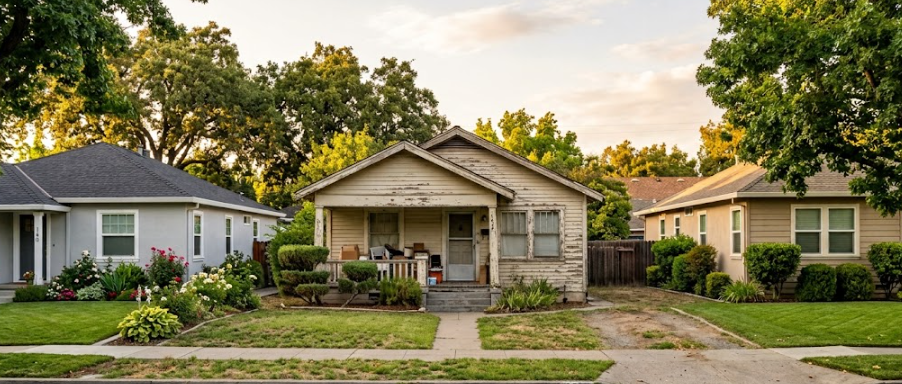
Buying the cheapest house in a desirable neighborhood can be a smart financial move — but only if you understand the true costs and risks involved. The strategy works best for buyers with renovation capital, a realistic timeline, and the patience to execute a thoughtful plan. Without careful planning and honest cost estimates, it can become a financial trap that erodes the very equity gains you hoped to build.
Let's slow this down and look at the actual numbers, risks, and realities of this strategy in today's DFW market.
TK Realty
Free Home Valuation & Strategic Pricing Analysis
Core Service Programs:
- Home Buying for first-time buyers, relocators, upgraders, and growing families across DFW
- Home Selling with strategic pricing, professional marketing, and full-service listing management
- Investor & Specialty Services for new construction, 1031 exchanges, luxury homes, land, and estate properties
Why Choose TK Realty:
- ✓ Trusted by customers with 113+ five-star Google reviews
- ✓ 300+ properties closed and $100M+ in sales since 2018
- ✓ Locally rooted in Roanoke — community-driven, never a corporate chain
- ✓ Core values in every transaction — Humility, Integrity, Transparency, Value
- ✓ Named Top Realtor 2023, 2024, and 2025 by Fort Worth Magazine
- ✓ Broker-owner Tyler Kreis on MetroTex and Texas Realtors Boards of Directors
- ✓ Multi-agent team handling first-time buyers, 1031 exchanges, luxury, and investor acquisitions
The Real Financial Case: Price Gap vs. True Cost of Ownership
The first number that catches a buyer's eye is the purchase price discount. In DFW's most desirable submarkets, that discount is real and meaningful. In Southlake, the cheapest homes — those needing full renovation or on a smaller lot — can list anywhere from $800,000 to $1.1 million against a neighborhood median of $1.2 to $1.5 million. In Colleyville, the gap runs $150,000 to $250,000. In Keller and Flower Mound, it's typically $100,000 to $200,000. That's a compelling entry point.
But purchase price is only the beginning. The true cost of ownership on a below-median home in a premium neighborhood includes renovation costs (often 20–50% of the purchase price for homes with deferred maintenance or outdated systems), property taxes reassessed at your new purchase price (effective rates of 1.8–2.7% annually across DFW's premium counties), HOA fees ranging from $300 to $1,000+ per year, and ongoing maintenance that runs higher for older homes — often 1–4% of value annually versus 0.5–1.5% for newer construction.
Over a 5–7 year horizon, the math can work strongly in your favor — but only if your renovation budget is accurate and your execution is disciplined. Buyers who underestimate renovation costs by even 20–30% (which research shows is common) can find that the price discount evaporates entirely. If you're evaluating your overall affordability picture as a Texas buyer, factor in every one of these line items before falling in love with a purchase price.
Why the 'Cheapest House' Exists — and What That Tells You
Understanding why a home is priced below its neighbors is the most important due diligence step in this strategy. The reason matters enormously — because some problems are fixable and some are permanent.
Deferred maintenance is the most common culprit. A roof past its useful life, an aging HVAC system, outdated plumbing, or original electrical panels from the 1980s are all fixable — but expensive. Expect $15,000 to $50,000 or more depending on the severity. Outdated finishes — original kitchens, dated bathrooms, worn flooring — are cosmetic and offer strong renovation ROI when done well. These are the scenarios where the strategy shines.
Structural issues require a harder look. Foundation problems are common in DFW due to the region's expansive clay soil, and repairs can run $10,000 to $50,000+. These are fixable, but they require specialist evaluation — not just a general home inspection — before you can accurately budget for them.
The situations that create a permanent ceiling on value are harder to renovate away: a significantly smaller lot than surrounding homes, an inherently awkward floor plan, or a location within the neighborhood that's adjacent to a busy road or commercial property. These factors don't disappear with a kitchen remodel. Before committing, research comparable sales of fully renovated homes in the immediate area and honestly assess whether your target property can ever reach that value. If you're exploring specific DFW neighborhoods, our guide to Keller's neighborhoods and homes under $500K across DFW can help you benchmark what's realistic in each submarket.
The Hidden Costs Nobody Budgets For
Beyond the obvious renovation line items, there's a second layer of costs that routinely catches buyers off guard. Being honest about these upfront is the difference between a strategy that works and one that doesn't.
- Property tax reassessment: Once you purchase, the home is reassessed at your new (higher) sale price. If the previous owner had a low assessed value, your annual tax bill can jump significantly — sometimes by thousands of dollars per year.
- HOA special assessments: Beyond regular dues, HOAs sometimes levy special assessments for neighborhood-wide improvements or deferred maintenance. These can run into the thousands with little warning.
- Permit fees and contractor overruns: Major renovations require city permits, and the fees vary by municipality across DFW. Contractor costs routinely run 10–20% above initial estimates — budget for it from the start.
- Temporary housing: If the renovation scope requires you to vacate the property, you're paying rent or hotel costs on top of carrying the mortgage. This cost is frequently omitted from renovation budgets entirely.
- Foundation inspection: A general home inspection is not sufficient for DFW properties. A separate structural engineer's foundation inspection ($300–$600) is essential and often reveals issues the general inspector missed.
You're Right to Be Cautious About Hidden Costs
Most buyers underestimate renovation costs by 20–30%. Property tax reassessment, HOA special assessments, permit fees, and temporary housing costs add up fast. It's smart to budget conservatively and build in a 10–20% contingency fund — this isn't pessimism, it's realistic planning.
A useful exercise: take your renovation estimate from a qualified general contractor, add 15%, then add the first-year property tax increase, HOA fees, and permit costs. That's your real first-year cost of ownership above the purchase price. If the numbers still work, you're on solid ground.
Financing a Fixer-Upper: Options and Risks
Financing a below-median home in poor condition is more complex than a standard mortgage. Traditional lenders may require repairs before closing or decline to finance altogether if the home has significant structural or safety issues. Understanding your options before you make an offer is essential.
FHA 203(k) loans allow you to finance both the purchase price and renovation costs into a single mortgage. They're powerful tools but come with specific contractor qualification requirements, mandatory inspections, and longer underwriting timelines. Fannie Mae HomeStyle Renovation loans offer similar purchase-and-renovate capability with more flexibility than FHA 203(k) — often the preferred option for conventional borrowers with strong credit.
Cash purchases eliminate appraisal risk entirely and make your offer more competitive, but they tie up significant liquid capital. For most buyers, a renovation loan is the more practical path — just get pre-approved before you start touring properties. Pre-approval for a renovation loan strengthens your negotiating position and signals serious intent to sellers in a competitive market. Our mortgage calculator can help you model the monthly payment impact of different purchase-plus-renovation scenarios.
The Appraisal Gap Trap
If the home's appraised value comes in below your purchase price, you must cover the difference in cash — a real risk with distressed or heavily renovated properties. Don't waive an appraisal contingency just to make your offer more competitive.
Appreciation Reality: Does the 'Rising Tide' Actually Lift This Boat?
The "rising tide" effect is real and well-documented. Below-median homes in desirable neighborhoods tend to appreciate at a faster percentage rate on their initial purchase price once renovated to neighborhood standards. The surrounding higher-value homes exert upward pressure on the lower-priced property, and a well-executed renovation can produce a meaningful "catch-up" effect toward the neighborhood median.
In DFW's premium submarkets, renovation ROI typically recovers 80–100%+ of renovation dollars at resale when done well — meaningfully above the 60–80% national average cited in Remodeling Magazine's Cost vs. Value data. Kitchen and bathroom remodels, along with deferred maintenance remediation, tend to produce the strongest returns in this market.
That said, the rising tide only lifts boats that are seaworthy. If your home has a fundamentally smaller lot, an obsolete floor plan, or a location adjacent to a permanent negative influence, the ceiling on its value is lower than the neighborhood median regardless of how well you renovate. Real estate investors and house flippers actively compete for these properties in DFW — often paying near or above asking price — which signals strong confidence in the investment thesis, but also means less negotiating room and faster decision timelines for owner-occupant buyers.
The price gap between the cheapest and most expensive homes in DFW's premium neighborhoods has generally widened over the past two to three years, which is a positive signal for the strategy: it means the neighborhood itself is appreciating strongly, and even the entry-level properties are being pulled upward.
DFW-Specific Realities: Taxes, HOAs, and Market Speed
This strategy plays out differently in DFW than in most other markets, and a few local realities deserve direct attention.
Property taxes are high. Texas has no state income tax, but effective property tax rates in DFW's premium counties run 1.8–2.7% of appraised value annually — significantly above the national average. On a $700,000 home, that's $12,600 to $18,900 per year before any other costs. The homestead exemption (available to owner-occupants on primary residences) reduces your taxable value and provides meaningful annual savings — apply for it immediately after closing.
HOAs are prevalent and powerful. Master-planned communities across Southlake, Colleyville, Keller, Flower Mound, Trophy Club, and Westlake almost universally have HOAs with architectural review committees. These committees govern exterior paint colors, landscaping, roofing materials, and structural additions. Your renovation plans may require formal approval, and that process takes time. Review the CC&Rs before making an offer — not after.
These homes move fast. Below-median homes in desirable DFW neighborhoods routinely go under contract within days of listing, with multiple offers. Competition from both owner-occupant buyers and investors is fierce year-round, with peak intensity from April through July. If you're serious about this strategy, you need to be pre-approved, have a contractor relationship in place, and be ready to move quickly when the right property appears. Our buyer resources page walks through exactly how to position yourself for a competitive offer.
Red Flags and Protection Strategies: What to Watch For
The option period is your most important protection in Texas. For a small, non-refundable fee paid directly to the seller — typically $100 to $500 — you have an unrestricted right to terminate the contract for any reason within a negotiated timeframe, usually 7 to 10 days. Use every day of it. Schedule your general home inspection, foundation inspection, and any specialist evaluations during this window. Do not waive it.
Get a Structural Engineer's Foundation Inspection
In DFW, foundation issues are common due to expansive clay soil. A separate foundation inspection by a licensed structural engineer ($300–$600) often reveals costly problems that a general home inspector misses — essential due diligence before committing to a 'cheapest house' purchase.
A few additional protections worth building into your process:
- Verify your agent's license at trec.texas.gov using the "Search Licensee" tool. Confirm the license is active and check for any disciplinary history. An experienced agent with a track record on renovation properties is not optional for this strategy — it's essential.
- Get a detailed renovation budget from a qualified general contractor before making an offer. Vague estimates lead to cost overruns and regret. You need real numbers, not ballpark ranges, before you commit.
- Review the Seller's Disclosure Notice carefully. Texas sellers are required to disclose known defects, but the disclosure only covers what they're aware of — it's not a substitute for independent inspections. Estate sales and foreclosures may be exempt from disclosure requirements entirely.
- If the appraisal comes in low, you have options. Renegotiate the price, increase your down payment, or walk away. Don't feel pressured to cover a large appraisal gap just to save a deal that no longer makes financial sense.
Why Tyler Kreis Real Estate Is the Right Choice for DFW Homebuyers
With 113+ five-star Google reviews, 300+ closed transactions, and $100M+ in sales since 2018, Tyler Kreis Real Estate has guided buyers through exactly this kind of decision — including the "cheapest house" strategy in DFW's most competitive premium neighborhoods. Named Top Realtor by Fort Worth Magazine in 2023, 2024, and 2025, the team brings consistent, recognized performance to every transaction.
Broker-owner Tyler Kreis serves on the boards of both MetroTex and Texas Realtors, giving clients direct access to deep local expertise across Southlake, Colleyville, Keller, Flower Mound, Westlake, Trophy Club, and the broader DFW metro. That board-level involvement means Tyler understands the regulatory landscape, market trends, and HOA dynamics in each submarket — not just the listing data.
What sets TK Realty apart in this specific strategy is the approach: we slow clients down instead of rushing them forward. We explain the true cost of ownership in plain language, coordinate clearly with lenders, inspectors, and title professionals, and we're willing to say "not yet" when a deal doesn't make financial sense. That kind of honest guidance — the kind that occasionally means walking away from a property — is exactly what buyers pursuing the "cheapest house" strategy need to avoid costly mistakes. Our client success stories reflect what that approach looks like in practice.
Ready to explore whether the "cheapest house" strategy makes sense for your situation? Schedule a free consultation with Tyler Kreis Real Estate today — we'll walk through the numbers, answer your questions, and help you move at your own pace.
Frequently Asked Questions
Is there a renovation ceiling risk when buying the cheapest house in a nice neighborhood?
Yes, and it's one of the most important things to evaluate before committing. A ceiling risk exists when, even after extensive and well-executed renovations, the home's value cannot reach the neighborhood median due to unalterable factors — a significantly smaller lot, an inherently awkward floor plan, or proximity to a permanent negative influence like a busy road or commercial property. Before over-investing in a renovation, research comparable sales of fully renovated homes in the immediate area and consult with both your agent and a qualified appraiser to understand the realistic ceiling. If the ceiling is meaningfully below the neighborhood median, your renovation budget needs to reflect that reality.
What is appraisal gap exposure when buying a fixer-upper, and how do I manage it?
Appraisal gap exposure occurs when the home's appraised value comes in below your agreed-upon purchase price — a genuine risk with distressed or below-median properties where comparable sales are limited. Because lenders base loan amounts on the appraised value rather than the purchase price, you would need to cover the difference in cash to close the transaction. To manage this risk, work with an agent who understands comparable sales in the neighborhood, consider a larger down payment to create buffer room, and negotiate an appraisal contingency in your contract that allows you to renegotiate or walk away if the appraisal falls short. Never waive an appraisal contingency on a distressed property just to strengthen your offer.
How do HOA restrictions affect renovating the cheapest house in a premium DFW neighborhood?
HOAs in DFW's premium neighborhoods — particularly master-planned communities — often have architectural review committees with strict guidelines governing exterior paint colors, roofing materials, landscaping, additions, and structural changes. These rules can slow your renovation timeline significantly, since exterior work may require formal approval before you can begin. In some cases, your planned improvements may not be permitted at all under the CC&Rs. Review the Covenants, Conditions, and Restrictions before making an offer — not after — and budget for potential architectural review delays and any required modifications to your renovation plans.
How long should I plan to own the cheapest house after renovating it to maximize its value?
For owner-occupants, plan to hold the property for at least three to five years after completing renovations. This timeline allows the market to fully absorb the improvements, gives renovated comparable sales time to establish a higher value baseline in the neighborhood, and helps offset transaction costs — closing costs and agent commissions typically run 8–10% of the sale price when you factor in both sides. Short-term flips can work for experienced investors with tight renovation budgets and strong contractor networks, but owner-occupants benefit far more from longer-term appreciation and the compounding effect of neighborhood value growth over time.
What makes Tyler Kreis Real Estate different from other real estate agents helping buyers with this strategy?
Tyler Kreis Real Estate approaches this strategy differently because we slow clients down rather than push them forward. We explain every cost, every risk, and every step in plain language — and we're willing to say "not yet" when a deal doesn't make financial sense for the buyer in front of us. With 113+ five-star Google reviews, 300+ closed transactions, and deep expertise in DFW's premium neighborhoods, we help buyers build realistic renovation budgets, understand true costs, and move at their own pace — not the market's pace. If you're ready to explore whether this strategy fits your situation, schedule a free consultation with Tyler Kreis Real Estate today.
Ready to Evaluate the 'Cheapest House' Strategy in DFW?
This decision involves real numbers, real risks, and real opportunity — and it deserves a real conversation. We'll walk through the true costs, help you assess the renovation potential, and make sure the strategy actually makes sense for your situation before you commit to anything.
There's no pressure and no rush. Just honest guidance from a team that knows DFW's premium neighborhoods inside and out.
Schedule a Free Consultation →*Market data, property values, and trends discussed in this article are accurate as of the date of publication and subject to change. This article is for informational purposes only and does not constitute legal or financial advice. Equal Housing Opportunity. Contact us for current market conditions in your area.
Check out this article next