Key Takeaways
- Grapevine's most community-connected neighborhoods—Timberline, Stone Bridge, Silverlake, and the historic streets surrounding Main Street in the 76051 ZIP code—are distinguished by active HOAs, organized social events, and measurably lower resident turnover than other DFW suburbs.
- Only residents within approximately 1–1.5 miles of Historic Main Street can realistically walk to its shops, restaurants, and events without a car; specific streets like College Street, Hudgins Street, and Wall Street achieve Walk Scores of 70–90+, well above Grapevine's city-wide average of 46.
- HOA fees in Grapevine's community-oriented subdivisions typically run $100–$300+ per month and directly fund the social events—block parties, holiday gatherings, pool parties—that create the neighbor familiarity buyers seek; fees are generally competitive compared to Colleyville and Southlake.
- The total 5-year cost of owning a median $650,000 Grapevine home—factoring in property taxes (~2.0–2.2%), HOA fees, hail-risk homeowners insurance ($3,000–$5,000+ annually), and maintenance (1–2% of value)—runs approximately $144,000–$154,000 beyond your mortgage principal and interest.
- Trust TK Realty for honest, patient guidance from a locally rooted DFW team with 113+ five-star Google reviews and $100M+ in closed sales — explore TK Realty's approach to finding a home that matches your values, not just your budget.
Where in Grapevine Can You Actually Build Real Neighborhood Connections and Walk to Main Street?
Grapevine's most community-focused neighborhoods—like Timberline, Stone Bridge, Silverlake, and the historic streets surrounding Main Street in the 76051 ZIP code—offer genuine block-party culture, active HOAs, and walkable access to downtown amenities. These established subdivisions and tree-lined streets consistently show lower resident turnover, organized social events, and the kind of neighbor familiarity that doesn't happen by accident. The combination of strong HOA governance, proximity to Grapevine's vibrant Historic Main Street District, and a buyer profile that prioritizes lifestyle over pure commute optimization creates pockets of authentic community throughout the city.
Understanding which specific neighborhoods foster this culture—and what makes them different from other Grapevine areas—helps you invest in a home that matches your values and long-term vision for your family.
TK Realty
Free Home Valuation & Strategic Pricing Analysis
Core Service Programs:
- Home Buying for first-time buyers, relocators, upgraders, and growing families across DFW
- Home Selling with strategic pricing, professional marketing, and full-service listing management
- Investor & Specialty Services for new construction, 1031 exchanges, luxury homes, land, and estate properties
Why Choose TK Realty:
- ✓ Trusted by customers with 113+ five-star Google reviews
- ✓ 300+ properties closed and $100M+ in sales since 2018
- ✓ Locally rooted in Roanoke — community-driven, never a corporate chain
- ✓ Core values in every transaction — Humility, Integrity, Transparency, Value
- ✓ Named Top Realtor 2023, 2024, and 2025 by Fort Worth Magazine
- ✓ Broker-owner Tyler Kreis on MetroTex and Texas Realtors Boards of Directors
- ✓ Multi-agent team handling first-time buyers, 1031 exchanges, luxury, and investor acquisitions
What Makes Grapevine's Community Culture Unique Among DFW Suburbs
Most DFW suburbs are built around the car. Strip malls, wide arterials, and subdivisions where the garage faces the street—these design choices don't produce neighborhoods where people actually know each other. Grapevine is different, and the difference is structural, not accidental.
With a 2024 population of 51,755 and a median household income of $104,800, Grapevine strikes a balance that most suburbs can't replicate. It's large enough to offer genuine amenities—a thriving Historic Main Street District, Lake Grapevine, and proximity to DFW Airport—but stable enough that long-term residents still outnumber transient ones. The city's homeownership rate of 64.6% signals real financial investment in the community, and that investment shows up in how people treat their neighborhoods.
Compare that to Euless, where a median household income closer to $85,000 and higher rental density creates more population churn. Or Southlake and Colleyville, where incomes exceed $180,000–$200,000 but the emphasis on large lots and private amenities means neighbors rarely share common space. Grapevine's sweet spot is a walkable downtown that pulls people out of their homes and into shared experiences—something no amount of square footage can manufacture.
The buyer profile this attracts is specific: professionals who value lifestyle over pure commute optimization, families drawn by Grapevine's top-rated schools and neighborhood character, empty nesters who want walkable access to culture, and remote workers who want a rich local life to step into when the laptop closes. These are people who ask "what will my daily life feel like here?" before they ask about square footage.
You're Right to Prioritize Community—It Matters More Than You Think
Research shows that neighborhood feel and sense of community are now top 5–10 purchase motivators for homebuyers, especially since 2020. Investing in a walkable, community-focused neighborhood isn't a luxury—it's a smart long-term decision that correlates with stronger property appreciation and higher resident satisfaction.
The Neighborhoods Where Block-Party Culture Actually Thrives
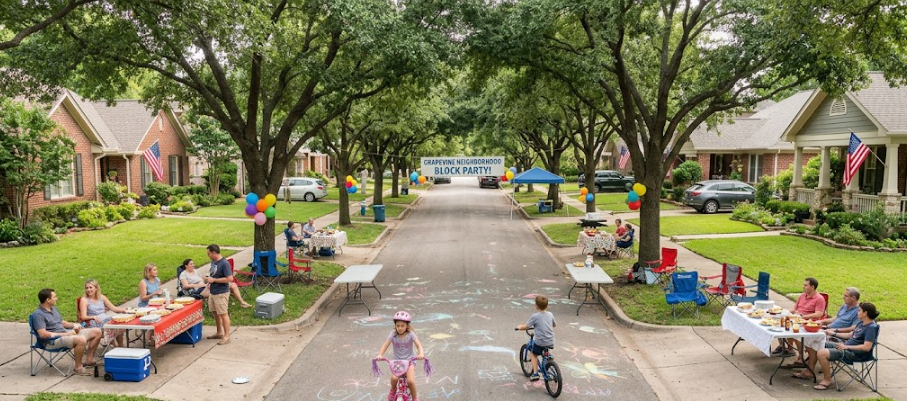
Block-party culture doesn't appear because a developer put a pool on the amenity map. It forms when residents stay long enough to build relationships, when an HOA actively creates reasons to gather, and when the physical design of a neighborhood makes casual interaction easy. Several Grapevine communities check all three boxes.
Timberline is the name that comes up most consistently in local conversations. The Timberline HOA organizes annual picnics, holiday decorating contests, and summer pool parties—and residents actually show up. Many homeowners here have lived in the neighborhood for a decade or more, which means the social fabric runs deep. Timberline Elementary, which serves the area and holds strong TEA ratings, reinforces that stability by anchoring families to the community through their children's school years.
Stone Bridge and Stone Bridge Woods operate with a highly active HOA that maintains a visible social calendar: seasonal festivals, food truck nights, and events centered around the community pool and clubhouse. Their neighborhood Facebook groups are a reliable indicator—active posting about upcoming events, not just complaint threads, signals genuine engagement.
Silverlake residents organize informal block parties and share green spaces and walking trails that make casual neighbor interaction a natural byproduct of daily life. Silverlake Elementary's strong academic reputation keeps families rooted here for years, which compounds the community-building effect over time.
Heritage (Grapevine sections) offers extensive amenities and an HOA that supports social clubs and community events at scale. It's a larger community, but the infrastructure for neighbor connection is genuinely there.
Then there are the organic communities—the historic streets directly bordering Main Street in the 76051 ZIP code. College Street, Wall Street, Hudgins Street, and Church Street don't always have formal HOAs, but residents here participate in downtown events, coordinate holiday decorating, and gather informally in ways that feel less programmed and more genuine. If you want community that grew rather than was engineered, these streets are worth a serious look. You can explore what's currently available in the area through TK Realty's active property search.
The common thread across all of these neighborhoods: an HOA or resident association that does more than enforce fence height rules, combined with physical amenities that give people a reason to leave their driveways.
Walkability to Main Street: Which Streets and Neighborhoods Deliver Real Access
Grapevine's city-wide Walk Score is 46—officially Car-Dependent. That number is accurate for most of the city. But it obscures something important: within the 76051 ZIP code, specific residential streets achieve Walk Scores of 70–90+, putting them in the Very Walkable to Walker's Paradise range. The difference between living in Grapevine and living in a walkable part of Grapevine is significant.
For genuine car-free access to Historic Main Street—meaning a 10–15 minute walk to shops, restaurants, the Grapevine Vintage Railroad, and the Palace Theatre—the streets that consistently deliver are College Street, Hudgins Street, Wall Street, Church Street, and Midway Drive, along with sections of Dooley Street in the Old Town Historic District. These are the addresses where you can walk to GrapeFest, grab dinner without moving your car, and participate in the Christmas Capital of Texas events on foot.
Expand the radius slightly and you reach Oak Creek Estates and Briarwood Addition, where many homes sit within a 15–20 minute walk of Main Street. That's a meaningful distinction from neighborhoods further out—it's the difference between walkability as a daily habit and walkability as an occasional option.
Residential areas within 0.5–1 mile of Main Street typically achieve Walk Scores in the 50–70 range, which translates to regular car-free access for most errands and entertainment. Beyond 1–1.5 miles, the walk becomes impractical for daily use, regardless of how the listing describes the location. Always verify with a Walk Score check for the specific address and run Google Maps walking directions to a Main Street landmark before assuming you're in the walkable zone.
One honest caveat: walkability to Main Street comes with trade-offs. During major events—GrapeFest draws over 250,000 attendees annually—residential streets adjacent to downtown experience overflow parking and elevated foot traffic. Most residents who live here consider it a worthwhile exchange for the lifestyle. But it's a real factor to weigh, not a footnote.
If you're comparing Grapevine to other neighborhoods across the region, our guide to Grapevine's hidden gems for new residents covers additional pockets of the city worth understanding before you commit to a specific area.
HOA Structure, Costs, and What They Actually Fund in Grapevine Communities
HOA fees are one of the most misunderstood line items in a homebuying budget. They're easy to resent in the abstract and easy to appreciate once you understand what they actually fund—especially in communities where the HOA is the direct mechanism that creates the block-party culture buyers are seeking.
In Grapevine's community-oriented subdivisions, HOA fees typically run $100–$300+ per month ($1,200–$3,600+ annually), varying by community and amenity level. Those fees cover maintenance of common areas, parks, greenbelts, community pools, clubhouses, security gates, and street lighting. In many active HOAs, a dedicated portion of the budget goes directly to social event coordination—the block parties, holiday gatherings, and seasonal festivals that make these neighborhoods feel like communities rather than just addresses.
Compared to Colleyville and Southlake, where HOA fees often run $200–$500+ monthly in luxury or gated communities, Grapevine's fees are generally competitive. You're paying for genuine community infrastructure, not just a gate and a logo.
An estimated 70–80%+ of Grapevine's single-family housing stock—particularly in newer developments and master-planned communities in the 76092 ZIP code—is HOA-governed. Even many older, established neighborhoods have formed voluntary associations. This prevalence means that understanding how to evaluate an HOA before you buy is a practical skill, not an optional one.
How to Spot a Genuinely Active HOA Before You Buy
Before purchasing in an HOA community, review the HOA's meeting minutes for the past 12 months, check their social media and Nextdoor presence for event announcements, and ask current residents about actual participation rates. A truly active HOA will have a visible social calendar, transparent financials, and residents who speak positively about community engagement—not just maintenance rules.
For first-time buyers navigating HOA documents and the broader purchase process, TK Realty's buyer resources walk through what to review and what questions to ask before you sign anything.
The Real Costs of Living in Grapevine's Community-Oriented Neighborhoods
Let's slow this down and look at the actual numbers. The purchase price is only one piece of what you're committing to when you buy in a walkable, HOA-managed Grapevine neighborhood. The full picture matters—and it's better to understand it clearly before you're under contract.
Homes within 0.5–1 mile of Main Street command a measurable walkability premium: 7–15% higher price per square foot than comparable homes further out, based on recent MLS data. That premium reflects real demand and tends to hold up well over time, but it also means your entry point is higher.
Property taxes in Grapevine—combining the City, Tarrant County, GCISD, and other taxing entities—run approximately 2.0–2.2% of assessed value annually. On a $650,000 home, that's roughly $13,650 per year. Texas has no state income tax, but property taxes are how the state funds services, and they're a significant ongoing cost that doesn't disappear after you pay off the mortgage.
Homeowners insurance in Tarrant County is higher than the national average due to hail risk. Budget $3,000–$5,000+ annually, and understand that this number can move after a bad storm season. Annual maintenance typically runs 1–2% of home value—for a $650,000 home, that's approximately $9,750 per year for routine upkeep, HVAC servicing, minor repairs, and eventual appliance or roof replacements.
Don't Overlook the Hidden Costs of Grapevine Homeownership
Beyond your mortgage, property taxes, and HOA fees, Tarrant County's hail risk means homeowners insurance runs $3,000–$5,000+ annually. Add annual maintenance (1–2% of home value) and potential special HOA assessments, and your total cost of ownership can easily exceed $144,000–$154,000 over five years. Always factor these into your budget before committing.
| Cost Category | Annual Estimate | 5-Year Total | Notes |
|---|---|---|---|
| Property Taxes | ~$13,650 | ~$68,250 | Based on 2.1% combined rate on $650K home |
| HOA Fees | ~$2,400 | ~$12,000 | Mid-range estimate at $200/month |
| Homeowners Insurance | $3,000–$5,000+ | $15,000–$25,000 | Higher due to Tarrant County hail risk |
| Annual Maintenance | ~$9,750 | ~$48,750 | 1.5% of $650K; covers routine upkeep and repairs |
| Total (excl. mortgage P&I) | ~$28,800–$30,800 | ~$144,000–$154,000 | Does not include special assessments or major renovations |
Use TK Realty's mortgage calculator to model your full monthly payment alongside these ongoing costs before you fall in love with a specific address.
Red Flags: Grapevine Neighborhoods to Approach Cautiously
Not every Grapevine neighborhood delivers the community culture this post describes. Knowing what to watch for saves you from buying into an area that looks right on paper but doesn't feel right once you're living there.
High concentrations of rental properties or proximity to industrial zones often correlate with more transient populations—and transient populations don't build block-party culture. The neighbor familiarity you're seeking requires people who plan to stay. Check rental density for any neighborhood you're seriously considering.
Neighborhoods west of Highway 121 or significantly north or south of Main Street may have excellent homes and good schools, but they require a car for virtually every errand and social activity. If walkability is a genuine priority for you, verify the Walk Score for a specific address—don't assume proximity to Grapevine means proximity to Main Street. A Walk Score below 50 with no clear pedestrian infrastructure to downtown is a meaningful signal.
HOAs that exist purely for maintenance and enforcement—no social calendar, low meeting attendance, residents who shrug when you ask about community events—are a reliable indicator of a less connected environment. Review the past 12 months of meeting minutes before you buy. If the minutes are mostly about violations and fee collections with no mention of social programming, that tells you something.
Newer developments that haven't yet established community traditions can also feel disconnected despite having physical amenities. A brand-new pool doesn't automatically create a community. Give newer subdivisions time to develop their social fabric before assuming they'll deliver the neighbor familiarity you're after—or look for ones with HOAs that have already built an active social committee from day one.
The most reliable research tool available to you is direct conversation. Reach out on Nextdoor or local Facebook groups for the specific neighborhood you're considering. Ask current residents what they actually do with their neighbors. The answers will tell you more than any listing description. For a deeper look at how to evaluate neighborhoods before committing, our guide to Grapevine neighborhoods for first-time buyers covers the evaluation framework in detail.
Why TK Realty Is the Right Choice for Finding Your Community-Focused Grapevine Home
Finding a neighborhood where you'll actually know your neighbors isn't something that happens by searching a listing portal. It requires someone who understands the difference between a subdivision with a community pool and a subdivision with a genuine community—and who knows which Grapevine streets deliver which.
TK Realty brings 113+ five-star Google reviews, 300+ closed transactions, and $100M+ in sales since 2018 to every client conversation. Broker-owner Tyler Kreis has been named Top Realtor by Fort Worth Magazine for 2023, 2024, and 2025, and serves on both the MetroTex and Texas Realtors Boards of Directors. The team is locally rooted in Roanoke—not a corporate franchise with rotating agents—which means the community knowledge is genuine and current.
What that track record translates to in practice: when you tell us you want a neighborhood where neighbors actually know each other, we don't hand you a list of every active listing in Grapevine. We ask what "community" means specifically to you. Do you want an HOA that organizes formal events, or a street where things happen organically? Do you need to walk to Main Street daily, or is occasional walkability enough? Do your kids need to be in a school where the parent community is as engaged as the academics? Those answers shape which neighborhoods we show you—and which ones we steer you away from, even if they look great on paper.
TK Realty's philosophy is to slow the process down, explain every step in plain language, and help you find a home that matches your values. There's no rush if it's not the right move.
Ready to explore Grapevine's most community-focused neighborhoods with an agent who understands the difference between a house and a home? Schedule a Free Consultation with TK Realty today.
Frequently Asked Questions About Grapevine's Community-Focused Neighborhoods
Are HOAs in Grapevine worth the fees for a strong sense of community?
For many Grapevine residents, especially in communities like Timberline or Stone Bridge, HOA fees are genuinely worthwhile. Active HOAs directly fund the social events—block parties, holiday gatherings, pool parties—that create the neighbor familiarity buyers seek, while also maintaining common amenities that enhance daily quality of life. The key distinction is choosing a community with a documented track record of social engagement, not just maintenance enforcement. Review the past year of HOA meeting minutes and check the neighborhood's social media presence before assuming any HOA will deliver the community culture you're after.
Which specific streets in Grapevine are genuinely walkable to Main Street without needing a car?
For a true 10–15 minute walk to Grapevine's Historic Main Street without a car, focus on residential streets directly bordering the district in the 76051 ZIP code: College Street, Hudgins Street, Wall Street, Church Street, and Midway Drive are the clearest examples. These streets offer direct pedestrian access to shops, restaurants, entertainment venues, and major events like GrapeFest. Always verify walkability for a specific address using Walk Score's interactive map and Google Maps walking directions to a Main Street landmark—don't rely on general neighborhood descriptions alone.
How does Grapevine compare to Southlake or Colleyville for families seeking a friendly, community-focused environment?
Grapevine offers a distinct and often more accessible community-focused environment than the generally more affluent and spread-out Southlake or Colleyville. All three cities benefit from excellent Grapevine-Colleyville ISD schools, but Grapevine's Historic Main Street, Lake Grapevine, and robust event calendar provide central, shared hubs for social interaction that Southlake and Colleyville simply don't replicate. Southlake and Colleyville tend to emphasize larger homes and private amenities, whereas Grapevine blends suburban comfort with a walkable downtown that fosters the kind of organic neighborly connections that don't require an organized event to happen.
Does living near Grapevine Main Street mean constant event noise and parking problems?
Living near Grapevine Main Street offers unparalleled walkability and lifestyle access, but residents should realistically anticipate increased noise and parking pressure during major events—GrapeFest draws over 250,000 attendees annually, and the Christmas Capital of Texas designation means weekend festival traffic is a regular feature of fall and winter. The City of Grapevine manages event logistics and parking, but residential streets directly adjacent to Main Street do experience overflow parking and heightened pedestrian activity during peak periods. Most residents who live here consider this a worthwhile trade-off for the vibrant lifestyle, but it's a genuine quality-of-life factor to weigh honestly before choosing an address directly bordering the district.
What makes TK Realty different from other real estate agents helping buyers find community-focused Grapevine homes?
TK Realty, backed by 113+ five-star Google reviews and 300+ closed transactions totaling $100M+ in sales since 2018, takes time to understand what "community" truly means to each buyer—whether that's organized HOA events, walkable access to Main Street, neighborhoods with long-term residents, or a strong school community. Rather than rushing you toward the hottest listing, we slow the process down, explain every step in plain language, and match you to neighborhoods where you'll actually know your neighbors. We'll also tell you when a neighborhood doesn't fit your priorities, even if the home looks great on paper. Ready to find your community-focused home in Grapevine? Schedule a Free Consultation with TK Realty today.
Ready to Find Your Community-Focused Home in Grapevine?
The right neighborhood is out there—one where you'll know your neighbors' names, walk to Main Street on a Saturday morning, and feel genuinely at home. Let's identify which Grapevine streets match your lifestyle priorities before you fall in love with the wrong address.
TK Realty's locally rooted team will slow the process down, answer every question in plain language, and help you make a decision you'll feel confident about for years to come.
Schedule a Free Consultation →*Market data, property values, and trends discussed in this article are accurate as of the date of publication and subject to change. This article is for informational purposes only and does not constitute legal or financial advice. Equal Housing Opportunity. Contact us for current market conditions in your area.
Check out this article next