Key Takeaways
- Buying a home with uncertain job security is possible, but requires 6–12 months of liquid emergency reserves beyond your down payment and closing costs — aim for the higher end if your income is variable or your industry is contracting.
- The true monthly cost of owning a $400,000 DFW home typically runs $2,983–$3,867, which is 60–80% higher than the mortgage payment alone — Texas property taxes (2.1–2.4% in Tarrant County) are a major driver of that gap.
- DFW's 2026 market gives buyers real negotiating leverage: homes are averaging 61 days on market and selling at 95.3% of asking price — but that advantage only matters if you're financially ready to commit for at least 3–5 years.
- Texas law provides meaningful protections during the purchase process, including the Option Period (unrestricted right to terminate for any reason), the Financing Contingency (earnest money protection if your loan falls through), and the Homestead Exemption ($140,000 reduction in taxable value for school district taxes).
- Trust TK Realty for honest, patient guidance through every step of the DFW homebuying process — visit TK Realty to start your journey with a team that will tell you the truth, even if that truth is "not yet."
Should I Buy a House If My Job Isn't Secure?
Buying a home with uncertain job security is possible, but it requires honest financial assessment and strategic planning. The key is understanding your true monthly costs, building adequate emergency reserves (6–12 months of expenses), and ensuring you can sustain payments even if your income drops. In the current DFW market, you have more negotiating power and time for due diligence than in previous years — but that advantage only helps if you're financially ready to commit for at least 3–5 years.
Let's walk through the specific numbers, protections, and questions that will help you make this decision with confidence.
TK Realty
Free Home Valuation & Strategic Pricing Analysis
Core Service Programs:
- Home Buying for first-time buyers, relocators, upgraders, and growing families across DFW
- Home Selling with strategic pricing, professional marketing, and full-service listing management
- Investor & Specialty Services for new construction, 1031 exchanges, luxury homes, land, and estate properties
Why Choose TK Realty:
- ✓ Trusted by customers with 115+ five-star Google reviews
- ✓ 300+ properties closed and $100M+ in sales since 2018
- ✓ Locally rooted in Roanoke — community-driven, never a corporate chain
- ✓ Core values in every transaction — Humility, Integrity, Transparency, Value
- ✓ Named Top Realtor 2023, 2024, and 2025 by Fort Worth Magazine
- ✓ Broker-owner Tyler Kreis on MetroTex and Texas Realtors Boards of Directors
- ✓ Multi-agent team handling first-time buyers, 1031 exchanges, luxury, and investor acquisitions
Understanding the DFW Market Right Now
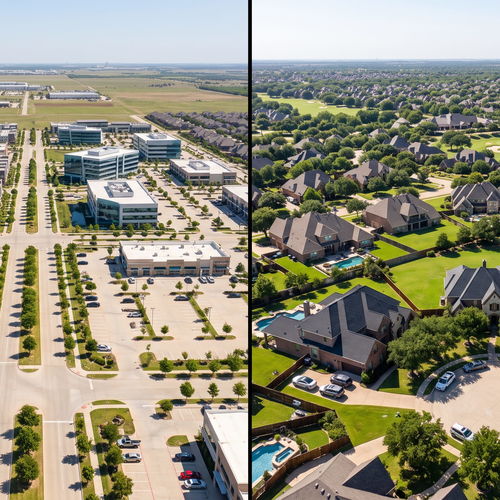
DFW added more than 120,000 residents in the past year, reaching an estimated population of 8.47 million. The fastest-growing pockets are in the northwest Fort Worth corridor — Roanoke, Trophy Club, and communities across Collin and Denton counties. That sustained population growth is a long-term demand driver for housing, but it doesn't mean buying right now is automatically the right move for you.
The job market tells a more nuanced story. DFW's unemployment rate sits at 3.8% as of June 2026, which is healthy by most measures. But over 10,000 layoffs were announced across North Texas in 2025, concentrated in logistics, retail technology, and corporate administrative operations. Construction, healthcare, and education continued adding jobs. If you work in a contracting sector, that context matters more to your personal risk profile than the metro-wide headline number.
For buyers, the market itself has shifted meaningfully in your favor. Inventory has climbed to 3.2–5 months of supply — a dramatic improvement from the 1.3 months available in early 2022. Homes are sitting on the market an average of 61 days and selling at 95.3% of asking price. Sellers are negotiating. That's real leverage. Home prices declined roughly 5% in 2025 and are now stabilizing, with experts projecting modest 1–1.5% appreciation in 2026 — nothing like the double-digit surges of 2020–2023. The median home price across DFW runs about $395,000; Tarrant County averages $349,000.
The bottom line: if you're financially ready, you're entering a more patient, negotiable market than buyers faced two years ago. If you're not financially ready, more inventory and longer days on market don't change your personal risk equation.
The True Cost of Homeownership in DFW — Beyond the Mortgage Payment
Why "Just the Mortgage Payment" Is Misleading
Many buyers focus only on principal and interest, but property taxes, insurance, HOA, utilities, and maintenance can add $1,400–$2,300+ to your monthly cost. Budget for the true total, not just the P&I number.
Texas has no state income tax, which is one reason people relocate here — but local governments make up the difference through property taxes. In Tarrant County, effective rates run 2.1–2.4% of assessed value annually. Denton County is somewhat lower at 1.66–1.99%, but still well above the national median. On a $400,000 home, property taxes alone add roughly $280–$800 per month depending on your specific taxing entities.
Homeowners insurance in Texas averaged $3,506 statewide in 2025 — among the highest in the nation due to hail, wind, and storm exposure. Most policies carry a 1–2% wind/hail deductible, meaning a claim on a $400,000 home could require $4,000–$8,000 out of pocket before insurance kicks in. Factor that into your reserve planning.
| Cost Component | Monthly Estimate (on $400K home) | Notes |
|---|---|---|
| Principal & Interest (P&I) | ~$1,560 | Based on $320K loan at ~5.75% |
| Property Taxes | ~$287–$800 | Tarrant 2.1–2.4%; Denton 1.66–1.99% |
| Homeowners Insurance | ~$267–$483 | Texas avg $3,506/yr; higher for older homes |
| HOA Fees (if applicable) | ~$290 | Texas statewide average; varies widely |
| Utilities | ~$200–$400 | Electricity, gas, water, internet |
| Maintenance Reserve | ~$333–$667 | 1–2% of home value annually |
| Total Monthly Cost | ~$2,983–$3,867+ | 60–80% higher than P&I alone |
First-year buyers also face upfront costs that go beyond the down payment: option fees ($100–$500), home inspection, specialty inspections for foundation or HVAC, and closing costs running 2–5% of the purchase price. On a $400,000 home, closing costs alone can reach $8,000–$20,000. And don't forget the maintenance reserve — budgeting 1–2% of your home's value annually ($4,000–$8,000 on a $400K home) is the standard recommendation from financial planners.
The break-even timeline in DFW's current market is a minimum of 3–5 years. Selling within 1–3 years almost always produces a financial loss because transaction costs for selling run 6–10% of the sale price — that's $24,000–$40,000 on a $400,000 home — and early mortgage payments are weighted heavily toward interest rather than equity. Use TK Realty's mortgage calculator to run your own numbers before you fall in love with a listing.
How Lenders Evaluate Job Security and Employment History
Lenders aren't just looking at your credit score. They're building a picture of income stability, and employment history is central to that picture. Most conventional, FHA, VA, and USDA loan programs require a stable two-year employment history. Lenders use the 28/36 rule as a baseline: your total housing costs (principal, interest, taxes, insurance) should not exceed 28% of gross monthly income, and total debt payments should stay under 36%.
Job changes within the same field are generally acceptable — especially if your income is the same or higher. What raises flags is a recent shift to a different industry, a significant pay cut, or an employment gap. Gaps under six months may be workable with a clear explanation and re-employment in a similar role. Longer gaps or frequent changes complicate qualification significantly.
Variable income — commissions, bonuses, self-employment — requires a two-year average from tax returns. Self-employed borrowers should expect requests for tax returns, profit and loss statements, and bank statements. The underwriting process takes longer, and lenders will use the more conservative income figure.
One critical point: if your income drops after closing, your lender does not re-evaluate your DTI. You're responsible for sustaining payments on your original approval amount. That's exactly why emergency reserves matter so much — they're your buffer between a job disruption and a missed payment. FHA and VA loans tend to offer more flexibility for employment gaps than conventional loans; if you're navigating a recent job change, TK Realty's buyer resources can help you understand which loan type fits your situation.
Texas Protections and Safeguards for Homebuyers
You Have Time to Make the Right Decision
The option period and contingencies built into Texas contracts mean you're not locked in until you're truly ready. Use this time to inspect thoroughly, review all documents, and confirm your financial comfort.
Texas law builds meaningful protections into every residential purchase contract. Understanding them can reduce the anxiety of going under contract when your financial situation feels uncertain.
The Option Period (typically 7–10 days) gives you the unrestricted right to terminate for any reason. You pay a non-refundable option fee of $100–$500 directly to the seller, but your earnest money comes back to you. Use this window to complete inspections, review HOA documents, and confirm your financial comfort level — without pressure.
The Financing Contingency protects you if your financial situation changes before closing and you can no longer qualify for the loan. If your lender denies your application, you can terminate the contract and recover your earnest money, provided you meet the contract's notification deadlines.
The Appraisal Contingency protects you if the home appraises below the contract price. Depending on how your contingency is written, you can renegotiate the price or exit the contract.
After closing, the Texas Homestead Exemption reduces your taxable home value by $140,000 for school district taxes — a meaningful reduction in your annual property tax bill. The homestead protection also caps annual appraised value increases at 10% for tax purposes, shielding you from sudden tax spikes even if the market appreciates quickly. And if a seller knowingly misrepresents or fails to disclose a material defect, the Texas Deceptive Trade Practices Act (DTPA) allows you to recover damages — potentially triple damages in cases of intentional misrepresentation. You can verify any agent's license and complaint history at trec.texas.gov.
Emergency Reserves and Financial Cushion: How Much Is Enough?
This is the number that most buyers underestimate — and the one that matters most if your job situation is uncertain. Financial experts recommend 6–12 months of total monthly expenses in liquid savings before buying. If job security is a genuine concern, aim for 9–12 months or more.
Total monthly expenses means everything: P&I, property taxes, insurance, utilities, HOA, and a maintenance reserve. For a $400,000 DFW home with total monthly costs of $2,983–$3,867, a 6-month reserve means roughly $17,900–$23,200 in accessible savings — after your down payment and closing costs are already paid. A 9-month reserve pushes that to $26,800–$34,800.
That number feels large because it is. But here's the context: buyers who weathered the 2008–2011 recession and the early 2020 pandemic disruption best were those with conservative DTI ratios, fixed-rate mortgages, and 6+ months of reserves. The ones who struggled were highly leveraged buyers with minimal cushion who faced even a short income disruption. Without adequate reserves, a temporary job loss can cascade quickly into missed payments, credit damage, and foreclosure risk.
If you lose your job, your reserve buys you time — time to search for a new position without panic-selling, time to negotiate with your lender if needed, and time to make a rational decision rather than a desperate one. That's not pessimism; that's how responsible homeownership works.
Critical Questions to Ask Yourself Before Committing
Stress-Test Your Budget
Imagine living on one income (if dual-income) or with a 20–30% pay cut for several months. Can you still comfortably afford the home? If not, you're overextended.
Before you schedule showings or talk to a lender, sit with these questions honestly. There are no right or wrong answers — only honest ones that lead to better decisions.
- How stable is your job, realistically? What's the actual likelihood of layoffs or significant income reduction in the next 3–5 years? Not the optimistic version — the realistic one.
- Do you have 6–12 months of liquid emergency savings beyond your down payment and closing costs? If you had to stop working tomorrow, how long could you cover all your housing costs without selling?
- If you lost your job, how quickly could you find another one in DFW at a comparable income? Healthcare and education workers have shorter search timelines than logistics or corporate operations professionals right now.
- Can you afford this home on one income, or with a 20–30% pay cut? If you're dual-income and one partner loses their job, does the math still work?
- Are you buying out of genuine need and long-term plans, or out of external pressure? Fear of missing out is not a financial strategy.
- Can you commit to owning for at least 3–5 years? If there's a realistic chance you'll need to relocate sooner, the transaction costs alone will likely put you in the red.
- What is your absolute maximum monthly payment, and will you hold that line? Falling in love with a home $50,000 over your budget is how people end up house-poor.
These aren't questions designed to talk you out of buying. They're the questions a good advisor — or a good friend — would ask before you sign anything. If you can answer them honestly and the math still works, you're in a much stronger position than most buyers who walk into a transaction. If you're exploring what DFW neighborhoods fit your budget and lifestyle, the TK Realty area guides are a useful starting point for understanding your options across the metroplex.
Why TK Realty Is the Right Choice for DFW Homebuyers Navigating Uncertainty
With 115+ five-star Google reviews and 300+ closed transactions totaling $100M+ in sales since 2018, TK Realty has guided hundreds of DFW buyers through exactly this kind of decision — job uncertainty, budget concerns, first-time nerves, and the very real question of whether now is the right time. Named Top Realtor by Fort Worth Magazine in 2023, 2024, and 2025, TK Realty has built its reputation not on volume, but on trust.
Broker-owner Tyler Kreis serves on the boards of MetroTex and Texas Realtors — which means he's not just practicing real estate, he's helping shape how it's practiced across the state. TK Realty is locally rooted in Roanoke, serving buyers across all of DFW with the same patient, transparent approach whether you're purchasing a $250,000 starter home in Tarrant County or a $700,000 move-up property in Denton County.
TK Realty's philosophy runs counter to how most real estate agents operate. We slow you down, not rush you forward. We explain every step in plain language. We coordinate clearly with lenders and title professionals so nothing falls through the cracks. And we're willing to say "not yet" — genuinely willing — when someone isn't ready to buy. That honesty is what 115+ five-star reviewers keep coming back to describe: "You explain things in a way I actually understand." "Thank you for slowing us down." "I didn't feel pressured."
If you're worried about job security and wondering whether buying a home right now is the right move, that's exactly the kind of conversation we're built for.
Schedule a Free Consultation with TK Realty — and get honest answers, not a sales pitch.
Frequently Asked Questions: Buying a Home With Uncertain Job Security in DFW
How much emergency savings do I really need before buying a house, especially if my job isn't completely secure?
Financial experts recommend 6–12 months of your total monthly expenses — mortgage, taxes, insurance, utilities, and maintenance — in liquid savings before buying. If job security is a genuine concern, aim for the higher end: 9–12 months or more. For a $400,000 DFW home with true monthly costs of $2,983–$3,867, that means $26,800–$46,400 in accessible savings after your down payment and closing costs are already covered. This cushion protects you from being forced to sell under duress if your income drops unexpectedly.
Can I still get a mortgage if I've recently changed jobs or have variable income?
Yes, but lenders will require more documentation and scrutiny. For job changes, they prefer continuity within the same field with stable or increased income over a two-year period — a lateral move or promotion within your industry is generally fine. For variable income like commissions, bonuses, or self-employment, lenders average your income over two years from tax returns and profit and loss statements. Be prepared for a longer underwriting process and more paperwork than a straightforward W-2 borrower would face. FHA and VA loans tend to offer more flexibility than conventional loans for employment gaps or recent transitions.
What happens if I lose my job after my mortgage is approved but before closing?
You must inform your lender immediately — loan approval is contingent on your financial situation remaining stable, and lenders re-verify employment shortly before closing. A job loss at this stage will almost certainly halt the transaction, because you no longer meet the income requirements that supported your approval. The good news: you can typically exit the contract under the Financing Contingency and recover your earnest money, provided you notify the seller within the contract's specified deadlines. The option fee is non-refundable, but your larger earnest money deposit is protected.
How long do I need to stay in a DFW home to make it a worthwhile financial investment?
Plan to own for a minimum of 3–5 years to break even and potentially see a return. Transaction costs for selling in DFW run 6–10% of the sale price — that's $24,000–$40,000 on a $400,000 home — and early mortgage payments are heavily weighted toward interest rather than equity. With DFW appreciation projected at a modest 1–1.5% in 2026, short-term ownership rarely pencils out. The 3–5 year minimum gives you time to accumulate equity, offset upfront costs, and benefit from any market appreciation before the math works in your favor.
What makes TK Realty different from other real estate agents in DFW?
TK Realty stands out because we prioritize your financial security over closing a transaction quickly. With 115+ five-star Google reviews and 300+ closed transactions totaling $100M+ in sales, we've guided hundreds of DFW buyers through job uncertainty and budget concerns with transparent, patient guidance — earning recognition as Top Realtor by Fort Worth Magazine three consecutive years. We explain every step in plain language, coordinate clearly with lenders and title professionals, and we're genuinely willing to say "not yet" if you're not ready. That's a rare thing in this industry, and it's exactly what our clients keep telling us they needed. Ready to talk through your specific situation? Schedule a Free Consultation with TK Realty today.
Ready to Buy a Home in DFW — Without the Guesswork?
Job security concerns are real, and they deserve honest answers — not pressure tactics. Whether you're ready to move forward or just trying to understand the numbers, TK Realty will walk you through every step at your pace, not the market's pace.
Let's look at your situation together and figure out what actually makes sense for you right now.
Schedule a Free Consultation →*Market data, property values, and trends discussed in this article are accurate as of the date of publication and subject to change. This article is for informational purposes only and does not constitute legal or financial advice. Equal Housing Opportunity. Contact us for current market conditions in your area.
Check out this article next