Key Takeaways
- Townhomes in DFW suburbs cost 10–15% less than single-family homes at purchase, but HOA fees of $250–$400/month close much of that gap over time — a five-year cost comparison shows townhomes running roughly $38,000 less in total out-of-pocket costs.
- For remote workers, shared walls are the single biggest lifestyle risk in a townhome — noise from neighbors can directly impact video calls and concentration, and this is something worth testing in person during a tour, not assuming away.
- Between 2021 and 2024, townhomes in DFW appreciated at 9–11% annually — slightly faster than single-family homes (8–10%) — driven by strong demand from entry-level buyers and tighter inventory (2.8 months of supply vs. 3.5 months for single-family).
- Before making an offer on a townhome, verify fiber internet availability at the specific address using the FCC National Broadband Map, and review HOA documents during the Texas Option Period for red flags like underfunded reserves or restrictions on home-based businesses.
- Trust Tyler Kreis Real Estate for calm, pressure-free guidance on buying in DFW — explore TK Realty's buyer resources to start your search with confidence.
Single-Family Home vs. Townhome in DFW Suburbs: Which Is Right for Remote Workers?
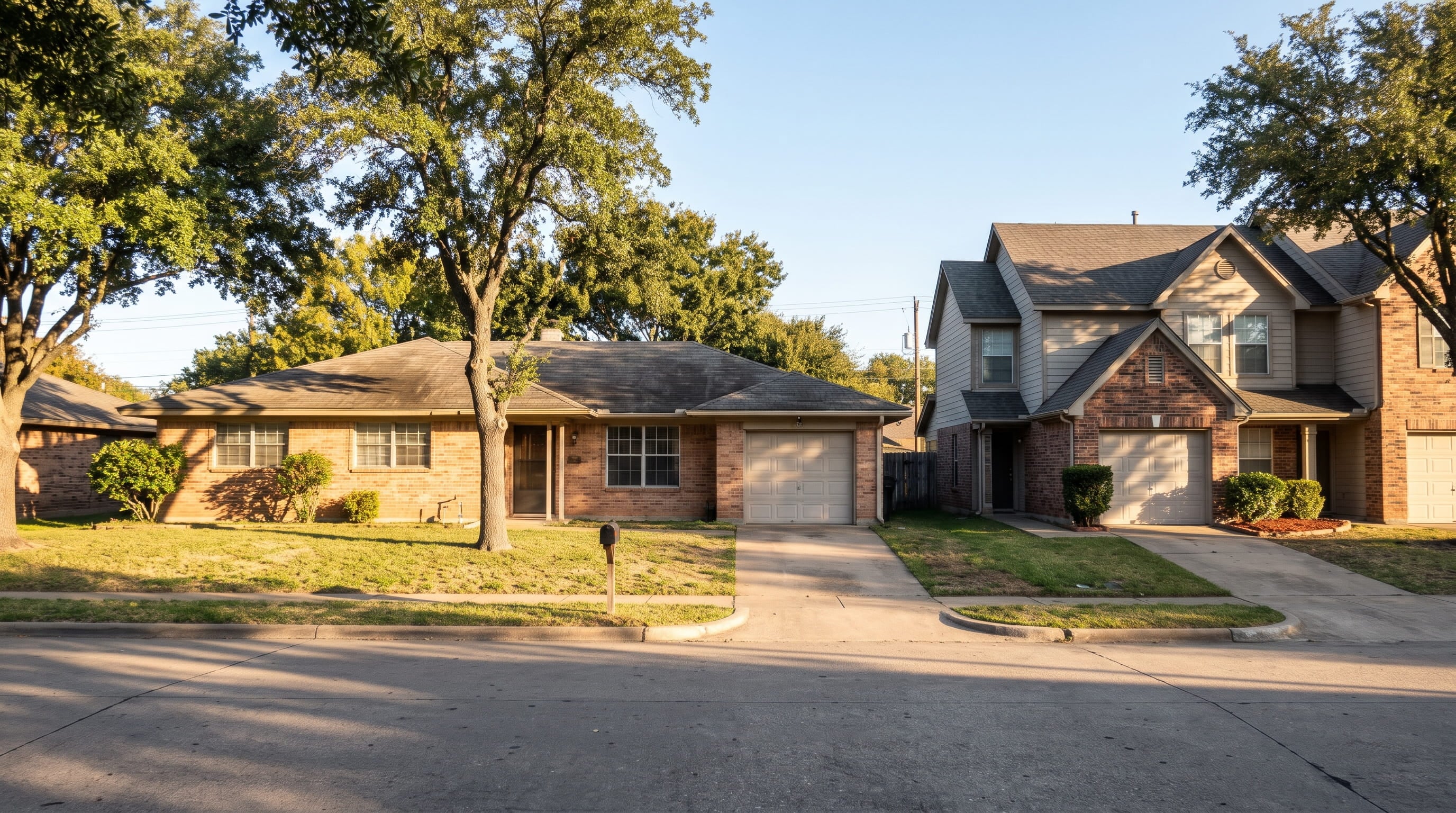
The choice between a single-family home and a townhome in DFW suburbs depends on your lifestyle priorities, maintenance tolerance, and long-term financial goals. Single-family homes offer privacy, yard space, and lower ongoing HOA fees but require more hands-on maintenance. Townhomes provide lower entry prices, faster appreciation recently, and lock-and-leave convenience, but come with shared walls, higher HOA fees ($250–$400/month), and limited outdoor space. For remote workers, the deciding factor is often whether you need a quiet, private office environment or can adapt to shared-wall living.
Let's walk through the numbers, lifestyle trade-offs, and market data so you can make the choice that actually fits your situation.
TK Realty
Free Home Valuation & Strategic Pricing Analysis
Core Service Programs:
- Home Buying for first-time buyers, relocators, upgraders, and growing families across DFW
- Home Selling with strategic pricing, professional marketing, and full-service listing management
- Investor & Specialty Services for new construction, 1031 exchanges, luxury homes, land, and estate properties
Why Choose TK Realty:
- ✓ Trusted by customers with 115+ five-star Google reviews
- ✓ 300+ properties closed and $100M+ in sales since 2018
- ✓ Locally rooted in Roanoke — community-driven, never a corporate chain
- ✓ Core values in every transaction — Humility, Integrity, Transparency, Value
- ✓ Named Top Realtor 2023, 2024, and 2025 by Fort Worth Magazine
- ✓ Broker-owner Tyler Kreis on MetroTex and Texas Realtors Boards of Directors
- ✓ Multi-agent team handling first-time buyers, 1031 exchanges, luxury, and investor acquisitions
Pricing and Total Cost of Ownership in DFW Suburbs
The sticker price difference between a townhome and a single-family home in the same DFW suburb is real — but it's only part of the story. Townhomes are typically 10–15% cheaper at purchase, a gap that has narrowed from 20–25% in 2022. However, townhomes cost more per square foot ($250–$350/sq ft vs. $220–$300/sq ft for single-family), reflecting higher land costs per unit, more complex construction, and premium locations in walkable mixed-use areas.
The biggest ongoing cost difference is HOA fees. A single-family HOA runs $500–$1,200 per year, covering common areas like parks and entryways. A townhome HOA runs $2,500–$4,500 per year because it also covers the building exterior — roof, siding, paint, and landscaping. That's a meaningful monthly difference. Property taxes in DFW run 2.0–2.5% of appraised value annually regardless of property type, with variation by county and school district.
Median Sold Prices by Suburb (Q3 2024)
| Suburb | Single-Family Median | Townhome Median | Price Gap |
|---|---|---|---|
| Frisco | $715,000 | $610,000 | $105,000 (15%) |
| McKinney | $550,000 | $475,000 | $75,000 (14%) |
| Prosper | $810,000 | $650,000 | $160,000 (20%) |
| Keller | $680,000 | $540,000 | $140,000 (21%) |
| Roanoke | $595,000 | $485,000 | $110,000 (18%) |
Breaking Down the Monthly Cost Difference
On a $500K single-family home, expect roughly $960/month in property taxes plus $83–$100/month in HOA fees. On a comparable $425K townhome, property taxes drop to around $815/month, but HOA fees jump to $208–$375/month. Townhome owners also save 15–25% on homeowner's insurance because the HOA's master policy covers the building exterior — you only need an interior (HO-6) policy. Single-family owners, by contrast, must budget for roof replacement ($12,000–$18,000), exterior painting ($5,000–$10,000), and ongoing landscaping.
Run the full five-year math and townhomes come out roughly $38,000 cheaper in total out-of-pocket costs — despite higher HOA fees — because the lower purchase price and reduced maintenance responsibility more than offset the monthly fee difference. If you want to run the numbers for a specific price point, the TK Realty mortgage calculator is a useful starting point for budgeting monthly payments.
Home Office Space and Remote Work Suitability
This is where the decision gets personal. Most new single-family homes in DFW suburbs over 2,500 sq ft now include a dedicated first-floor flex room or study as a standard feature — a direct response to remote work demand. You get a door that closes, separation from household noise, and full control over your environment. That matters when you're on back-to-back video calls or need deep focus for hours at a time.
Newer three-story townhome plans are catching up. Many now include a first-floor bedroom or media room with an attached bath, explicitly marketed as a home office suite. Two-story plans, however, often require sacrificing a guest bedroom to create a dedicated office — a trade-off worth thinking through before you tour. If you're comparing new construction options across both property types, the TK Realty new construction page covers what's currently available in the DFW market.
The Shared Wall Concern Is Real
If you work from home and need a quiet environment for calls and concentration, shared walls in townhomes can be a genuine lifestyle issue. This isn't a minor trade-off — it's worth testing in person during a tour. Visit at different times of day, ask the seller directly about noise, and have your agent inquire about the type of firewall and soundproofing between units.
Newer townhome construction with double-wall framing and insulated firewalls offers meaningfully better soundproofing than older units built in the 1990s and 2000s. But shared walls will always carry some noise risk. If your work requires sustained quiet and your schedule doesn't give you flexibility around neighbor activity, that's a real constraint — not a minor inconvenience.
Lifestyle Trade-Offs: Privacy, Space, and Maintenance
Single-family homes in DFW suburbs typically sit on 0.15–0.25 acre lots. That means a real backyard — space for dogs, kids, a garden, or just a quiet place to decompress after a long work-from-home day. You control the exterior, the landscaping, and how the property looks and functions. The trade-off is that you also own all of that responsibility: lawn care, roof maintenance, exterior repairs, and the time those things consume on weekends.
Townhome back patios are a different story. Most are 10x15 feet, fully paved, with tall privacy fences. There's no yard for a dog to run in and no space for kids to play. Guest parking is often a block away, and shared driveways can create friction with neighbors. The HOA handles all exterior maintenance — which is genuinely convenient for people who travel frequently or simply don't want to spend Saturday afternoons on home upkeep.
There's one more thing remote workers should factor in: HOA rules. Many townhome communities have restrictions on parking commercial vehicles, running a home-based business with client visits, or even the hours during which you can receive deliveries. If your remote work involves any of those things, read the rules carefully before you commit. The TK Realty buyer resources page walks through what to look for in HOA documents during the due diligence process.
Market Data: Appreciation, Inventory, and Resale Speed
Between 2021 and 2024, single-family homes in DFW appreciated at 8–10% annually, according to data from the Texas A&M Real Estate Research Center. Townhomes appreciated slightly faster — 9–11% annually — driven by high demand from entry-level buyers and a lower starting price point that kept more buyers in the market even as rates rose.
Inventory tells a similar story. As of Q3 2024, townhome supply sat at 2.8 months — tighter than the 3.5 months of supply for single-family homes. Average days on market reflects that: townhomes sold in roughly 38 days compared to 45 days for single-family homes. If liquidity matters to you — either because your plans might change or because you're thinking about resale — townhomes currently move faster in this market.
One data point worth flagging for remote workers specifically: MLS listings that mention a dedicated "home office" or "study" sell for a 2.7% premium and spend five fewer days on the market in DFW, according to 2024 Zillow Research data. That applies to both property types — a well-configured home office is a genuine value driver when it comes time to sell.
Internet Infrastructure: A Critical Factor for Remote Workers
Fiber-to-the-home (FTTH) service is widely available in Frisco, Allen, and McKinney, with over 85% household coverage from AT&T Fiber and Spectrum. In these areas, gigabit speeds are accessible to most buyers regardless of whether they choose a single-family home or a townhome. Prosper and Celina have rapidly expanding fiber coverage, but service can be inconsistent in newer developments — particularly in subdivisions where infrastructure is still being built out.
Keller, Southlake, and Flower Mound have more mixed coverage. Established neighborhoods often rely on older cable infrastructure, while newer pockets have fiber access. The key point: don't assume fiber is available just because a neighborhood is new or well-regarded.
Verify Internet at the Specific Address
Don't assume fiber is available just because it's available in the neighborhood. Use the FCC National Broadband Map to check service at the exact address before making an offer. For remote workers, this is non-negotiable — broadband availability should be verified the same way you'd verify the school district or property tax rate.
Understanding HOA Documents and Townhome Regulations
Texas law requires sellers to provide a Resale Certificate and the HOA's governing documents — including the budget, bylaws, rules, and account statements — before closing. This disclosure is mandatory, and the contract specifies a deadline for delivery. The Texas Option Period (typically 7–10 days, purchased for $100–$500) gives you the unrestricted right to terminate the contract for any reason during that window. Use it to read the HOA documents carefully, not just skim them.
Most DFW townhomes are sold as "fee simple," meaning you own the structure and the lot beneath it — not just the airspace inside. This matters for financing: fee-simple townhomes in a Planned Unit Development (PUD) are financed exactly like single-family homes, without the additional lender requirements that apply to condominiums. In 2023, the Texas Legislature passed several bills increasing HOA transparency and capping certain fees, giving buyers additional protections when entering HOA-governed communities.
Red Flags in HOA Documents
Before closing on a townhome, look for underfunded reserves, a history of large special assessments, pending litigation against the HOA, and rules that restrict home-based businesses or client visits. These can cost you thousands and directly impact your ability to work from home. If the reserve fund is thin and the roof is aging, a special assessment could land in your lap within the first year of ownership.
Top Townhome and Single-Family Communities in DFW: Compared and Reviewed
Not every DFW suburb offers the same mix of property types, price points, or infrastructure for remote workers. Here's how the major markets break down, with suburb-specific data to help you focus your search.
Frisco: Premium New Construction and Mixed-Use Development
Frisco leads in new townhome development, anchored by high-end mixed-use projects like The Star that offer walkable amenities alongside suburban school quality. With a median single-family price of $715,000 and a median townhome price of $610,000, Frisco sits at the premium end of the market. Fiber optic internet covers over 85% of households, and Frisco ISD is consistently ranked among the best in Texas. Appreciation runs 8–10% annually with average days on market around 38–45 days.
McKinney: Balanced Inventory and Affordable Entry Points
McKinney offers the highest volume of new and existing townhome inventory among DFW suburbs, with a median single-family price of $550,000 and a median townhome price of $475,000. Master-planned communities provide access to strong amenities, and walkable projects like Watters Creek attract remote workers seeking an urban-suburban lifestyle. Good broadband coverage with fiber available in newer developments. McKinney ISD offers solid schools with competitive property tax rates.
Prosper: Explosive Growth and Premium Pricing
Prosper has seen population growth of over 10% year-over-year (2023–2024), with projections to reach 55,000 residents by 2027. Median prices reflect that demand: $810,000 for single-family, $650,000 for townhomes. Newer construction dominates, with strong fiber optic infrastructure, and Prosper ISD is a major draw for families. Appreciation rates are among the highest in DFW at 9–11% annually. For buyers considering Prosper's growth trajectory, the broader DFW investment context is worth reviewing.
Keller: Single-Family Dominance and Larger Lots
Keller remains predominantly single-family, with lot sizes typically running 0.20–0.35 acres. Townhome inventory is very limited — mostly legacy units from the 1990s and 2000s with higher HOA fees due to aging exteriors. Median single-family price is $680,000; townhomes at $540,000 are harder to find and often require more interior updating. Keller ISD is well-regarded. For buyers who prioritize privacy and yard space over walkability, Keller delivers. The Keller neighborhood guide covers the lifestyle nuances of each area.
Roanoke: Emerging Growth Corridor with Competitive Pricing
Roanoke is part of the rapidly expanding AllianceTexas corridor, with a projected 15–20% population increase between 2024 and 2027. Median prices are competitive: $595,000 for single-family, $485,000 for townhomes. Good broadband infrastructure with fiber available in newer developments. Strong appreciation potential as the area continues to build out. For buyers interested in Roanoke specifically, the Roanoke real estate investment overview provides additional context on the corridor's growth trajectory.
| Suburb | SF Median | TH Median | Fiber Coverage | Townhome Supply | Annual Appreciation |
|---|---|---|---|---|---|
| Frisco | $715K | $610K | 85%+ | High | 8–10% |
| McKinney | $550K | $475K | Good | High | 8–10% |
| Prosper | $810K | $650K | Good (verify) | Moderate | 9–11% |
| Keller | $680K | $540K | Mixed | Very Low | 8–10% |
| Roanoke | $595K | $485K | Good (newer areas) | Moderate | Strong growth |
Why Tyler Kreis Real Estate Is the Right Choice for DFW Homebuyers
With 115+ five-star Google reviews, 300+ closed transactions, and $100M+ in sales since 2018, Tyler Kreis Real Estate has guided hundreds of DFW buyers through exactly this kind of decision — single-family vs. townhome, which suburb, which HOA, which neighborhood actually has fiber. These aren't abstract questions to us. They're the ones we answer every week.
Tyler Kreis serves on both the MetroTex and Texas Realtors Boards of Directors, which means the institutional knowledge behind every transaction goes well beyond the MLS. We understand which HOAs have strong reserves and which have deferred maintenance problems. We know which new construction communities in Prosper and Frisco are delivering on their infrastructure promises and which are still catching up. That kind of ground-level knowledge protects your interests in ways that a quick online search simply can't.
Named Top Realtor by Fort Worth Magazine in 2023, 2024, and 2025, and locally rooted in Roanoke, TK Realty is not a corporate chain optimizing for volume. We're a community-driven team that believes real estate decisions should feel calm and informed — never rushed. If the numbers don't make sense for your situation right now, we'll tell you that. If a townhome HOA has red flags, we'll walk you through them before you're under contract. We move at your pace, not the market's.
Schedule a free consultation with Tyler Kreis Real Estate today, and let's find the home that actually fits your life.
Frequently Asked Questions: Single-Family Home vs. Townhome in DFW
Are townhome HOA fees really worth it in DFW?
It depends on your lifestyle. Townhome HOA fees ($250–$400/month) cover all lawn care, exterior maintenance — including roof replacement, which can run $15,000+ for a single-family homeowner — and often a master insurance policy for the building exterior. For remote workers who travel frequently or simply don't want to spend weekends on home maintenance, that "lock and leave" convenience can be well worth the cost. The trade-off is less control over your property and a higher fixed monthly expense that doesn't go away even when nothing needs fixing.
Will I regret having a shared wall if I work from home?
This is one of the most significant risks for remote workers, and it deserves honest consideration. Noise from neighbors — whether it's a TV through the wall, footsteps from above, or conversations bleeding through — can directly impact concentration and video call quality. When touring a townhome, pay attention to the time of day, ask the seller directly about noise, and have your agent inquire about the type of firewall and soundproofing between units. Newer construction with double-wall framing and insulated firewalls is meaningfully better than older units, but shared walls will always carry some noise risk. Test it in person before you decide.
Is it harder to get a loan for a townhome than a house in Texas?
Generally, no. As long as the townhome is classified as "fee simple" in a Planned Unit Development (PUD) — which most DFW suburban townhomes are — it is financed exactly like a single-family home, with the same loan products and qualification standards. Financing becomes more complex if the property is legally structured as a condominium, because the entire condo project must be warranted by the lender. That's less common in DFW's suburban townhome market, but it's worth confirming the legal classification early in your search so there are no surprises at the loan application stage.
How much privacy and yard space do you actually give up with a townhome?
You give up a significant amount, and it's worth being clear-eyed about that. Most DFW townhomes have very small, often fully-paved back patios — typically 10x15 feet with tall privacy fences. There is no private yard for dogs or children to run in, and outdoor entertaining space is minimal. Privacy is also reduced by close proximity to neighbors, shared driveways, and guest parking that's often located a block away. Single-family homes in these same suburbs typically sit on 0.15–0.25 acre lots with full private yards and meaningful separation from neighbors. If outdoor space and privacy are important to your daily quality of life, that difference is not a small one.
What makes Tyler Kreis Real Estate different from other DFW real estate agents?
The difference is in how we approach the process. We believe in slowing things down, explaining every number, and helping you move only when the decision genuinely makes sense for your situation — not because the market is moving or a deadline is looming. With 115+ five-star Google reviews, 300+ closed transactions, and $100M+ in sales since 2018, we've built that reputation by prioritizing your long-term interests over quick commissions. As a broker-owner serving on the MetroTex and Texas Realtors Boards, Tyler Kreis brings institutional knowledge of DFW market trends, HOA regulations, and community-specific details that protect you throughout the process. Whether you're weighing a single-family home against a townhome or navigating any other real estate decision, we'll walk you through the trade-offs without pressure. Schedule a free consultation with Tyler Kreis Real Estate and let's start with the numbers that matter for your situation.
Ready to Compare Single-Family Homes and Townhomes in DFW?
Choosing between a single-family home and a townhome is one of the most consequential decisions in your home search — and the right answer depends on your specific lifestyle, budget, and work-from-home needs. There's no pressure and no rush. Let's slow this down, look at the real numbers for your situation, and find the property type and suburb that actually fits your life.
Schedule a Free Consultation →Market data, property values, and trends discussed in this article are accurate as of the date of publication and subject to change. This article is for informational purposes only and does not constitute legal or financial advice. Equal Housing Opportunity. Contact us for current market conditions in your area.
Check out this article next