
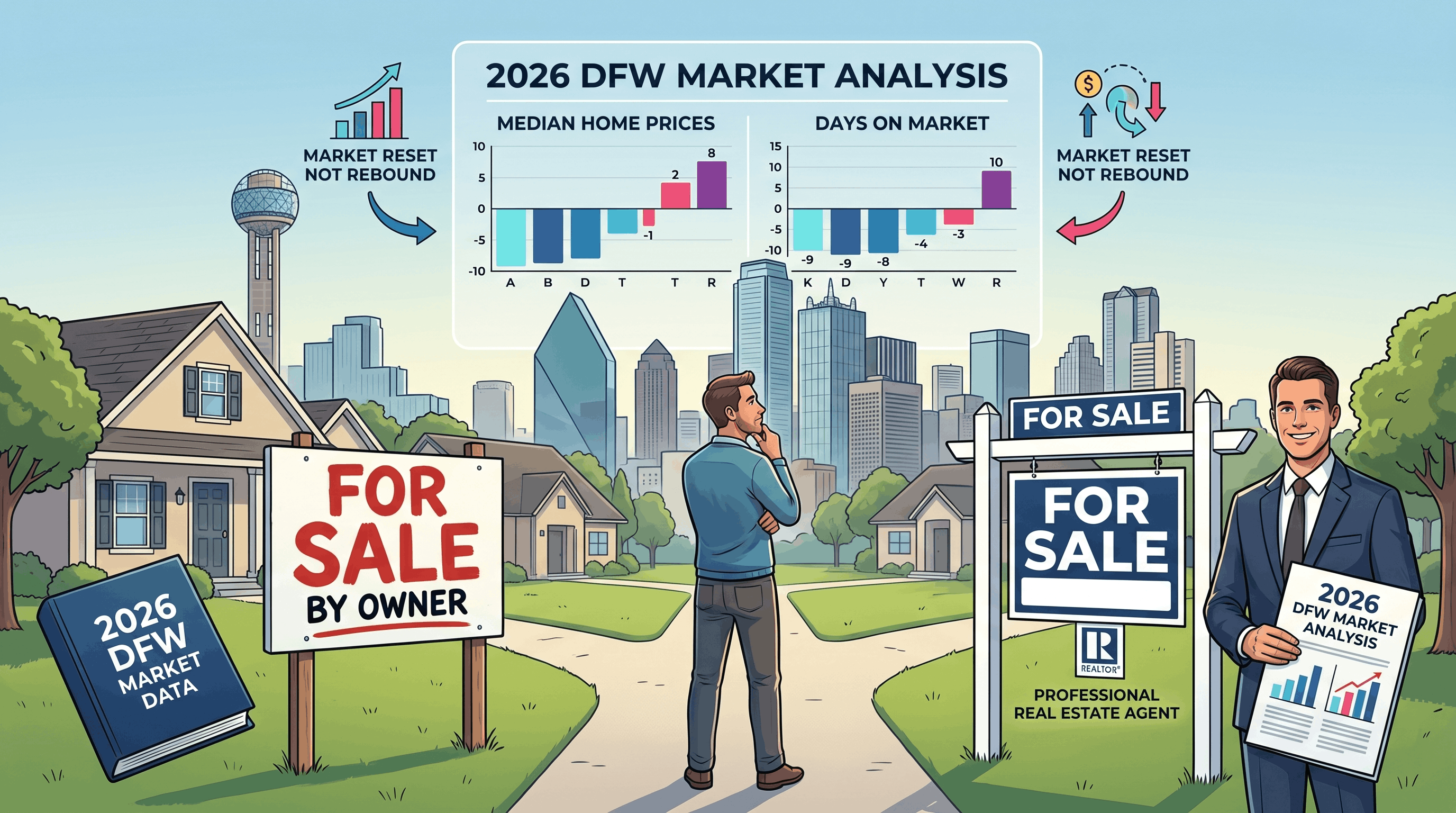
According to the NAR's 2025 Profile of Home Buyers and Sellers, the median FSBO home sold for $360,000 — compared to $425,000 for agent-assisted sales. That's an 18% gap. On a $400,000 home, that's $65,000 left on the table, even after accounting for the commission you saved. But that's not the whole story. The real question isn't whether you can sell FSBO — it's whether you should, given what's changed in the DFW market since 2024.
The Dallas-Fort Worth real estate landscape looks fundamentally different in 2026 than it did during the pandemic-era frenzy. Inventory has climbed. Buyers have options. The August 2024 NAR settlement rewrote the rules on how commissions are negotiated. And Texas property law has always been unforgiving to sellers who cut corners. If you're weighing FSBO against hiring a professional agent, this guide is designed to help you see the full picture — clearly, calmly, and without pressure.
Key Takeaways
- FSBO homes sell for an average of 18% less than agent-assisted homes — a $65,000 gap on a $400,000 property — despite sellers saving on listing commission.
- DFW housing inventory now sits at 3.5–5.4 months, meaning buyers have real options and sellers can no longer rely on scarcity to drive prices.
- The August 2024 NAR settlement changed how buyer's agent commissions work — FSBO sellers who mishandle this lose access to 88% of the buyer pool.
- Texas Property Code Section 5.008 requires disclosure of all known material defects regardless of "as-is" clauses — FSBO sellers who miss this face civil litigation under the DTPA.
- FSBO market share has fallen to an all-time low of 5% in 2025, down from 15% in the early 2000s.
- FSBO works in very limited circumstances — primarily when selling directly to a family member, neighbor, or known cash investor.
- Professional agents provide hyper-local CMA pricing, full MLS exposure, legal compliance, and negotiation defense that FSBO sellers simply cannot replicate.
The FSBO Myth: Why Saving Commission Costs You More
The appeal of selling your home without an agent is easy to understand. On a $400,000 home, a 2.5–3% listing commission is $10,000–$12,000. That's real money, and it's natural to wonder whether you could keep it. But the financial math only works if you assume the sale price stays the same. It doesn't.
The NAR's 2025 data is clear: agent-assisted homes sold for a median of $425,000 while FSBO homes sold for a median of $360,000. That's not a rounding error — that's $65,000. Even if you subtract a full 6% commission from the agent-assisted sale, the net proceeds still favor the agent-assisted seller by tens of thousands of dollars. The commission savings are real, but they're dwarfed by the price gap.
The Real Cost Breakdown: FSBO vs Agent-Assisted
Selling FSBO is not free. Here's what you actually pay out of pocket when you go the DIY route in the DFW market:
- Flat-fee MLS listing: To get your home onto the North Texas Real Estate Information Systems (NTREIS) MLS — which syndicates to Zillow, Realtor.com, and other platforms — you'll pay a flat-fee broker between $99 and $595.
- Professional photography: Buyers scroll listings on their phones. Blurry smartphone photos kill showings before they start. Professional real estate photography runs $150–$300 in DFW.
- Legal fees: Without an agent to draft TREC-compliant contracts, most FSBO sellers need a real estate attorney to review documents. Expect $500–$1,500 or more.
- Signage and marketing: Yard signs, social media ads, and open house materials add up quickly.
- Buyer's agent commission: Even as a FSBO seller, if a buyer comes with a buyer's agent — and 88% of buyers do — that agent will expect compensation, typically 2.5–3% of the sale price.
When you add all of this up and compare it against the lower sale price, the numbers rarely favor FSBO. Understanding how real estate agent commission rates work in the current market is the first step to making an honest financial comparison.
Why the $65,000 Price Gap Exists
The price gap between FSBO and agent-assisted sales isn't random. It has specific, predictable causes:
Limited buyer exposure. A flat-fee MLS listing puts your home on Zillow. A professional agent puts it in front of the entire broker network — including agents who have qualified buyers actively searching right now, before a listing even goes public. That difference in reach translates directly to competition, and competition drives price.
Pricing mistakes. Without a Comparative Market Analysis (CMA) built from neighborhood-specific data, FSBO sellers frequently misprice their homes by 5–15%. Zillow's research shows that homes priced just 10% above market value sit five times longer than accurately priced homes. Once a listing stagnates, buyers assume something is wrong and submit lowball offers.
Buyer hesitation. Buyers' agents — who represent 88% of all buyers — prefer working with licensed professionals. They know that FSBO transactions are more likely to involve non-standard contracts, disclosure gaps, and emotional sellers who make negotiations volatile. Many agents quietly steer their clients toward listings where the transaction is more likely to close cleanly.
Negotiation disadvantage. When you're emotionally attached to your home and negotiating directly with a buyer, the power dynamic shifts. Buyers and their agents are trained to find pressure points. FSBO sellers often accept lowball offers simply to end the stress.
"The commission savings are real. But they're almost always smaller than the price gap they create. Let's slow this down and look at the actual numbers for your home."
The 2026 DFW Market Has Changed Everything
The strategy that might have worked in 2021 — when homes in Roanoke and Keller were receiving 20 offers in 48 hours — will fail in 2026. The DFW market has fundamentally shifted, and that shift matters enormously to the FSBO vs. agent decision.
As of 2026, DFW housing inventory sits between 3.5 and 5.4 months, depending on the county and price point. A six-month supply is considered a balanced market. We're no longer in an extreme seller's market where scarcity did your marketing for you. Buyers have options, and they know it. If your home isn't priced correctly or marketed professionally, they will simply move on to the next listing.
The median home price in DFW has stabilized around $403,000–$418,000. Price appreciation has slowed significantly from the pandemic-era pace. And the median days on market has stretched to 36–50 days — with FSBO homes frequently exceeding that range. Understanding how to unlock maximum value from your home sale in this environment requires a different approach than it did three years ago.
Why Inventory Levels Matter to Your Sale
When inventory was at 0.5–1 month in 2021, buyers were desperate. They waived inspections, skipped appraisals, and paid over asking price without blinking. In that environment, even a poorly marketed FSBO home could attract offers because there was simply nothing else available.
At 3.5–5.4 months of inventory, that dynamic is gone. Sellers can no longer rely on scarcity to drive urgency. A buyer who tours your FSBO home and feels uncertain about the price, the condition, or the paperwork will simply schedule a showing at the new construction community down the street — where the builder is offering a rate buydown and $15,000 in closing cost assistance. That's the competition resale sellers face in 2026, and it makes professional marketing and accurate pricing essential, not optional.
The New Buyer Profile: Older, Cautious, and Agent-Dependent
The buyers shopping in DFW today are not the same buyers who were in the market in 2021. According to NAR's 2025 data, the median age of a first-time homebuyer has reached a record high of 40 years old. Repeat buyers average 62. These are mature, experienced people who expect professional, seamless transactions. They are not interested in navigating a FSBO seller's learning curve.
Eighty-eight percent of buyers use a real estate agent. Those agents have written buyer representation agreements that guarantee their clients a specific level of service — and those agents prefer working with listing agents who know the process, use the right forms, and respond professionally. When a buyer's agent calls a FSBO seller who doesn't know the difference between an option period and a contingency, the transaction often falls apart before it starts.
If you're curious about how buyers navigate the home search process, it's worth understanding just how agent-dependent the modern buyer experience has become — because that directly affects your sale.
The NAR Settlement: What Changed and Why It Matters for FSBO Sellers
In August 2024, the National Association of Realtors implemented a landmark settlement that fundamentally changed how buyer's agent commissions are structured. If you're considering selling FSBO in 2026, you need to understand this change — because it creates a specific trap that catches many FSBO sellers off guard.
Before the settlement, sellers typically offered a buyer's agent commission directly on the MLS — usually 2.5–3% of the sale price. That offer was visible to every agent in the system, and it created a clear financial incentive for buyer's agents to bring their clients to your listing. After the settlement, that practice was eliminated. Buyer's agent compensation can no longer be advertised on the MLS.
How the New Commission Structure Works
Here's what the new structure looks like in practice:
Listing agent commission is negotiated directly between the seller and their listing agent, typically 2.5–3% for full-service representation. This hasn't changed dramatically.
Buyer's agent compensation is now a separate negotiation. Buyers sign written agreements with their agents specifying the fee. Sellers can offer a "seller concession" to cover that fee — but they're not legally required to.
Here's the catch-22 for FSBO sellers: If you refuse to offer a seller concession to cover the buyer's agent fee, the buyer must pay their agent out of pocket. Most buyers cannot afford to do this after a down payment, closing costs, and moving expenses. So they skip your home and buy from a seller who is willing to negotiate.
If you do offer the concession, you're paying the buyer's agent anyway — which means your actual savings from going FSBO are reduced to just the listing agent commission you avoided. And you still don't have a listing agent protecting your interests, managing the paperwork, or defending your price during negotiations.
Professional agents navigate this complexity every day. They know how to structure concessions in a way that maximizes your net proceeds without alienating buyers. FSBO sellers who try to figure this out on their own often get it wrong in ways that cost them significantly. If you're working through how the new rules affect your specific situation, a no-pressure consultation with a TK Realty agent can walk you through exactly what the numbers look like for your home and timeline.
If you're trying to understand how the NAR settlement affects your specific sale, that's exactly what a consultation is designed to clarify. No pressure — just honest guidance on what the new rules mean for your timeline and proceeds.
Get a Free, No-Pressure ConsultationLegal Complexity: Texas Property Law and FSBO Risk
Texas real estate law does not offer grace periods for sellers who didn't know the rules. Whether you're a licensed professional or a homeowner selling on your own, you are held to the same legal standards. And those standards are stricter than most FSBO sellers realize.
This is the area where FSBO risk is highest — and where a single mistake can cost far more than any commission you saved. The difference between full-service and discount real estate representation becomes especially clear when you examine the legal protections a professional agent provides.
The Seller's Disclosure Trap
Under Texas Property Code Section 5.008, almost all residential home sellers must provide a written Seller's Disclosure Notice to the buyer. This requirement applies equally to FSBO sellers and agent-assisted sellers. There are no exceptions for sellers who "just want to move on" or who believe their home's condition is obvious.
You must disclose all known material defects: past foundation repairs, roof leaks, plumbing issues, HVAC problems, water intrusion, pest infestations, and more. The key word is "known" — you're not required to hire inspectors to discover new problems, but you cannot conceal problems you're already aware of.
Professional agents use the Texas REALTORS® Form 1406, which is far more comprehensive than the basic TREC Form 55-0. The more detailed disclosure actually protects the seller by creating a clear record of what was disclosed and when. FSBO sellers who use minimal forms or skip disclosures entirely are creating significant legal exposure.
MUD and PID Disclosures: A Common FSBO Mistake
If you're selling a home in DFW suburbs like Frisco, Prosper, Celina, Keller, or Roanoke, there's a high probability your property is located within a Municipal Utility District (MUD) or Public Improvement District (PID). These districts finance infrastructure through special assessments and bonds that are passed on to property owners.
Texas Water Code Chapter 49 requires sellers to provide specific statutory disclosure notices about these districts to the buyer before the contract is signed. This isn't a formality — it's a legal requirement with real consequences. If you miss this disclosure, the buyer has a legal right to terminate the contract and recover their earnest money, even after the option period has expired.
Licensed agents automatically generate these disclosures as part of the transaction process. FSBO sellers frequently don't know the disclosures exist until a buyer's attorney points out the omission — at which point the deal may already be falling apart.
Contract Forms and Legal Liability
Licensed agents in Texas are required to use TREC-promulgated contract forms, including the 1-4 Family Residential Contract. These forms are updated regularly by state attorneys to reflect current law. In early 2025, significant updates were made to reflect the NAR settlement's impact on broker compensation language.
FSBO sellers who download generic "Texas real estate contracts" from the internet are often working with outdated forms that miss critical provisions. If an earnest money dispute arises, if the option period is mishandled, or if a contingency is improperly drafted, the FSBO seller has no broker to mediate — and no E&O insurance to cover errors.
Licensed agents carry Errors and Omissions insurance. If a TK Realty agent makes a clerical error, there's a professional safety net. A FSBO seller operates without one. If you make an error on the disclosure or mishandle a contract contingency, you are personally and financially liable.
⚠️ Selling 'As-Is' Doesn't Mean You Don't Have to Disclose
Many FSBO sellers believe that listing a home "as-is" exempts them from Texas disclosure requirements. This is false and dangerous. Selling "as-is" means you won't make repairs — it does NOT exempt you from Texas Property Code Section 5.008, which requires disclosure of all known material defects regardless of the "as-is" clause. Failure to disclose can result in civil litigation and damages under the Texas Deceptive Trade Practices Act (DTPA), which can include actual damages, attorney's fees, and in some cases treble damages.
FSBO vs Professional Agent: Head-to-Head Comparison
Let's put the two approaches side by side across every dimension that matters to a DFW home seller in 2026. The data here is drawn from NAR's 2025 research, TREC records, and local DFW market analytics.
| Decision Factor | For Sale By Owner (FSBO) | Agent-Assisted Sale (TK Realty) |
|---|---|---|
| Net Proceeds | Lower. Median FSBO sale price is $65,000 less than agent-assisted (NAR 2025), despite saving on listing commission. | Higher. Accurate pricing and full market exposure drive up the final sale price and net proceeds. |
| Time on Market | Often longer. Mispricing and limited marketing cause listings to stagnate past the 50-day mark. | Faster. Professional marketing creates urgency and competition in the critical first week of listing. |
| Marketing Reach | Limited to flat-fee MLS, Zillow, yard signs, and personal social media. | Full MLS syndication, broker networks, professional photography, 3D tours, and targeted digital ads. |
| Legal Risk | Extremely high. Seller is personally liable for disclosure errors, MUD notices, and contract breaches. | Low. Agents use TREC-approved forms, ensure compliance, and carry E&O insurance. |
| Negotiation | Emotional and direct. Buyers view FSBO sellers as motivated and submit lowball offers accordingly. | Objective and strategic. Agents act as a buffer to secure the highest price and best terms. |
| Buyer's Agent Commission | Still applies in most cases. Refusing to offer a concession eliminates 88% of buyers. | Structured into the transaction professionally, with clear negotiation strategy. |
| Stress and Time | High. You manage every call, showing, document, and negotiation personally. | Low. The agent manages the entire transaction from listing to closing. |
| Best Used When... | Selling directly to a family member, neighbor, or known cash investor where no marketing is needed. | You want to maximize equity, ensure legal protection, and minimize personal stress. |
Why FSBO Market Share Is Collapsing
FSBO market share has fallen from roughly 15% in the early 2000s to an all-time historic low of 5% in 2025. That decline is not a coincidence — it reflects the growing complexity of real estate transactions and the growing awareness among sellers that DIY selling costs more than it saves.
The post-NAR settlement rules have made the commission structure more complex, not simpler. The legal disclosure requirements in Texas have not gotten more forgiving. And buyer expectations have shifted toward professional, seamless transactions. The combination of these factors has made FSBO increasingly impractical for the average homeowner.
Understanding what to look for when choosing a real estate agent in Roanoke, TX can help you see exactly what professional representation includes — and why it's worth the investment.
What Professional Agents Actually Do (Beyond Unlocking Doors)
The stereotype of a real estate agent as someone who unlocks doors and collects a check is outdated and inaccurate. Here's what a professional TK Realty listing agent actually does on your behalf:
- Hyper-local CMA pricing. Analyzing neighborhood-specific data — including comparable sales within the same school district zone, subdivision, and condition tier — to price your home perfectly on day one. This is not a Zillow estimate. It's a professional analysis that accounts for factors an algorithm cannot see.
- Professional marketing. Hiring photographers, creating 3D virtual tours, running targeted digital ad campaigns to buyers actively searching in your price range, and leveraging the broker's internal network to find buyers before the listing even goes public.
- Buyer screening. Vetting pre-approval letters from reputable local lenders before allowing buyers into your home. Not every pre-approval is equal — some are solid, some are not. Your agent knows the difference.
- Appraisal and inspection defense. When a buyer's inspector flags a minor issue, or when the home appraises below the contract price, a professional agent knows how to challenge the appraisal, negotiate repair credits, or restructure the deal without letting it collapse.
- Legal protection. Using TREC-approved forms, ensuring all required disclosures are complete, carrying E&O insurance, and having a broker available to mediate disputes if they arise.
If you want to understand the full scope of what professional representation includes, a conversation with a TK Realty agent is the clearest way to see how it applies to your specific home and situation.
💡 Every Day Your Home Sits Unsold Costs You Real Money
In DFW's current market, homes priced just 10% above market value sit five times longer than accurately priced homes. Every month of carrying costs — mortgage payments, property taxes (notoriously high in Texas), insurance, utilities, and HOA dues — adds up fast. A home that sits for 60+ days also develops a stigma: buyers start asking "What's wrong with it?" and submit lowball offers. Professional pricing on day one creates urgency and competition that a stale listing can never recover.
When FSBO Actually Makes Sense (And When It Doesn't)
Here's the honest answer: FSBO is not always wrong. There are specific, narrow circumstances where selling without an agent is a reasonable choice. Acknowledging that is important — because this decision needs to make sense for your situation, not for anyone else's.
The FSBO Sweet Spot: Direct Sales to Known Buyers
FSBO works best when marketing is unnecessary because you already have a buyer. The most common scenarios:
- Selling to a family member or close friend. If your adult child is buying your home, or your neighbor has been asking to buy your property for years, there's no need for MLS exposure, professional photography, or broker network outreach. The buyer is already identified.
- Selling to a cash investor who has already inspected. If a real estate investor has approached you directly, has done their due diligence, and is ready to close on a cash basis, the transaction is simpler. Investors expect to negotiate hard on price, but they also move quickly and don't require financing contingencies.
Even in these situations, consider hiring a real estate attorney to handle the contract and disclosures. The legal requirements don't disappear just because you know the buyer — and a real estate attorney typically costs $500–$1,500, which is far less than the cost of a disclosure lawsuit.
NAR's 2025 data supports this: a significant portion of FSBO sales — roughly 30–60% depending on the region — involve sellers who already knew the buyer before the transaction. When you remove those "known buyer" FSBO sales from the data, the financial case for FSBO in an open market becomes even weaker.
Why FSBO Fails in Today's DFW Market
Outside of the "known buyer" scenario, FSBO is a difficult path in 2026 DFW for four specific reasons:
- Balanced inventory means buyers have options. Your home must stand out on its own merits, priced correctly and marketed professionally. Scarcity is no longer doing the work for you.
- Mispricing is fatal. Without a professional CMA, FSBO sellers frequently misprice by 5–15%. In a market where buyers are cautious and rate-sensitive, even a 5% overpricing can mean 30+ extra days on market and a stigmatized listing.
- 88% of buyers use agents. Refusing to work cooperatively with buyer's agents — or mishandling the concession structure — eliminates the vast majority of your potential buyer pool.
- Legal complexity is too high. One disclosure error, one missing MUD notice, one outdated contract form — any of these can give the buyer grounds to terminate, recover earnest money, or pursue civil litigation.
For sellers who want to understand how the current market affects their specific neighborhood — whether that's Dallas, Fort Worth, or the surrounding suburbs — local market expertise matters more than it has in years.
We Understand the Temptation to Skip Disclosures (And Why You Shouldn't)
We understand the temptation: you're selling "as-is," the buyer is paying cash, or you just want to move on quickly. But skipping disclosures is the most expensive shortcut you can take. One undisclosed defect — a roof leak you knew about, a foundation repair you didn't mention — can trigger a lawsuit under the Texas Deceptive Trade Practices Act, resulting in damages that dwarf any commission you saved. Professional agents ensure compliance so you can close and move on without looking over your shoulder.
Wondering whether FSBO or an agent is right for your specific situation? That's a conversation worth having. We can walk you through the numbers and help you see what actually makes sense for your home and timeline — no pressure, no sales pitch.
Talk Through Your Options With a TK Realty AgentKey Statistics: The Data Behind the Decision
When millions of dollars in DFW real estate equity are shifting hands, the numbers tell the true story. Here are the verified statistics that define the 2026 market and the FSBO vs. agent decision:
- Sale price gap: Agent-assisted homes sell for a median of $425,000 vs. $360,000 for FSBO homes — an 18% difference, or $65,000 on a $400,000 property (NAR 2025 Profile of Home Buyers and Sellers).
- Buyer agent usage: 88% of buyers used a real estate agent in their purchase (NAR 2025). These agents have written buyer representation agreements and expect professional cooperation from sellers.
- Buyer age: The median first-time buyer is now 40 years old. Repeat buyers average 62. These are experienced, cautious buyers who expect seamless, professional transactions.
- Days on market: DFW median is 36–50 days. FSBO homes that are mispriced or poorly marketed frequently exceed this range, developing a stigma that triggers lowball offers.
- Seller satisfaction: 87% of sellers who used an agent said they would definitely or probably use that agent again (NAR 2025). That's an exceptionally high satisfaction rate for any professional service.
- Mispricing impact: Homes priced 10% above market value sit five times longer than accurately priced homes (Zillow research). In DFW, where carrying costs include high Texas property taxes, every additional month on market is a direct financial loss.
- FSBO seller challenges: Surveys consistently show that FSBO sellers struggle most with pricing correctly, understanding paperwork, selling within their desired timeframe, and preparing the home for sale.
If you want to know what your home is actually worth in today's DFW market — not a Zestimate, but a real professional analysis — a professional home valuation from TK Realty gives you the data you need to make a confident decision.
The decision to sell FSBO or hire an agent ultimately comes down to one question: Are you trying to save a commission, or are you trying to maximize what you walk away with? Those are not the same goal. And in 2026 DFW, the data is clear about which approach delivers better outcomes for the vast majority of sellers.
For sellers who are also thinking about what comes next — whether that means upsizing into a larger home or navigating the full process of moving up in the market — getting the sale right on your current home is the foundation everything else is built on.
Frequently Asked Questions About FSBO vs Agent-Assisted Sales
You're not legally required to pay a buyer's agent commission after the August 2024 NAR settlement. However, since 88% of buyers use an agent, those agents have written agreements with their buyers guaranteeing a specific fee. If you refuse to offer a seller concession to cover that fee, the buyer must pay their agent out of pocket — and most buyers simply cannot afford to do this on top of a down payment and closing costs. In practice, refusing to offer a buyer's agent concession eliminates the vast majority of your potential buyer pool. You end up paying the concession anyway, which means your actual savings from going FSBO are reduced to just the listing agent commission you avoided — without any of the professional protection a listing agent provides.
On paper, you save the 2.5–3% listing agent commission — roughly $10,000–$12,000 on a $400,000 home. But NAR's 2025 data shows that FSBO homes sell for a median of 18% less than agent-assisted homes, which is a $65,000 gap on a $400,000 property. After accounting for flat-fee MLS fees, professional photography, legal review, and the buyer's agent concession you'll almost certainly need to offer anyway, most FSBO sellers leave $40,000–$65,000 in equity on the table compared to what a professional agent would have delivered. The commission savings are real — they're just smaller than the price gap they create.
At minimum, you need the TREC Seller's Disclosure Notice (Form 55-0), a legally binding Residential Purchase Agreement (the TREC 1-4 Family Residential Contract), a Lead-Based Paint Addendum if the home was built before 1978, and all applicable HOA documents. If your property is in a Municipal Utility District (MUD) or Public Improvement District (PID) — which is common throughout DFW suburbs including Frisco, Prosper, Celina, and Keller — you must provide statutory water district notices to the buyer before the contract is signed. Missing any of these documents gives the buyer legal grounds to terminate the contract and recover their earnest money, even after the option period has passed. TREC forms are updated regularly, so using outdated forms downloaded from generic websites creates additional legal risk.
Yes, absolutely — and this is one of the most dangerous misconceptions among FSBO sellers. Selling a home "as-is" means you are stating upfront that you will not make repairs after the inspection. It does NOT exempt you from Texas Property Code Section 5.008, which requires you to disclose all known material defects to the buyer. If you know the roof leaks, the foundation was repaired, or there's a history of water intrusion, you must disclose it — regardless of the "as-is" clause in the contract. Failure to disclose known material defects can result in civil litigation under the Texas Deceptive Trade Practices Act (DTPA), which allows for actual damages, attorney's fees, and potentially treble damages. The "as-is" clause protects you from repair requests, not from disclosure obligations.
In DFW's current market, the median days on market is 36–50 days for agent-listed homes. FSBO homes frequently exceed this range because they lack the "launch momentum" that professional marketing creates in the critical first week — when a new listing gets the most attention and generates the most showings. A professional agent coordinates professional photography, broker open houses, targeted digital ads, and network outreach before the listing goes live, so the home hits the market with maximum exposure on day one. If a FSBO home is mispriced, it can sit for 60+ days or longer, at which point it develops a stigma that makes buyers suspicious and leads to lowball offers even after a price reduction.
Agents have a fiduciary duty to act in their client's best interest, and they cannot illegally steer clients based on FSBO status alone. However, buyer's agents are absolutely within their rights — and their professional responsibility — to advise clients about the risks of FSBO transactions: non-standard or outdated contracts, potential disclosure failures, and sellers who may be uncooperative or emotionally volatile in negotiations. Many buyer's agents warn their clients that FSBO transactions are statistically more volatile and more likely to fall apart before closing. This professional caution naturally reduces the number of showings FSBO homes receive, which further limits competition and suppresses the final sale price.
Ready to See What Your Home Is Actually Worth in Today's DFW Market?
You've done the research. You understand the numbers, the legal landscape, and what the 2026 DFW market actually looks like. Whether you're still weighing your options or ready to take the next step, we're here to help you make the decision that's right for your home and your timeline — not ours.
At TK Realty, we don't push. We explain, we listen, and we help you build a plan that makes sense. A free, no-pressure consultation is the clearest way to see what professional representation would actually mean for your bottom line.
Schedule a Free Consultation — No Pressure, No ObligationCheck out this article next