
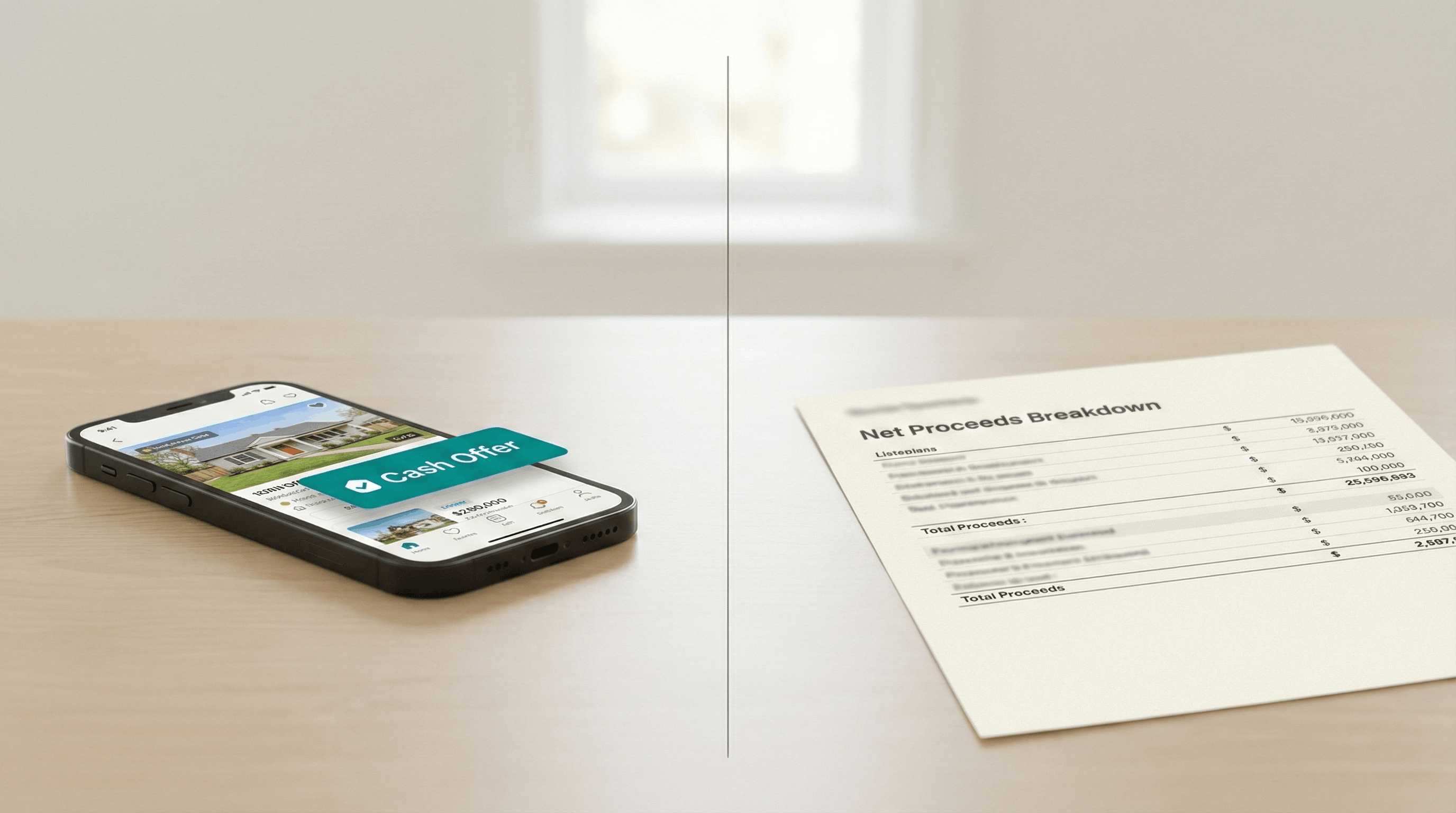
A few months ago, a family in Tarrant County reached out with what they thought was a simple question: "We got offers from Opendoor and Offerpad. Which one should we take?"
The Opendoor offer came in at $388,000. The Offerpad offer was $340,000. Same house. Same week. A $48,000 difference — and neither number was what the home was actually worth.
When we sat down and walked through the real math — service fees, closing costs, repair deductions, the works — the picture changed completely. The "higher" offer wasn't necessarily the better deal, and the "lower" offer definitely wasn't what it seemed.
That's not unusual. iBuyer cash offers are designed to move fast and feel simple. But simple and straightforward are two different things. The fees are real, the deductions add up, and the gap between what you're told upfront and what you actually walk away with can be tens of thousands of dollars.
So let's slow this down and look at the real numbers — Opendoor vs. Offerpad, side by side, with nothing hidden.
Key Takeaways
- Opendoor charges a 5% service fee. Offerpad charges up to 8%. But neither number tells the full story.
- Repair deductions after inspection can reduce your net proceeds by $7,000 to $40,000+ — and they're usually non-negotiable.
- On a $400,000 Tarrant County home, the total "convenience cost" can range from roughly break-even (Opendoor) to over $56,000 less than a traditional sale (Offerpad).
- Texas Senate Bill 1968 (effective January 2026) now requires written agreements before any agent — including iBuyer agents — shows you a home or submits an offer.
- A traditional listing with the right agent often nets the same or more than Opendoor — and significantly more than Offerpad.
- The best decision depends on your timeline and financial situation, not their marketing.
If you're here, you're already doing the right thing.
Searching "Opendoor vs Offerpad" means you got a cash offer — maybe two — and something felt off. Maybe the numbers seemed too good. Maybe you noticed the fees buried in the fine print. Maybe you just want to understand what you're actually agreeing to before you sign.
That instinct? It's worth trusting.
These companies spend millions on marketing that makes selling your home look as easy as booking a hotel room. And for some people, in some situations, a cash offer genuinely makes sense. But for most DFW homeowners, there's a significant gap between what's advertised and what you actually net — and that gap is what we're going to break down here.
No agenda. No pressure. Just the math.
What Is an iBuyer? The Plain-Language Version
An iBuyer — short for "instant buyer" — is a company that uses technology to make a cash offer on your home, usually within 24 hours. The pitch is simple: skip the showings, skip the repairs, skip the uncertainty of the open market. They buy your house directly, handle the logistics, and you move on.
The two biggest names in DFW right now are Opendoor and Offerpad. Both operate in Tarrant County and across the Metroplex. Both promise speed and convenience. And both charge for that convenience in ways that aren't always obvious at first glance.
Here's the important distinction most sellers miss: the "offer" you see on your screen is not your final number. It's a starting point. After you accept the initial range, the company schedules an inspection — either virtual or in-person — and that's when the deductions start. Repair credits, closing costs, and service fees all come off the top before you see a dime.
Think of it this way: the initial offer is the sticker price. What you actually walk away with is a different number entirely.
Opendoor: How It Works and What It Actually Costs
Opendoor is the larger of the two companies and operates in over 134 cities across the DFW Metroplex, including Roanoke, Fort Worth, Arlington, Keller, Southlake, and Grapevine. As of early 2026, they've undergone a significant strategic shift they're calling "Opendoor 2.0" — moving from a pure home-flipping model to what they describe as a digital real estate platform.
The Current Fee Structure
Service fee: 5% of the purchase price. This is their primary revenue line and is positioned as a direct replacement for the traditional real estate commission.
Closing costs: 1% to 3% of the sale price, covering title insurance, escrow fees, and recording fees. These are standard costs you'd pay in any sale, but they're on top of the 5% service fee.
Repair deductions: This is where the real cost often hides. After Opendoor's inspection — now often conducted via their "Key Agent" smartphone app or AI-driven virtual scoping — they'll issue a list of required repairs and deduct the estimated cost from your offer. Sellers report deductions ranging from $7,000 to $20,000+ on mid-market DFW homes.
What Sellers Often Miss
Opendoor's initial "offer range" is not a firm offer. It's an estimate. The final, binding offer comes after the inspection and repair assessment. Sellers in online forums consistently describe this as a "bait and switch" — not because it's illegal, but because the gap between the initial range and the final net proceeds can be $20,000 to $30,000 or more.
How the Process Works
- Submit your property details online. Opendoor's algorithm generates a preliminary offer range within 24 hours.
- Accept the initial range. If the numbers look reasonable, you move forward to the assessment phase.
- Property assessment. A "Key Agent" or virtual scoping tool evaluates your home's condition and identifies needed repairs.
- Receive your final offer. This includes the service fee, closing costs, and an itemized repair deduction. This is your real number.
- Choose your closing date. Opendoor offers a 10-to-60-day closing window, and you can pick the date that works for your timeline.
What's Changed in 2026
Opendoor has been working to rebuild trust after the FTC's 2022 complaint — which resulted in $62 million in refunds to sellers who were misled about potential savings. The company now operates under stricter disclosure requirements and has shifted toward an agent-integrated model where licensed real estate professionals conduct assessments rather than relying solely on algorithms.
Their financials tell an interesting story: revenue has declined significantly from peak levels (Q4 2025 revenue projected at $596 million, down 45% year-over-year), but the company's per-transaction economics have improved. They're not buying as many homes, but they're losing less money on each one. For sellers, this translates to tighter pricing — Opendoor is offering closer to fair market value than in previous years, but with more conservative repair deductions.
Offerpad: How It Works and What It Actually Costs
Offerpad operates in North Texas with a focus on suburban and Sunbelt markets. Their approach is different from Opendoor's tech-first model — Offerpad emphasizes a "human-AI hybrid" with their HomePro specialists conducting more hands-on assessments.
The Current Fee Structure
Service fee: Up to 8% of the purchase price. This is a significant increase from the 5% baseline they offered in earlier years and substantially higher than Opendoor's current rate. Offerpad justifies this premium through included perks like a free local move.
Closing costs: 1% to 3%, similar to Opendoor and standard for any transaction.
Repair deductions: This is where Offerpad's costs can escalate dramatically. Sellers have reported deductions of $15,000 to $40,000+ on mid-market properties — often significantly higher than Opendoor's estimates for the same home. One widely cited case involved a seller receiving a $40,000 repair deduction from Offerpad versus a $7,000 deduction from Opendoor on the same property.
Cancellation fee: Offerpad charges a 1% cancellation fee if you back out after a specific point in the process (typically 4 days before closing). Opendoor generally does not charge a formal cancellation fee, though their acceptance criteria have tightened.
The 8% Fee in Context
At 8%, Offerpad's service fee alone exceeds the average total commission on a traditional Texas home sale (5.85%). When you add closing costs and repair deductions, the total transaction cost can approach 15% to 20% of your home's value. On a $400,000 home, that's $60,000 to $80,000 in total costs — before accounting for any below-market offer price.
How the Process Works
- Request an offer online. Offerpad combines algorithm recommendations with their HomePro team to generate a preliminary offer within 24 hours.
- Schedule a HomePro assessment. Unlike Opendoor's increasingly virtual approach, Offerpad often sends a specialist to your home in person.
- Receive your final offer. Includes service fee, closing costs, and itemized repairs.
- Choose your closing window. Offerpad offers an 8-to-90-day range — broader than Opendoor's — plus a free local move within 50 miles and a 3-day extended stay after closing.
The Perks That Offset (Some of) the Cost
Offerpad's higher fee comes with logistical benefits that matter to some families. The free local move can save $2,000 to $5,000 depending on your situation. The 3-day post-closing extended stay eliminates the stressful same-day move that many sellers dread. And their Trade-In program lets you make an offer on your next home before your current one closes.
Whether those perks are worth the fee difference depends entirely on your situation. For a family relocating with kids mid-school-year, the logistical support could be valuable. For a homeowner with flexibility and time, it's an expensive convenience.
Opendoor vs. Offerpad: The Side-by-Side Comparison
Here's what both companies look like when you put them next to each other — and next to a traditional listing with a full-service agent.
| Feature | Opendoor | Offerpad | Traditional Listing |
|---|---|---|---|
| Service Fee / Commission | 5.0% | Up to 8.0% | 5.85% (Texas avg.) |
| Closing Costs | 1% – 3% | 1% – 3% | ~3.54% |
| Repair Deductions | AI/agent-estimated | HomePro-estimated | Negotiated with buyer |
| Offer Timeline | 24 hours | 24 hours | Varies (days to weeks) |
| Closing Window | 10 – 60 days | 8 – 90 days | 30 – 60 days (typical) |
| Cancellation Fee | None (generally) | 1% (after deadline) | Varies by contract |
| Free Move | No | Yes (within 50 miles) | No |
| Extended Stay | Flexible closing date | 3 days post-closing | Negotiable |
| Inspection Method | Virtual/AI + Key Agent | HomePro in-person | Buyer's inspector |
| Negotiation Room | Minimal | Minimal | Full negotiation |
| DFW Presence | 134+ cities | North Texas suburbs | Market-wide |
The Real Math: A $400,000 Tarrant County Home
This is the section that changes the conversation. Let's take a home at $400,000 fair market value — close to the Tarrant County median — and show exactly what a seller would net through each path.
Why This Matters
When you see a cash offer, it's natural to compare that number to what you think your home is worth. But the real comparison isn't offer price vs. market value. It's net proceeds vs. net proceeds — what actually lands in your bank account after every fee, deduction, and cost is accounted for.
| Cost Element | Traditional Listing | Opendoor (5% Fee) | Offerpad (8% Fee) |
|---|---|---|---|
| Fair Market Value | $400,000 | $400,000 | $400,000 |
| Actual Offer Price | $400,000 | $388,000 (97% FMV) | $340,000 (85% FMV) |
| Service Fee / Commission | $23,400 (5.85%) | $19,400 (5.0%) | $27,200 (8.0%) |
| Closing Costs | $14,160 (3.54%) | $7,760 (2.0% est.) | $6,800 (2.0% est.) |
| Repair Deductions | $5,000 (negotiated) | $12,000 (deducted) | $15,000 (deducted) |
| Seller Concessions | $8,000 (2% avg.) | $0 | $0 |
| Staging / Prep Costs | $2,000 | $0 | $0 |
| Estimated Net Proceeds | $347,440 | $348,840 | $291,000 |
Let those numbers settle for a moment.
In this scenario, Opendoor's net proceeds ($348,840) are roughly comparable to a traditional listing ($347,440) — the elimination of seller concessions and staging costs offsets the slightly below-market offer. That's the strongest case for an iBuyer: when the offer is close to market value, the speed and certainty can make the math work.
But Offerpad's net proceeds ($291,000) leave over $56,000 on the table compared to a traditional sale. That's not a rounding error. On a median-priced Tarrant County home, that's more than a year of property taxes, insurance, and maintenance combined.
The Key Variable: Offer-to-Market-Value Ratio
The single biggest factor in whether an iBuyer sale makes financial sense is how close their offer is to your home's actual fair market value. Opendoor has been offering in the 95%–97% range in many DFW transactions. Offerpad's offers have been reported as low as 85% of FMV in some cases. That 10–12 percentage point difference alone accounts for $40,000–$48,000 on a $400,000 home — before fees even enter the equation.
This is exactly why getting an independent home valuation before accepting any cash offer is so important. You need to know what your home is actually worth to evaluate whether the offer you're looking at is reasonable.
The "Bait and Switch" Problem: Initial Offer vs. Final Net
The most common complaint about both Opendoor and Offerpad — across Reddit, the BBB, Trustpilot, and consumer forums — centers on the same issue: the number you see first is not the number you get.
Here's the typical pattern. You enter your address online. Within 24 hours, you get an "offer range" or "preliminary estimate" that looks promising. For a home worth $400,000, you might see a range of $380,000 to $420,000. You get excited. You start planning.
Then comes the inspection. And the repair deductions. And the service fee. And the closing costs. And suddenly that $400,000 range has become $348,000 — or $291,000.
What Consumer Reviews Actually Say
Opendoor currently holds a 4.2 out of 5 aggregate rating across platforms. The positive reviews consistently praise the speed and simplicity. The negative reviews almost universally cite repair cost overestimates — sellers feeling that the deductions were inflated beyond what the repairs would actually cost.
Offerpad holds a 3.9 out of 5, with positive reviews highlighting the moving perks and friendly staff. Negative reviews focus on steep repair deductions and what many sellers describe as "lowball" final offers that bear little resemblance to the initial estimate.
On platforms like Trustpilot and the BBB, where consumers are more likely to file complaints, ratings drop to the 1.7 to 3.7 range for both companies.
Repair Deductions: Non-Negotiable by Design
In a traditional sale, you can negotiate repair credits with the buyer, get competing contractor bids, or offer a reduced price instead of making repairs. With an iBuyer, the repair deduction is essentially take-it-or-leave-it. The company's internal renovation team estimates costs based on their own standards — and those standards are designed to bring the home to "market-ready" condition that minimizes their holding time, not necessarily to address only genuine deficiencies.
Other Common Friction Points
Beyond the headline fee issues, sellers report frustration with logistical requirements that add stress to the process.
Closing day photo evidence: Some sellers are required to submit photos proving the home is fully vacated by midnight before the closing date — a stressful task when you're managing a move.
Funding timing: Despite the "cash" label, wire transfers don't always arrive first thing. Some sellers report funds not clearing until late in the day or even the following business day, which can disrupt a simultaneous purchase.
Repetitive documentation: Sellers have flagged being asked for the same information multiple times — HOA details, property disclosures, utility information — creating a process that feels less "streamlined" than advertised.
What About Texas Property Taxes? The Cost Most Sellers Forget
Texas has no state income tax, which is great — until you see the property tax bill. The average effective property tax rate in Texas is 1.74%, ranking it 7th highest in the nation. In an iBuyer transaction, these taxes are prorated to the exact day of sale. But there's a less obvious cost that catches many sellers off guard.
The Homestead Exemption Trap
If you live in your home as your primary residence, you benefit from Texas's homestead exemption, which caps your property's assessed valuation increase at 10% per year. This can mean your assessed value is significantly lower than the actual market value — saving you thousands annually in taxes.
When you sell to an iBuyer, that exemption disappears. The property gets reassessed at its full market value for the following year. While this doesn't cost you directly (you've already sold), it's worth understanding because:
Why This Matters for Your Decision
If you're buying another home in Texas: Your new property won't have the benefit of years of capped appreciation. Your first-year tax bill could be substantially higher than you're used to paying.
If you're concerned about your neighborhood: When iBuyers purchase homes and reassess at full market value, it can trigger reassessment pressure on surrounding properties, potentially raising your neighbors' taxes.
If you're closing in Q1: Property tax proration in early January through March is based on the previous year's tax bill, since the current year's rates haven't been set yet. Make sure your contract includes a tax proration agreement to account for any supplemental bills once the county finalizes the actual rate.
These aren't reasons to avoid an iBuyer outright. But they're costs that don't show up on the fee comparison chart — and they should be part of your total calculation. Understanding what your home is actually worth in today's market is the starting point. You can get a free home valuation here to see where you stand.
Texas Senate Bill 1968: What Changed for Sellers in 2026
Effective January 1, 2026, Senate Bill 1968 made significant changes to the Texas Real Estate License Act (TRELA) that directly affect how iBuyers operate in the state. If you're considering selling to Opendoor or Offerpad, here's what you need to know.
Mandatory Written Agreements
Under SB 1968, any licensed real estate agent — including agents working for Opendoor or Offerpad — must now enter into a written agreement with a prospective buyer before showing a home or submitting an offer. This means the days of "unrepresented" browsing through iBuyer apps are over. The agreement must clearly state that compensation is negotiable and is not set by law.
Elimination of Subagency
The bill repeals references to subagency in Texas real estate law, ensuring that consumers understand from the start who represents their interests. In practice, this means the iBuyer's agent is clearly working for the company — not for you.
What This Means for You
These changes are designed to protect sellers by increasing transparency. Before SB 1968, it wasn't always clear where the iBuyer's interests ended and yours began. Now, the lines are drawn more clearly from the outset.
The practical takeaway: you should have your own representation when evaluating an iBuyer offer. The company's agent is working for the company. Their job is to acquire your home at a price that makes sense for their business model. Your job is to make sure the transaction makes sense for you.
If you want to understand more about how commissions and agent representation work in Texas, we've broken that down in detail.
Other Options Worth Knowing About
Opendoor and Offerpad aren't your only options if you're looking for speed or cash certainty. The 2026 DFW market has several alternatives that attempt to bridge the gap between a fast cash sale and a full open-market listing.
Bridge Providers: Buy Before You Sell
Knock offers bridge financing at a 2.25% fee, letting you buy your next home before selling your current one — no home-sale contingency required. Homeward provides an upfront cash offer (up to 88% of FMV) while allowing you to keep the upside from an eventual open-market sale, though their service fee can run up to 7%. Orchard offers equity advances to tap into your home's value before the sale closes.
These models work well for families who need to move but don't want to accept a steep discount on their current home.
Cash Offer Marketplaces
HomeLight's Simple Sale and similar platforms connect you with a network of local cash investors. These offers typically range from 50% to 70% of market value and are best suited for homes in significantly worse condition than what Opendoor or Offerpad will accept.
Traditional Listing with a Full-Service Agent
For most DFW homeowners with a home in good condition and a reasonable timeline, a traditional listing still nets the highest proceeds. The current Tarrant County market has a 3.5-month supply of inventory — the highest since 2022, which means there are more homes available, but well-priced properties in strong neighborhoods still move.
The trade-off is time and effort: showings, staging, negotiation, and a 30-to-60-day closing process. Whether that trade-off is worth $20,000 to $56,000 in additional net proceeds depends entirely on your situation.
If you're weighing the differences between full-service and discount agent models, we've covered that comparison in depth.
| Alternative | Best For | Typical Fee |
|---|---|---|
| Knock | Buying before selling | 2.25% + loan costs |
| Homeward | Cash certainty + open-market upside | 1% – 7% |
| Orchard | Equity access for downsizers | Standard commission |
| HomeLight Simple Sale | Distressed or as-is properties | Variable / negotiated |
| Traditional MLS Listing | Maximizing net proceeds | 5.85% commission (TX avg.) |
When an iBuyer Cash Offer Actually Makes Sense
We're not here to tell you that iBuyers are always a bad deal. That wouldn't be honest, and it wouldn't be helpful. There are real situations where the speed, certainty, and simplicity of a cash offer are worth the cost.
An iBuyer Might Be Worth It If:
You're relocating on a tight corporate timeline and need to close within 30 days with no contingencies.
You're going through a divorce and both parties want a clean, fast exit from the property.
You've inherited a home you don't live in and can't manage remotely — especially if it needs work you don't want to oversee.
Your home needs significant repairs and you don't have the cash or energy to bring it to market-ready condition.
You've already purchased your next home and carrying two mortgages is costing you more per month than the iBuyer discount.
The offer is genuinely close to market value. If Opendoor offers 97% of FMV with modest repair deductions, the math can work out to be comparable to a traditional sale.
In each of these cases, the "convenience cost" isn't just about money — it's about stress, time, and mental bandwidth. Those are real costs, even if they don't show up on a closing statement.
When an iBuyer Doesn't Make Sense
For most DFW homeowners — especially those with homes in good condition, reasonable equity, and a flexible timeline — the math almost always favors a traditional sale.
If your home is well-maintained, properly priced, and in a desirable Tarrant County neighborhood, you're giving away equity for convenience you may not actually need. The average time on market for a well-priced home in Fort Worth and surrounding areas is still manageable — and every dollar saved on iBuyer fees is a dollar that goes toward your next move.
Here's the honest question to ask yourself: Is the convenience worth $20,000 to $56,000?
For some people, the answer is yes. For most, when they see the actual numbers, the answer changes.
The DFW Market in 2026: What Sellers Should Know
Understanding where the local market stands helps put the iBuyer decision in context.
The DFW market in early 2026 is what analysts call "balanced but uneven." Inventory has risen to 3.5 months in Tarrant County — the highest since 2022 — which gives buyers more options and reduces the urgency that characterized the 2021–2022 frenzy.
For sellers, this means pricing strategy matters more than ever. A well-priced home in a strong neighborhood still sells. An overpriced home sits. And an iBuyer offer, in this environment, may look more appealing if your home has been on the market for weeks without strong interest.
Rising insurance costs (up 11% year-over-year) and property taxes create additional carrying costs that make speed attractive. But "attractive" and "financially optimal" aren't always the same thing. If you're not sure where your home falls in the current market, the best starting point is understanding its actual value — not the number an algorithm generates. Explore the areas we serve to get a feel for what's happening in your specific neighborhood.
Take Your Time — This Decision Deserves It
There's a reason iBuyer marketing emphasizes speed. When you feel like you need to decide now, you're less likely to run the numbers, compare your options, or talk to someone who isn't trying to buy your house.
But here's the thing: you don't have to decide today.
The Opendoor offer will still be there tomorrow. The Offerpad offer isn't expiring tonight. And your home isn't losing value because you took a week to make sure you're making the right move.
Before You Accept Any Cash Offer, Do This:
- Get an independent home valuation — not from the company trying to buy your house
- Calculate your true net proceeds for each option (use the table above as a template)
- Ask for an itemized repair deduction list and get a second opinion on the estimated costs
- Read the contract carefully — especially cancellation terms and proration clauses
- Understand what happens to your homestead exemption and future tax liability
- Compare the iBuyer offer against what a traditional listing would realistically net
- Talk to an agent who isn't connected to the iBuyer — someone who can give you unbiased guidance
- Give yourself at least a week before making a final decision
Real estate decisions should feel calm, informed, and confident. Never rushed. If you're feeling pressure to move fast, that's a sign to slow down — not speed up.
Frequently Asked Questions
How much does Opendoor charge in fees?
Opendoor charges a 5% service fee on the sale price, plus 1% to 3% in closing costs. However, the total cost often includes repair deductions that can add $7,000 to $20,000+ to the transaction expenses, depending on the home's condition. The all-in cost typically ranges from 8% to 12% of your home's value.
How much does Offerpad charge in fees?
Offerpad charges a service fee of up to 8%, plus 1% to 3% in closing costs. Repair deductions can add $15,000 to $40,000+ on mid-market properties. When combined with the company's typically lower offer-to-market-value ratio (reported as low as 85% of FMV), total costs can reach 15% to 20% of your home's value. Offerpad also charges a 1% cancellation fee if you back out close to closing.
Do iBuyers pay fair market value for homes?
Generally, no. iBuyers build a "liquidity discount" into their offers because they're taking on the risk of reselling your home. Opendoor has been offering in the 95%–97% of FMV range in many DFW transactions, while Offerpad's offers have been reported as low as 85% of FMV. The discount varies based on market conditions, the company's inventory goals, and your home's characteristics.
Can I negotiate an iBuyer's repair deduction?
In most cases, no. iBuyer repair deductions are largely take-it-or-leave-it. Unlike a traditional sale where you can get competing contractor bids, negotiate a reduced credit, or offer a price reduction instead of repairs, the iBuyer's deduction is based on their internal renovation estimates. Your main negotiating power is the ability to walk away — which is why it's so important to know your home's true value before entering the process.
What is Senate Bill 1968 and how does it affect selling my home?
Texas Senate Bill 1968, effective January 1, 2026, updated the Texas Real Estate License Act to require written agreements between agents and buyers before showing a home or submitting an offer. It also eliminated subagency, making it clearer who represents whom in a transaction. For sellers dealing with iBuyers, this means the company's agent must now have a formal agreement in place — and that agreement should make clear that the agent represents the company, not you. It's one more reason to have your own representation.
Is selling to Opendoor or Offerpad worth it in DFW?
It depends entirely on your situation. If you need to sell quickly due to relocation, divorce, or financial pressure — and the offer is reasonably close to market value — the speed and certainty can be worth the cost. But for most DFW homeowners with homes in good condition and a flexible timeline, a traditional listing typically nets $20,000 to $56,000 more in proceeds on a $400,000 home. The right move is to compare your actual net proceeds across all options before committing.
What are alternatives to Opendoor and Offerpad in Texas?
Several alternatives exist in the DFW market. Bridge providers like Knock (2.25% fee) and Homeward (up to 7%) let you buy before you sell. HomeLight's Simple Sale connects you with local cash investors for distressed properties. And a traditional listing with a full-service agent remains the highest-net-proceeds option for homes in good condition. You can also explore TK Realty's seller resources to see what options make sense for your specific situation.
Not Sure Which Path Makes Sense for Your Situation?
If you've got a cash offer sitting in your inbox — or you're thinking about requesting one — let's look at the numbers together. We'll run a side-by-side net proceeds comparison based on your actual home value, not an algorithm's estimate. No pressure, no pitch. Just clarity.
Schedule a Conversation Get Your Free Home ValuationRelated resources: Real Estate Agent Commission Rates in Roanoke, Texas · Things You Shouldn't Do When Buying a Home · Seller Resources · Mortgage Calculator
Check out this article next