
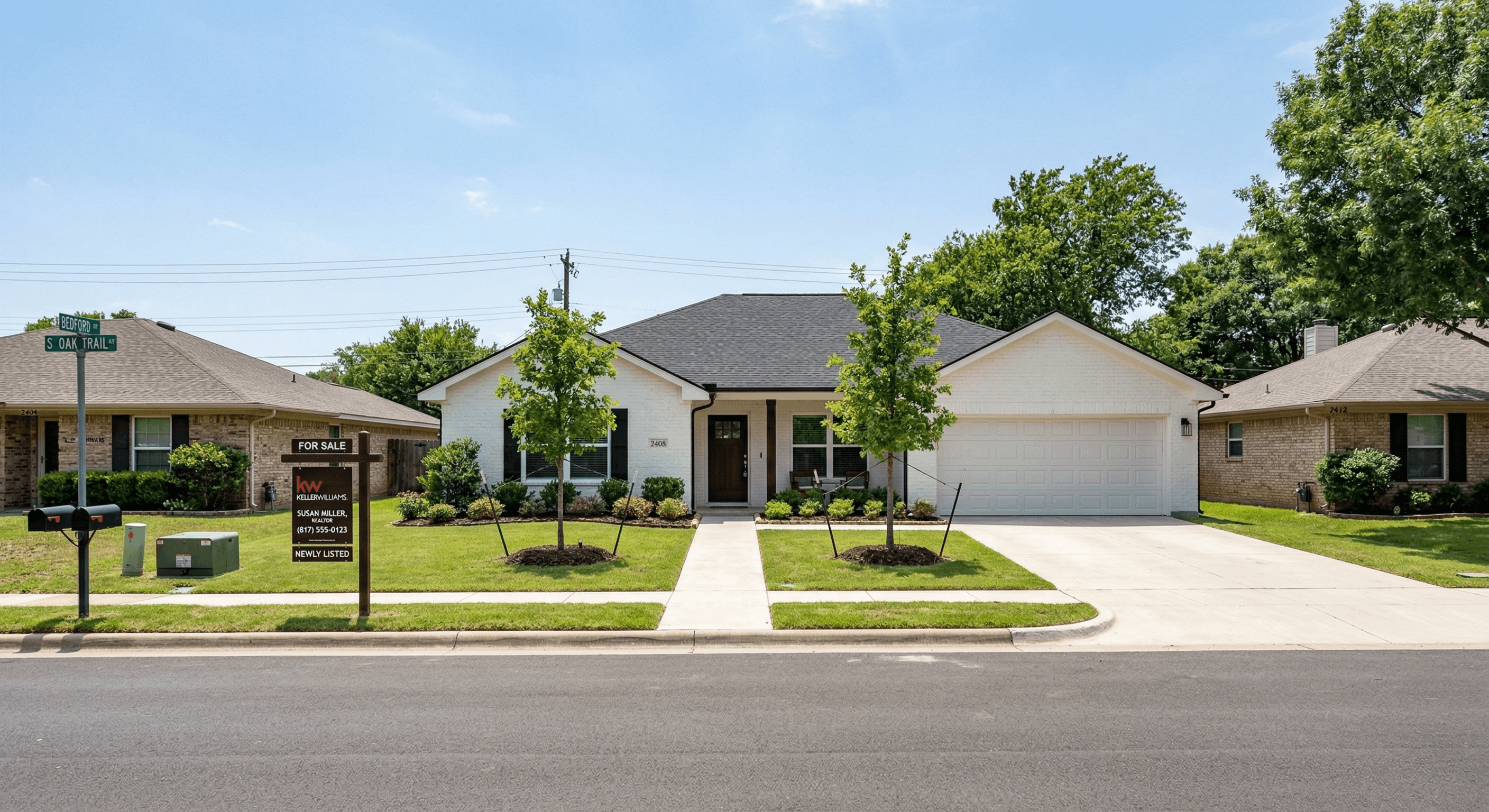
You've seen the headlines about DFW real estate prices. Maybe you've watched friends get outbid, heard stories about homes going $50K over asking, or spent a few too many evenings scrolling through listings that seem just out of reach. The pressure is real. But here's what most people miss: there are still solid neighborhoods where you can find a home for under $500K — if you know where to look and what actually matters.
This isn't a list of compromises. It's a practical, honest guide to the DFW neighborhoods that offer genuine value, strong communities, and real homes — not just what's left over after everyone else has picked through the market. Whether you're a first-time buyer trying to figure out where to start, a growing family weighing schools and space, or someone who's been renting and finally ready to make a move, this guide is for you.
Let's slow this down and look at what's actually available — and what you need to know before you decide.
Key Takeaways: Homes for Less Than $500K in DFW
- $500K is a meaningful threshold in DFW — it opens doors to established neighborhoods with good bones, not just distant suburbs or fixer-uppers
- North Dallas neighborhoods like Plano, Richardson, and parts of Frisco offer strong schools and consistent appreciation within this budget
- East Dallas and Lakewood appeal to buyers who value walkability, character, and community identity over square footage
- Fort Worth typically offers 20-30% more home for the same price as Dallas — and it has its own distinct identity worth considering
- Suburban options like Arlington, Irving, and Carrollton provide more space and newer construction, but commute time is a real trade-off
- Property taxes, flood risk, and neighborhood trajectory matter as much as the listing price — don't skip the due diligence
- The right neighborhood is the one that fits your actual life, not the one that sounds best on paper
Why $500K Matters in DFW Right Now
Before we get into specific neighborhoods, it's worth understanding what $500K actually means in the current DFW market — because context changes everything. If you're going to make a smart decision, you need facts, not fear. Understanding how the DFW market actually works is the foundation for making a choice you'll feel good about five years from now.
The DFW median home price has hovered around $425,000, which means $500K puts you slightly above the median. That's not a small thing. It means you're not scraping the bottom of the market or fighting over entry-level inventory. You have real options — established neighborhoods, multiple bedrooms, and in many cases, homes that have already been updated and are move-in ready.
What $500K Actually Gets You in DFW
In practical terms, $500K in DFW typically gets you somewhere between 2,000 and 3,500 square feet, depending on the neighborhood and the age of the home. In North Dallas suburbs like Plano or Richardson, you're looking at the higher end of that range — established homes built in the 1990s or early 2000s with updated kitchens, good school districts, and mature landscaping. In East Dallas or Lakewood, you might be looking at something smaller and older, but with character and a walkability score that newer suburbs can't match. In Fort Worth, that same $500K stretches noticeably further.
Most homes in this price range are 15 to 30 years old. That's not a negative — it means the neighborhood is established, the trees are grown, and the infrastructure is proven. It also means you should budget for eventual updates to HVAC systems, roofing, or plumbing, depending on when those systems were last serviced. We'll talk more about inspections later, because this is where a lot of buyers get surprised.
How This Price Point Compares to DFW Averages
Being slightly above the median price in DFW gives you a meaningful advantage: you're not competing in the ultra-premium market where cash buyers and corporate investors dominate, but you're also not limited to neighborhoods that require significant renovation before they're livable. At $500K, you have flexibility. You can compare multiple desirable neighborhoods, weigh trade-offs honestly, and take the time to find the right fit — rather than grabbing whatever you can afford before someone else does.
That flexibility is worth protecting. The worst thing you can do is let urgency drive a decision that should be driven by clarity. There's no rush if it's not the right move.
You're Right to Feel Overwhelmed
DFW has hundreds of neighborhoods and thousands of homes under $500K. Feeling confused about where to start is completely normal. The good news: you don't have to figure this out alone. This guide is designed to give you a clear framework — not more noise to sort through.
The North Dallas Sweet Spot: Plano, Frisco & Richardson
If you ask most DFW buyers where they want to live, North Dallas neighborhoods come up almost immediately — and for good reason. The combination of excellent schools, established infrastructure, and consistent long-term appreciation makes this corridor one of the most reliable places to buy in the entire metroplex. The key is knowing which pockets of these neighborhoods still offer homes under $500K, and what you're actually getting when you buy there.
The best decisions here come from building real relationships before discussing transactions — meaning, understanding what the community actually feels like before you commit to a 30-year mortgage in it. Drive through on a Saturday. Walk to the nearest coffee shop. Talk to people. The data only tells part of the story.
Plano: Established Neighborhoods with Strong Schools
Plano is one of the most consistently desirable cities in DFW, and for buyers under $500K, there are still real opportunities — particularly in established neighborhoods like Lakeside, Willow Bend, and Ridgeview Ranch. These aren't starter neighborhoods; they're mature communities with good bones, tree-lined streets, and the kind of stability that comes from decades of owner-occupancy.
The Plano Independent School District (PISD) is one of the strongest in Texas, which drives consistent demand and helps protect home values over time. For families with children, this is a legitimate draw — not just marketing language. The commute to Dallas is reasonable, and the tech corridor along the 121 and 75 corridors means that many buyers in Plano work within 20 minutes of home. That's a quality-of-life factor that's easy to underestimate until you're living it.
At the $500K price point in Plano, expect homes built in the 1990s to early 2000s, typically 3-4 bedrooms, with updated kitchens or bathrooms in many cases. Competition can be real in this range, so being prepared with financing and a clear sense of your priorities matters.
Richardson: Underrated and Underpriced
Richardson is one of the most consistently undervalued cities in the DFW area, and buyers who overlook it in favor of Plano often end up paying more for a comparable home. The Richardson Independent School District (RISD) is strong — genuinely strong, not just "good for the price" strong — and the established neighborhoods like Cottonwood Valley offer the kind of mature, settled feel that takes decades to develop.
What makes Richardson particularly interesting under $500K is the mix of residents. You'll find long-term homeowners who've been there for 20+ years alongside younger families who discovered the neighborhood recently. That mix creates community stability that's harder to quantify but easy to feel when you spend time there.
Richardson also benefits from its proximity to UT Dallas and the Telecom Corridor, which keeps demand steady and supports long-term appreciation. If you're comparing Plano and Richardson at similar price points, Richardson often gives you more home for the money — and the quality difference is smaller than the price difference suggests.
Frisco: The Older Sections Near Legacy
Frisco has become one of the most talked-about cities in DFW — and one of the most expensive. New construction in Frisco routinely pushes well past $600K-$700K, which puts much of the city out of range for buyers under $500K. But the older sections of Frisco, particularly neighborhoods built in the 1990s and early 2000s near the Legacy corridor, still offer opportunities.
Areas like Stonebriar and neighborhoods along the Coppell border have homes that were built before Frisco's explosive growth — which means they're more affordable but still benefit from the city's excellent infrastructure, top-rated Frisco ISD schools, and proximity to major employers and amenities. Expect to be at the higher end of your $500K budget here, and expect competition. But if Frisco is where you want to be, the older sections are where the value lives.
Trying to narrow down between Plano, Richardson, and Frisco — and not sure which one actually fits your situation? That's exactly the kind of conversation worth having before you start touring homes.
Let's talk about your neighborhood prioritiesEast Dallas & Lakewood: Character Homes with Walkability
Not every buyer is looking for a newer suburban home with a three-car garage and a neighborhood pool. Some buyers want something different — a home with history, a street with trees that have been growing for 60 years, a neighborhood where you can walk to a restaurant on a Tuesday night without getting in your car. East Dallas and Lakewood are for those buyers.
These neighborhoods require a different mindset than the North Dallas suburbs. The homes are older, the lots are smaller, and the competition can be fierce even at the $500K price point. But the reward is a sense of place that newer developments simply can't replicate. The key is moving at your own pace, not the market's pace — character homes require patience to find the right one, and rushing leads to expensive surprises.
Lakewood: The Gold Standard of Established Dallas
Lakewood is one of Dallas's most beloved and most competitive neighborhoods. The tree-lined streets, the 1920s-1950s architecture, the proximity to White Rock Lake, and the strong neighborhood identity make it consistently desirable — and consistently expensive. Under $500K in Lakewood, you're typically looking at smaller homes that may need updates, or homes on the edges of the neighborhood rather than the prime streets.
That said, even a smaller Lakewood home in need of updates represents a fundamentally sound investment in location. The neighborhood has appreciated steadily for decades and shows no signs of slowing. If you're willing to put in some work — or budget for renovations — Lakewood under $500K can be a genuinely smart move. Just be prepared for multiple offers, quick timelines, and the reality that you may lose a few before you win one.
East Dallas Neighborhoods: Knox-Henderson, Swiss Avenue, Munger Place
East Dallas is a broad category that covers everything from the eclectic energy of Knox-Henderson to the historic grandeur of Swiss Avenue and Munger Place. What these neighborhoods share is an authenticity that's increasingly rare — a mix of restored historic homes, newer infill construction, independent restaurants and shops, and a community identity that feels earned rather than manufactured.
Under $500K in East Dallas, you have more options than you might expect. The neighborhoods adjacent to Knox-Henderson and Lower Greenville offer solid walkability and character at prices that are more accessible than Lakewood. Swiss Avenue and Munger Place are architecturally stunning — Prairie-style and Craftsman homes that have been meticulously restored — though competition here is real and prices reflect the desirability.
For buyers who value the ability to walk to dinner, know their neighbors, and live in a neighborhood with a genuine sense of community, East Dallas is worth serious consideration. It's not for everyone — the homes are older, the lots are smaller, and the streets are narrower — but for the right buyer, it's exactly right.
Why Character Homes Require a Different Approach
Buying an older home in an established neighborhood is fundamentally different from buying a newer suburban home, and buyers who don't understand this difference often end up with expensive surprises. Homes built in the 1920s through 1960s have older systems — electrical panels that may need updating, plumbing that may be original, foundations that have settled over decades. None of these are necessarily deal-breakers, but they require a thorough inspection and an honest assessment of what you're willing to take on.
Working with someone who understands older construction — who knows the difference between a foundation issue that's cosmetic and one that's structural, who can read an inspection report and tell you what actually matters — is essential in these neighborhoods. Patience is also essential. The right character home is worth waiting for. The wrong one, bought in a hurry, can cost you tens of thousands in unexpected repairs.
Fort Worth Neighborhoods: More Home for Your Money
Fort Worth doesn't get the attention it deserves in conversations about DFW real estate — and that's actually good news for buyers. While everyone is focused on Dallas, Plano, and Frisco, Fort Worth is quietly offering some of the best value in the entire metroplex. Established neighborhoods, strong community identity, and a cultural scene that's genuinely distinct from Dallas make Fort Worth worth serious consideration.
The honest truth is that Fort Worth typically offers 20-30% more home for the same price as comparable Dallas neighborhoods. That's not a small difference. On a $500K budget, that gap can mean the difference between a 2,200 square foot home and a 2,800 square foot home — or between a home that needs work and one that's move-in ready. The choice between Dallas and Fort Worth should be based on lifestyle fit, not just price, which is why honest advice about what makes sense for you matters more than any market comparison.
Tanglewood: Fort Worth's Premier Neighborhood
Tanglewood is to Fort Worth what Lakewood is to Dallas — the established, tree-lined neighborhood that everyone knows and most people aspire to. Developed primarily in the 1920s through 1950s, Tanglewood has the kind of mature landscape and architectural character that takes generations to develop. The streets are quiet, the homes are substantial, and the community identity is strong.
Under $500K in Tanglewood, you'll find opportunities — particularly on the edges of the neighborhood or in homes that need cosmetic updates. The proximity to downtown Fort Worth, excellent schools, and the neighborhood's consistent appreciation history make it one of the most reliable places to buy in the entire DFW area. Competition exists here, but it's nothing like what you'd face in comparable Dallas neighborhoods.
Ridglea & Westcliff: Underrated Gems
Ridglea and Westcliff are the neighborhoods that Fort Worth insiders know about and outsiders overlook. Solid homes, established infrastructure, good bones, and a genuine sense of community — without the premium price tag that comes with Tanglewood's name recognition. These neighborhoods offer similar quality at lower prices, which means less competition and more room to negotiate.
For buyers who want the Fort Worth established-neighborhood experience without stretching to the top of their budget, Ridglea and Westcliff are worth a serious look. The homes are well-built, the neighbors are long-term residents, and the neighborhood infrastructure is proven. Under $500K, you can find genuinely good homes here without the bidding war anxiety that comes with more prominent neighborhoods.
Near Southside: The Up-and-Coming Option
Near Southside Fort Worth is in the middle of a genuine revitalization — not the manufactured kind where a developer builds a few restaurants and calls it a neighborhood, but the organic kind where independent businesses, artists, and young families are choosing to invest. Walkable to restaurants, galleries, and entertainment, Near Southside offers a lifestyle that's increasingly rare at this price point.
Homes under $500K in Near Southside offer real appreciation potential for buyers who are willing to be early to a trend. The risk is real — revitalization takes time, and the neighborhood isn't fully there yet — but for buyers with a 5-10 year horizon who want value and don't mind being part of a neighborhood's evolution, this is worth considering. Just go in with eyes open about where the neighborhood is today, not just where it's headed.
Researching neighborhoods is one thing — actually evaluating them with someone who knows DFW deeply is another. If you want a straight conversation about which neighborhoods fit your situation, we're here for it.
Get help evaluating neighborhoods in DFWThe Suburbs: Arlington, Irving & Carrollton Under $500K
Suburban DFW gets a bad reputation in some circles — dismissed as sprawl without soul. That's not fair, and it's not accurate. For families prioritizing space, newer construction, and family-friendly amenities, the suburbs offer real value that established urban neighborhoods simply can't match at this price point. The key is going in with honest expectations about what suburban life actually involves — including the commute.
Before you commit to a suburban neighborhood, understanding the real estate process — including how commute time affects your daily life — is essential. A neighborhood that looks perfect on paper can feel wrong when you're living the 45-minute commute every day.
Arlington: The Family-Friendly Middle Ground
Arlington sits geographically between Dallas and Fort Worth, which makes it a genuine middle ground in more ways than one. The schools are good, the neighborhoods are family-oriented, and the price point under $500K gives you significantly more home than you'd find in comparable Dallas neighborhoods. The presence of major entertainment venues — Globe Life Field, AT&T Stadium — adds a lifestyle dimension that some buyers find genuinely appealing.
The honest trade-off in Arlington is commute. If you work in downtown Dallas or in the North Dallas tech corridor, you're looking at 30-45 minutes each way under normal traffic conditions — and DFW traffic is not always normal. That commute is manageable, but it's not short. Make sure you've driven it at actual commute times before you commit. The savings on housing are real, but so is the time cost.
Irving & Coppell: Corporate Corridor Appeal
Irving and Coppell are particularly strong options for buyers who work in the corporate corridor around Las Colinas, DFW Airport, or the Freeport Parkway area. The commute for these buyers is genuinely short — often 10-20 minutes — which changes the calculus significantly. What you give up in urban walkability, you get back in time, and at $500K in these areas, you're looking at newer subdivisions with modern amenities and solid schools.
Coppell in particular has a strong reputation for its school district and community feel. It's more expensive than Irving but still accessible under $500K in many neighborhoods. Irving offers more variety — from older established areas near Las Colinas to newer subdivisions further out — and generally more competitive pricing.
Carrollton: The Value Play
Carrollton is one of the most consistently overlooked cities in DFW, and that's genuinely good news for buyers who discover it. Sandwiched between Plano, Frisco, and Irving, Carrollton offers a mix of older established neighborhoods and newer subdivisions, solid schools, and a less competitive market than its neighbors. Under $500K, you can find genuinely good homes here without the bidding war pressure that comes with Plano or Frisco.
The Carrollton-Farmers Branch ISD has improved significantly in recent years, and the city's infrastructure is solid. For buyers who want North Dallas proximity without North Dallas prices, Carrollton is a legitimate option that deserves more attention than it typically gets.
Don't Ignore the Commute Math
A 30-minute commute each way adds up to 250 hours per year — that's more than 10 full days of your life, every single year. Before you choose a neighborhood based on price alone, drive the actual commute at actual commute times. The neighborhood savings need to be worth the time cost, and only you can make that call honestly.
What Actually Matters When Choosing a Neighborhood
Here's where most neighborhood guides go wrong: they give you a list of features and let you figure out what matters. But features don't tell you what fits your life. The goal isn't to find the "best" neighborhood — it's to find the right one for you, specifically. That requires being honest about your actual priorities, not the priorities you think you should have.
Making decisions that feel calm, informed, and confident starts with clarity about what you actually need — and that's harder than it sounds when you're surrounded by opinions, market pressure, and conflicting advice. Let's break it down.
Schools: What the Data Actually Shows
School quality is the factor that drives more neighborhood decisions than almost anything else — and it's also the factor that's most frequently misunderstood. Here's the honest truth: PISD, FISD, RISD, and most of the other strong DFW school districts are all genuinely good. The difference between them, in terms of educational outcomes, is smaller than most people assume. Marketing and reputation have amplified small differences into perceived chasms.
What matters more than district reputation is individual school performance. Two elementary schools in the same district can have meaningfully different cultures and outcomes. Research the specific school your child would attend, not just the district's overall rating. And if you don't have children and aren't planning to, school quality shouldn't be driving your neighborhood decision at all — though it does affect resale value, so it's not entirely irrelevant.
Commute & Lifestyle Fit
The commute math is simple and brutal: a 45-minute commute each way, five days a week, 50 weeks a year is 375 hours annually. That's nearly 16 full days of your life, every year, sitting in traffic. If a suburban neighborhood saves you $50,000 on a home but costs you 375 hours per year in commute time, you need to decide whether that trade-off makes sense for your life — not for some hypothetical buyer's life.
Walkability is the flip side of this equation. Walkability scores are useful, but only if you actually walk. If you drive everywhere regardless of proximity, paying a premium for a walkable neighborhood is paying for something you won't use. Be honest about your actual habits, not your aspirational ones. The neighborhood that fits your real life is better than the one that fits the life you imagine having.
Appreciation Potential vs. Stability
Every buyer wants a home that appreciates. That's reasonable. But appreciation potential and stability are different things, and which one matters more depends entirely on your timeline. Established neighborhoods — Plano, Richardson, Tanglewood, Lakewood — appreciate slowly and predictably. They don't shoot up 20% in a year, but they also don't drop 15% in a downturn. For buyers with a 10+ year horizon, this predictability is genuinely valuable.
Up-and-coming neighborhoods like Near Southside Fort Worth or parts of East Dallas offer more upside — but also more risk. If the revitalization continues, early buyers do very well. If it stalls, they're stuck in a neighborhood that hasn't fully arrived. Short-term buyers — anyone planning to sell within 5 years — should strongly favor stability over upside. The time horizon changes everything.
The Neighborhood Visit Hack
Visit any neighborhood you're seriously considering on a Saturday morning and a weekday evening. You'll see completely different activity levels, different people, and get a real sense of what daily life actually feels like there. One visit at noon on a Tuesday tells you almost nothing. Two visits at different times tells you a lot.
Red Flags to Watch in Any Neighborhood
No neighborhood guide is complete without an honest conversation about what can go wrong. Avoiding costly mistakes in real estate decisions means doing the due diligence that most buyers skip because it feels tedious — until they're living with the consequences. These are the red flags worth investigating before you commit to any neighborhood, regardless of how good it looks on paper.
Flood Risk & Insurance Costs
Flood risk in DFW is real, and it's more widespread than most buyers realize. The standard advice is to check FEMA flood maps — and you should — but FEMA maps are not the complete picture. They're updated infrequently, and they don't capture the localized flooding that happens in neighborhoods that technically sit outside official flood zones. The 2021 winter storm and various summer flooding events have shown that water goes where it goes, regardless of what the maps say.
The best source of information about a neighborhood's actual flood history is the neighbors themselves. Talk to people who have lived there for 10+ years. Ask them directly: has this street flooded? Has the backyard held water? Have you ever had water in the garage? These conversations are awkward to initiate but invaluable. Flood insurance can add $1,000 or more annually to your housing costs — that's real money that needs to be in your budget before you make an offer.
Property Tax Implications
DFW property taxes are among the highest in the country, and they vary significantly by location and school district. On a $500,000 home, the effective tax rate typically ranges from about 1.8% to 2.2% annually — which translates to $9,000 to $11,000 per year, or $750 to $917 per month. That's not a small number, and it's one that many buyers underestimate when they're focused on the mortgage payment.
School district choice is the biggest driver of tax rates in DFW. Some districts have significantly higher rates than others, and the difference compounds over time. On a $500K home, the difference between a 1.8% and 2.2% tax rate is $2,000 per year — $20,000 over 10 years. That's meaningful. And don't assume taxes will stay flat: DFW property taxes typically increase 3-5% annually as assessed values rise. Factor this into your long-term budget, not just your first-year payment.
Neighborhood Trajectory & Long-Term Stability
A neighborhood's trajectory — whether it's improving, stable, or declining — matters as much as its current condition. A neighborhood that's declining slowly can look fine on a quick visit but reveal itself over time through deferred maintenance, increasing vacancies, and falling prices. The signs are usually there if you know what to look for.
Look at home prices over 5-10 years, not just the last 12 months. Recent appreciation can be market-wide and doesn't tell you much about a specific neighborhood's fundamentals. Check crime statistics, but interpret them carefully — crime data is often misrepresented and can reflect reporting patterns as much as actual crime rates. Most importantly, talk to long-term residents. People who have lived in a neighborhood for 10-20 years have seen things come and go, and they'll usually tell you honestly what's changed and where things are headed.
Why Property Taxes Matter More Than You Think
On a $500,000 home, the difference between a 1.8% and 2.2% property tax rate is $2,000 per year — and $20,000 over a decade. School district choice is the single biggest driver of tax rates in DFW. Before you fall in love with a neighborhood, look up the actual tax rate for that specific address. It will affect your monthly payment more than most buyers anticipate.
The Home Inspection Reality: Why It Matters More Than Price
You can find the perfect neighborhood, negotiate a great price, and still end up in a difficult situation if you don't take the home inspection seriously. A great neighborhood doesn't fix a home with a failing HVAC system, outdated electrical, or a foundation that's been moving for 20 years. These are the issues that turn a good deal into an expensive lesson.
Understanding every step of the process — including what happens after the inspection and how to use the results — is what separates buyers who feel confident from buyers who feel anxious. The inspection is not a formality. It's one of the most important steps in the entire process.
What a Good Inspection Reveals
A thorough home inspection — typically costing $400 to $600 depending on the size and age of the home — covers the major systems: HVAC, roofing, plumbing, electrical, and foundation. These are the big-ticket items. A failing HVAC system can cost $8,000-$15,000 to replace. A roof replacement runs $15,000-$30,000 depending on the size and materials. Foundation work in DFW — where expansive clay soils cause significant movement — can range from a few thousand dollars for minor repairs to $20,000 or more for serious structural issues.
Older homes in established neighborhoods — exactly the kind you're likely to find under $500K in Lakewood, East Dallas, Plano, or Tanglewood — often have systems that are approaching the end of their useful life. This isn't a reason to avoid these homes; it's a reason to know what you're buying. A good inspector will tell you not just what's wrong today, but what's likely to need attention in the next 5-10 years. That information is invaluable for budgeting and negotiating.
Negotiating Based on Inspection Findings
Here's the mindset shift that separates experienced buyers from first-timers: inspection results are a negotiation tool, not a reason to walk away. Almost every home has issues. The question is which issues are deal-breakers, which are negotiation points, and which are just the normal reality of owning an older home.
A cracked foundation pier is a deal-breaker. An HVAC system that's 15 years old and working fine is a negotiation point — you can ask for a credit toward eventual replacement. Cosmetic issues like dated paint, worn flooring, or aging fixtures are neither — they're just the cost of buying an older home, and they're cheap to fix compared to structural problems. The goal is to use inspection findings to get to a fair deal, not to find reasons to back out of a good neighborhood and a solid home.
The Inspection Conversation
Don't view inspection results as a reason to walk away — use them as a negotiation tool. Most issues are fixable; the question is who pays for the fix. A seller who won't negotiate on legitimate inspection findings is telling you something important about how the transaction will go. Pay attention to that signal.
You now have a solid framework for evaluating neighborhoods and homes. The next step is moving from research to action — and that's where having the right partner makes all the difference.
Ready to start looking? Let's find the right neighborhood for youMaking Your Decision: A Practical Framework
At this point, you have a lot of information. Maybe too much. The goal now is to narrow it down — not by eliminating options arbitrarily, but by getting clear on what actually matters to you and letting that clarity drive the decision. Slowing down to make better decisions is one of the most valuable things you can do in a market that constantly pushes you to move faster.
Here's a practical three-step framework for moving from information to decision — without the anxiety that comes from trying to evaluate everything at once.
Step 1: Define Your Non-Negotiables
Start by writing down three to five things that genuinely matter most to you and your family. Not what you think you should want — what you actually need. Be honest. If you hate yard work, a large lot isn't a feature; it's a burden. If you work from home, commute time is irrelevant. If your kids are grown, school district quality shouldn't be your primary filter.
Common non-negotiables include: commute time to a specific employer, school district for specific children, proximity to family or friends, minimum square footage, single-story vs. two-story, and walkability to specific amenities. Once you have your list, rank it. The top two or three items should be driving your neighborhood search. Everything else is a preference, not a requirement.
Step 2: Research & Visit
Online research gets you to the shortlist. Actual visits get you to the decision. Once you've identified three to five neighborhoods that meet your non-negotiables on paper, spend time in each of them — not just driving through, but actually being there. Walk around. Sit at a coffee shop. Visit a local park on a weekend morning. Talk to people who live there.
The goal is to get a feel for the community, not just the homes. You're going to live in this neighborhood for years — maybe decades. The quality of that experience depends as much on the people and the culture as it does on the square footage or the school ratings. Trust your gut when you're there, but also be honest about whether your gut is responding to something real or just to aesthetics.
Step 3: Run the Numbers
Before you make any final decisions, run the complete financial picture for each neighborhood you're seriously considering. This means: estimated mortgage payment at current rates, property tax rate for that specific location, homeowner's insurance estimate, HOA fees if applicable, estimated utility costs for the size of home you're considering, and commute costs (gas, tolls, vehicle wear) if relevant.
Add these up into a total monthly housing cost, not just a mortgage payment. The difference between neighborhoods often looks smaller when you're comparing listing prices and much larger when you're comparing total monthly costs. A home that's $30,000 cheaper in a higher-tax district might actually cost you more per month than a slightly more expensive home in a lower-tax area. Run the numbers before you fall in love with a listing.
Working With Someone Who Gets It
Neighborhood research is the foundation. But research alone doesn't get you to the right home — it gets you to the right shortlist. Moving from shortlist to decision, from offer to closing, from closing to actually feeling good about what you've done requires someone who knows DFW neighborhoods deeply and who will slow you down if it's not the right move.
The real estate industry has a reputation for pushing transactions. For rushing buyers toward decisions they're not ready to make. For prioritizing commission over client outcomes. That reputation exists for a reason, and it's one of the things that makes buyers cautious — rightly so. Building real relationships before discussing transactions is the alternative — and it produces better outcomes for everyone.
What to Look for in a Real Estate Partner
The right real estate partner listens to your priorities, not their commission timeline. They ask questions before they show you listings. They tell you when a neighborhood isn't right for your situation, even if you're excited about it. They explain the process in plain language, without jargon or condescension. And they're willing to say "not yet" when the timing or the neighborhood or the specific home isn't right.
Deep knowledge of DFW neighborhoods is non-negotiable. The difference between a good deal and a mistake in this market often comes down to knowing which streets in a neighborhood are better than others, which school boundaries matter, which flood zones are real concerns and which are technical designations with minimal practical impact. That knowledge comes from years of working in specific neighborhoods — not from reading the same online resources you can access yourself.
The best real estate relationships are built on trust, not urgency. If you feel rushed, that's a signal. If you feel like your questions are being brushed aside, that's a signal. The right partner makes you feel informed, not pressured — and that feeling should start from the very first conversation.
"The process is straightforward when explained clearly and handled patiently. Real estate decisions should feel calm, informed, and confident — never rushed or emotional."
Frequently Asked Questions: Homes Under $500K in DFW
There's no single "best" neighborhood — it depends entirely on your priorities. If you want established schools and community stability, Plano or Richardson are consistently solid choices with strong fundamentals. If you prefer walkability and character over square footage, East Dallas neighborhoods like Knox-Henderson or the areas near Lakewood offer genuine community feel at accessible price points. If you want more home for your money, Fort Worth neighborhoods like Tanglewood or Ridglea offer excellent value. The key is matching the neighborhood to your actual lifestyle — not what sounds best on paper or what someone else recommends without knowing your situation.
Property taxes in DFW range from approximately $9,000 to $11,000 annually on a $500,000 home, which translates to an effective rate of 1.8% to 2.2% of home value. School district choice is the single biggest factor — different districts have meaningfully different rates, and the gap compounds significantly over time. On a $500K home, the difference between a 1.8% and 2.2% rate is $2,000 per year, or $20,000 over a decade. Budget for 3-5% annual increases as assessed values rise, and always factor property taxes into your total monthly housing cost — not just your mortgage payment.
Yes, flood risk is real and deserves serious attention before you commit to any neighborhood. FEMA flood maps are a starting point, but they're updated infrequently and don't capture all the localized flooding that happens in DFW neighborhoods — particularly during heavy rain events. Some neighborhoods have experienced significant flooding outside official flood zones. The most reliable source of information is long-term residents: ask people who have lived there for 10+ years whether they've seen water in the street, the yard, or the garage. Flood insurance can add $1,000 or more annually to your housing costs, so factor this into your budget before you fall in love with a listing.
This is genuinely a lifestyle question, not a financial one — and the honest answer is that it depends on what your daily life actually looks like. Newer suburban homes offer more square footage, lower immediate maintenance costs, and modern systems, but typically come with longer commutes and less walkability. Older established neighborhoods offer character, community identity, and often better location fundamentals, but may need system updates and require a more thorough inspection process. Don't choose based on price alone — choose based on what actually fits how you live. A newer home you love is better than an older home you thought you should want.
Fort Worth typically offers 20-30% more home for the same price as comparable Dallas neighborhoods — meaning more square footage, newer systems, or a more prominent location within the neighborhood. Dallas neighborhoods tend to offer better walkability and more established urban amenities; Fort Worth offers more space and a distinct cultural identity that's genuinely different from Dallas, not just a cheaper version of it. Neither city is objectively better — the right choice depends on whether you prioritize walkability and urban energy or space and value. Both cities have excellent established neighborhoods under $500K; the question is which lifestyle fits your actual life.
A home inspection is one of the most important steps in the entire buying process — not a formality to check off the list. At $400-600, it's also one of the best investments you'll make, because it can reveal issues that cost tens of thousands of dollars to fix: failing HVAC systems, aging roofs, plumbing problems, foundation movement, or outdated electrical panels. This is especially true in established neighborhoods where homes are 20-40 years old. Don't skip the inspection, don't waive it to make your offer more competitive, and don't view the results as a reason to walk away — use them as a negotiation tool. Most issues are fixable; the question is who pays for the fix.
Finding Your Neighborhood Under $500K Shouldn't Feel Rushed
You've done the research. You understand what matters — the commute math, the tax implications, the inspection realities, and the lifestyle trade-offs. Now it's time to move at your own pace and find the neighborhood that actually fits your life. We're here to slow things down, explain the process clearly, and help you make a decision you feel genuinely confident about — not one you made because the market felt urgent.
Let's start the conversationCheck out this article next