
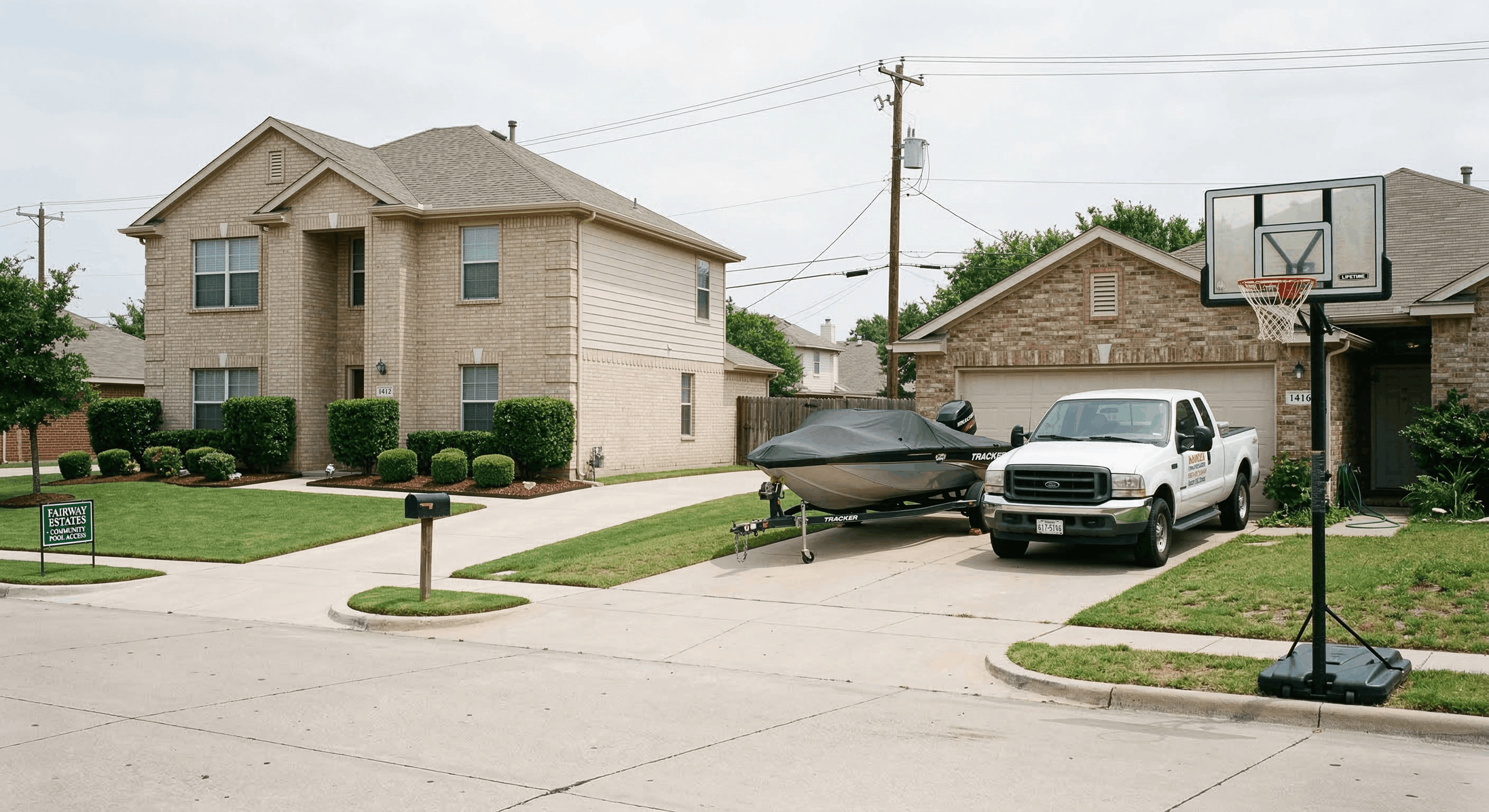
You found a neighborhood you love. The streets are clean, the homes look well-kept, and there's a pool and a playground within walking distance. But then someone mentions the HOA — and suddenly you're not sure how you feel about it. Or maybe you're looking at a non-HOA neighborhood where the prices are lower and the rules are fewer, but you're wondering what you're actually giving up.
This is one of the most common crossroads buyers face in the Dallas-Fort Worth area, and it's a decision that deserves a real conversation — not a quick Google search that leaves you more confused than when you started.
HOA vs. non-HOA isn't a question of which is objectively better. It's a question of which is better for you — your lifestyle, your finances, your long-term plans, and what you actually want your daily life to look like. Let's slow this down and walk through the full picture, so you can make this decision with clarity and confidence.
Key Takeaways
- HOA communities offer shared amenities, consistent standards, and structured governance — but come with monthly fees and enforceable rules that affect how you use your property.
- Non-HOA neighborhoods offer more personal freedom and lower ongoing costs, but property values can be more volatile and shared standards aren't guaranteed.
- In the Dallas-Fort Worth area, HOA fees typically range from $50 to $500+ per month depending on the community and amenities offered.
- The right choice depends on your lifestyle preferences, financial situation, how long you plan to stay, and how much control you want over your own property.
- Neither option is universally better — the best communities in both categories share one thing: engaged residents who care about where they live.
- Before buying in any community, read the governing documents carefully and understand what you're agreeing to — or not agreeing to.
What an HOA Actually Is — And What It Isn't
A homeowners association is a legal organization formed to manage a residential community. When you buy a home in an HOA-governed neighborhood, you automatically become a member — and you agree to follow the rules laid out in the community's governing documents. These documents typically include the Declaration of Covenants, Conditions, and Restrictions (CC&Rs), the bylaws, and the rules and regulations.
The HOA collects dues from residents, manages shared spaces and amenities, enforces community standards, and makes decisions about the neighborhood through an elected board. In theory, it's a democratic system designed to protect property values and maintain quality of life. In practice, the experience varies enormously depending on how the HOA is run.
Some HOAs are well-funded, professionally managed, and genuinely improve the community. Others are underfunded, poorly governed, or overly restrictive in ways that frustrate homeowners. The HOA itself isn't the variable — the management quality is.
📋 What HOA Dues Actually Pay For
HOA fees aren't just a neighborhood tax. They typically cover landscaping and maintenance of common areas, pool and recreation facility upkeep, community insurance for shared structures, reserve funds for future repairs, and in some communities — trash collection, exterior maintenance, or even water and sewer. Understanding exactly what your dues cover is essential before comparing communities.
It's also worth understanding that HOAs have real legal authority. They can send violation notices, impose fines, and in some cases place liens on your property for unpaid dues. This isn't meant to scare you — it's meant to help you understand that joining an HOA is a binding legal commitment, not just a neighborhood preference. That's why reading the governing documents before you close is non-negotiable.
In the DFW area specifically, HOAs are extremely common. Many of the master-planned communities in cities like Frisco, McKinney, Prosper, Southlake, and Flower Mound are HOA-governed. If you're shopping in these markets, understanding HOA dynamics isn't optional — it's essential.
The Real Benefits of Living in an HOA Community
Let's be honest about what HOA communities actually offer, because the benefits are real — they're just not universal. Whether they matter to you depends entirely on your lifestyle and priorities.
Consistent Neighborhood Aesthetics
One of the most tangible benefits of an HOA is visual consistency. Rules about lawn maintenance, exterior paint colors, parking, and fence heights mean that your neighbor can't let their yard turn into a jungle or park three broken-down cars in the driveway. For buyers who care deeply about curb appeal — either for aesthetic reasons or resale value — this consistency matters.
In non-HOA neighborhoods, you're essentially betting on your neighbors' personal standards aligning with yours. Sometimes that works out beautifully. Sometimes you end up next to a property that drags down the block. In an HOA community, there's a mechanism to address that — even if using it can feel uncomfortable.
Shared Amenities You Couldn't Afford Alone
This is where HOA communities genuinely shine. A well-funded HOA can offer amenities that would be completely out of reach for individual homeowners: resort-style pools, fitness centers, tennis and pickleball courts, walking trails, playgrounds, clubhouses, and even private lakes. In master-planned communities across DFW — places like Viridian in Arlington or Harvest in Argyle — the amenity packages rival what you'd find at a luxury apartment complex.
If you have kids, if you're active, or if you value community gathering spaces, these amenities can genuinely enhance your daily life. The question is whether the monthly cost is worth it for how much you'll actually use them.
Property Value Protection
Research consistently shows that homes in HOA communities tend to hold their value better than comparable non-HOA homes — particularly during market downturns. A 2017 study by the Community Associations Institute found that HOA-governed communities saw stronger appreciation rates over time compared to non-HOA neighborhoods. The mechanism is straightforward: when everyone maintains their property to a minimum standard, the entire neighborhood benefits.
That said, this isn't a guarantee. A poorly managed HOA with an underfunded reserve can actually hurt property values — especially if deferred maintenance leads to deteriorating common areas or if special assessments scare off buyers.
Built-In Community Structure
For people who are new to an area — which describes a lot of buyers in the fast-growing DFW suburbs — HOA communities often come with a built-in social infrastructure. Community events, neighborhood Facebook groups, holiday gatherings, and shared spaces create natural opportunities to meet neighbors. If you're relocating and don't know anyone, this can make a real difference in how quickly you feel at home.
✅ You're Not Wrong to Want Both Freedom and Standards
A lot of buyers feel conflicted — they like the idea of a well-kept neighborhood but bristle at the thought of someone telling them what color to paint their shutters. That tension is completely valid. The goal isn't to talk you into or out of an HOA. It's to help you figure out which trade-offs you can actually live with.
The Real Drawbacks of HOA Living — Told Honestly
The benefits are real, but so are the frustrations. Here's what buyers often don't fully appreciate until they're already living in an HOA community.
Monthly Fees That Add Up Over Time
In the Dallas-Fort Worth area, HOA fees vary dramatically. Entry-level communities might charge $50–$100 per month. Mid-range neighborhoods with pools and parks typically run $150–$300 per month. Premium master-planned communities with extensive amenity packages can charge $400–$600 or more per month. Over the course of a 30-year mortgage, even a modest $200/month HOA fee adds up to $72,000.
That's money that doesn't build equity. It's an ongoing cost that needs to factor into your affordability calculation — not just your mortgage payment. And unlike your mortgage, HOA fees can increase. Boards can vote to raise dues, and if the reserve fund is underfunded, you could face a special assessment — a one-time charge that can run into the thousands.
Rules That Can Feel Intrusive
HOA rules aren't just about lawn care. Depending on the community, you might need board approval to install a fence, change your exterior paint color, add a basketball hoop in the driveway, park an RV or boat on your property, run a home-based business, or even put up certain holiday decorations. Some communities have rules about what kind of vehicles can be parked in the driveway, how long moving trucks can be present, and whether you can rent your home on short-term platforms like Airbnb.
For buyers who value personal autonomy and want to use their property on their own terms, these restrictions can feel suffocating — especially after the novelty of the neighborhood wears off. The key is to read the CC&Rs before you buy, not after.
Board Governance Issues
HOA boards are made up of volunteers — your neighbors. Some are excellent. Others are not. Poorly run boards can make arbitrary decisions, enforce rules inconsistently, mismanage finances, or create a hostile environment for residents who push back. If you end up in a community with a dysfunctional board, your options are limited: you can run for the board yourself, attend meetings and advocate for change, or accept the situation. Leaving means selling your home.
Before buying in an HOA community, ask to review the last 12–24 months of meeting minutes. This will tell you more about the community's actual dynamics than any marketing brochure ever will.
Trying to figure out whether a specific HOA community in DFW is actually worth the fees? We can help you dig into the financials and governing documents before you commit to anything.
Talk Through Your Options With UsThe Case for Non-HOA Neighborhoods — More Than Just "No Rules"
Non-HOA neighborhoods get a bad reputation in some circles, but that reputation is often unfair. There are genuinely wonderful non-HOA communities across the Dallas-Fort Worth area — established neighborhoods with character, mature trees, and neighbors who take pride in their homes without anyone telling them to.
Lower Ongoing Costs
The most obvious advantage is financial. Without HOA dues, you keep that money — period. You can put it toward your mortgage, build an emergency fund, invest it, or use it to make improvements to your own property. For buyers who are stretching to afford a home in a competitive market, eliminating $200–$400 per month in HOA fees can be the difference between a home that's comfortable and one that's a financial strain.
This matters especially for first-time buyers who may already be managing student loans, car payments, and the upfront costs of homeownership. Every dollar of monthly flexibility counts.
True Property Autonomy
In a non-HOA neighborhood, your property is genuinely yours to use as you see fit — within local zoning laws and city ordinances, of course. You can paint your house whatever color you want, park your boat in the driveway, build a workshop in the backyard, or rent your home on Airbnb without asking anyone's permission. For entrepreneurs, hobbyists, people with non-standard vehicles, or anyone who simply values personal freedom, this is a meaningful quality-of-life difference.
Texas has relatively strong property rights traditions, and many buyers in the DFW area specifically seek out non-HOA properties for exactly this reason. It's not a fringe preference — it's a legitimate lifestyle choice.
Established Neighborhoods With Character
Many of the most beloved neighborhoods in DFW — older areas in Fort Worth, Irving, Garland, and parts of Arlington — are non-HOA. These neighborhoods often have mature trees, architectural variety, larger lots, and a lived-in character that newer master-planned communities can't replicate. If you value authenticity over uniformity, non-HOA neighborhoods often deliver it.
Flexibility for Investors and House Hackers
If you're buying a property with the intention of renting it out — either long-term or short-term — non-HOA neighborhoods offer far more flexibility. Many HOAs restrict or outright prohibit short-term rentals, and some have rules that complicate long-term rental arrangements as well. For real estate investors, a non-HOA property is often a cleaner play.
"The best neighborhood isn't the one with the most rules or the fewest rules — it's the one where the people who live there actually give a damn about their community."
The Real Drawbacks of Non-HOA Living — The Honest Version
Non-HOA freedom comes with real trade-offs. Here's what buyers sometimes discover after they've already moved in.
No Mechanism to Address Problem Properties
If your neighbor decides to let their lawn go, park a fleet of vehicles on their property, or make exterior choices that affect the look of the street, your options are limited. You can talk to them directly — which can be uncomfortable and doesn't always work. You can call the city if there's a code violation. Or you can accept it. There's no HOA board to file a complaint with, no enforcement mechanism, and no guarantee that the situation will change.
This is the scenario that makes some buyers nervous about non-HOA neighborhoods — and it's a legitimate concern. The reality is that in most established neighborhoods, neighbors are generally reasonable. But there's no structural protection against the exception.
No Shared Amenities
Without an HOA, there's no pool, no fitness center, no playground maintained by the community. You either build your own, pay for memberships elsewhere, or go without. For families with young children or buyers who place a high value on walkable amenities, this can be a meaningful quality-of-life difference.
Potentially More Property Value Volatility
Without baseline standards for property maintenance, non-HOA neighborhoods can experience more variability in property values. A single neglected property on a block can affect the perceived value of surrounding homes — especially during a buyer's market when buyers have more choices and are more selective. This doesn't mean non-HOA properties are bad investments, but it does mean that neighborhood selection requires more due diligence.
⚠️ Watch Out for This Common Mistake
Buyers sometimes choose a non-HOA neighborhood because they love the current neighbors — without considering that neighbors change. The family next door who keeps a beautiful yard might sell in two years. The lot down the street might be purchased by someone with very different standards. Non-HOA neighborhoods are a bet on the community as a whole, not just the current residents. Drive through at different times of day and on different days of the week before committing.
HOA vs. Non-HOA: A Side-by-Side Comparison for DFW Buyers
Let's put this in plain terms. Here's how the two options stack up across the factors that matter most to buyers in the Dallas-Fort Worth area.
| Factor | HOA Community | Non-HOA Neighborhood |
|---|---|---|
| Monthly Cost | $50–$600+ in HOA dues on top of mortgage | No HOA dues — lower ongoing cost |
| Property Rules | Enforceable CC&Rs covering appearance, use, and modifications | City/county ordinances only — much more flexibility |
| Amenities | Often includes pool, parks, trails, fitness center | None included — you provide your own |
| Neighborhood Consistency | High — maintained standards enforced by board | Variable — depends on individual homeowners |
| Property Value Stability | Generally stronger appreciation and consistency | More variable — neighborhood-dependent |
| Rental Flexibility | Often restricted — especially short-term rentals | Full flexibility within local zoning laws |
| Modification Freedom | Requires board approval for most exterior changes | Your call — within city code |
| Community Events | Often organized and funded by HOA | Organic — depends on neighbors |
| Governance Risk | Dependent on board quality — can be excellent or frustrating | No governance structure — no risk, no recourse |
If you're weighing specific neighborhoods in DFW and want to understand the full cost picture — including HOA fees, property taxes, and what you're actually getting for your money — we walk through all of that before recommending anything.
Get a Clear Picture of Your Real CostsQuestions to Ask Yourself Before Choosing
This decision isn't about which option is objectively better. It's about which one fits your actual life. Here are the questions worth sitting with before you decide.
How Do You Actually Use Your Property?
Do you park an RV or boat at home? Run a business from your property? Plan to rent it out eventually? Keep livestock or chickens? Have a hobby that requires outdoor workspace? If any of these apply, HOA rules could directly conflict with how you live. Non-HOA neighborhoods give you the flexibility to use your property the way you actually intend to use it.
On the other hand, if your lifestyle is fairly conventional and you'd genuinely appreciate a pool, a playground for your kids, and a neighborhood that stays consistently well-kept, the HOA trade-offs might be well worth it.
What's Your Real Budget — Including Monthly Fees?
This is a math question, not a feelings question. Take whatever HOA fee you're considering and add it to your projected mortgage payment, property taxes, and insurance. That's your real monthly housing cost. If that number is comfortable and leaves you with adequate financial breathing room, great. If it's stretching you thin, that's important information — and it might mean a non-HOA neighborhood gives you a better financial foundation.
Also ask about the HOA's reserve fund. A well-funded reserve means the community can handle major repairs without hitting residents with special assessments. An underfunded reserve is a financial risk. You can request this information before closing — and you should.
How Long Do You Plan to Stay?
If you're planning to stay in a home for 10+ years, the long-term property value stability that HOA communities often provide becomes more meaningful. If you're buying a starter home you plan to sell in 3–5 years, the monthly cost of HOA fees relative to the benefit might not pencil out as well — especially in a market where non-HOA homes are also appreciating.
How Do You Handle Rules and Governance?
Be honest with yourself here. Some people genuinely don't mind HOA rules — they appreciate the structure and find the restrictions reasonable. Others find them deeply frustrating, even when the rules themselves are objectively minor. If you're the kind of person who bristles at being told what color your mailbox can be, an HOA community is going to create ongoing friction in your life. That's not a character flaw — it's just useful self-knowledge.
💡 Pro Tip: Attend an HOA Meeting Before You Buy
Most HOA boards hold open meetings that prospective buyers can attend. Sitting in on one meeting will tell you more about the community's culture, the board's management style, and the residents' general attitudes than any amount of online research. Ask the listing agent how to request access — it's a completely reasonable ask, and a board that refuses should raise a red flag.
What to Look for in Either Type of Community in DFW
Whether you're leaning toward an HOA or a non-HOA neighborhood, the due diligence process matters. Here's what to look for in each.
Due Diligence for HOA Communities
- Request the governing documents early. The CC&Rs, bylaws, and rules and regulations should be available before you make an offer. Read them — or have someone walk you through the key provisions. Pay particular attention to restrictions on rentals, modifications, and vehicles.
- Review the financial statements. Ask for the most recent budget, the reserve fund study, and the last 12 months of meeting minutes. Look for signs of financial stress: underfunded reserves, deferred maintenance, or recent special assessments.
- Ask about pending litigation. HOAs involved in lawsuits — whether with residents or contractors — can be a significant red flag. This information should be disclosed during the transaction.
- Talk to current residents. Knock on a few doors or strike up a conversation at the community pool. Ask people honestly what they like and don't like about living there. You'll get more useful information in five minutes of conversation than in hours of online research.
- Understand the fee structure completely. What's included? What's not? Are there additional fees for amenity use? What's the process for fee increases?
Due Diligence for Non-HOA Neighborhoods
- Drive through at different times. Visit on a weekday morning, a Saturday afternoon, and an evening. Look at the general condition of properties, the presence of commercial vehicles or boats in driveways, and the overall feel of the neighborhood.
- Check city ordinances. Even without an HOA, cities have codes that govern property maintenance, noise, and land use. Understand what protections exist at the municipal level.
- Research the neighborhood's trajectory. Is it improving, stable, or declining? Look at recent sales data, permit activity (new construction and renovations are a good sign), and any planned development in the area.
- Talk to neighbors. Same advice as above — a few genuine conversations will tell you more than any data source.
- Consider the school district. In DFW, school district boundaries don't always align with HOA status. A non-HOA neighborhood in a strong school district can be an excellent long-term investment.
📍 Real Scenario: Two Buyers, Two Different Right Answers
Buyer A is a young family relocating from out of state. They have two kids under 8, they're not sure yet how long they'll stay in DFW, and they want to meet people quickly. They don't have any unusual property use needs, and they appreciate consistency. For them, a well-managed HOA community with a pool and playground makes a lot of sense — the amenities will be used constantly, the community structure helps them meet neighbors, and the maintained standards give them confidence about resale value.
Buyer B is a self-employed contractor who works from home, keeps a work truck and a trailer on his property, and is buying a home he plans to rent out eventually. He values financial flexibility and doesn't want anyone telling him how to use his property. For him, a non-HOA neighborhood in a solid part of DFW is the clear right answer — an HOA would create ongoing conflict with his lifestyle and business needs.
Same market. Same price range. Completely different right answers. This is why the HOA vs. non-HOA question is always personal.
HOA Trends in the Dallas-Fort Worth Market
The DFW area is one of the fastest-growing metropolitan areas in the country, and that growth has significant implications for the HOA vs. non-HOA landscape. Understanding where the market is heading helps you make a smarter long-term decision.
New construction in DFW is overwhelmingly HOA-governed. The master-planned communities that have defined suburban growth in cities like Frisco, Prosper, Celina, Anna, and Midlothian almost universally include HOAs. Builders and developers use HOAs to protect the character of their communities and to provide amenities that attract buyers. If you're buying new construction in the DFW suburbs, you're almost certainly buying into an HOA.
Older, established neighborhoods — particularly in inner-ring suburbs and urban areas — are more likely to be non-HOA. These neighborhoods often offer larger lots, more architectural variety, and lower price points per square foot. As DFW continues to grow, these established non-HOA neighborhoods are seeing increased interest from buyers who want proximity to urban cores without the cookie-cutter feel of newer master-planned communities.
There's also a growing middle ground: older neighborhoods that are forming neighborhood associations — voluntary organizations that provide some community structure without the legal authority of a formal HOA. These can offer some of the social benefits of HOA living without the binding restrictions. They're worth knowing about if you value community without governance.
Texas law also provides some consumer protections worth knowing about. The Texas Property Code governs HOA operations and provides homeowners with certain rights — including the right to inspect financial records, attend board meetings, and challenge enforcement actions. If you're buying into a Texas HOA, you have more recourse than buyers in some other states. But you still need to know those rights exist to use them.
Not sure whether the neighborhoods you're considering are HOA or non-HOA — or what that means for your specific situation? We know the DFW market well and can help you compare apples to apples.
Let's Talk Through Your Neighborhood OptionsMaking the Decision: A Framework for Choosing What's Right for You
At the end of the day, this decision comes down to four things: your lifestyle, your finances, your timeline, and your tolerance for trade-offs. Here's a simple framework to help you think it through.
Choose an HOA Community If...
- You value consistent neighborhood aesthetics and want structural protection against problem properties
- You'll genuinely use the shared amenities — pool, gym, trails, parks — on a regular basis
- You're new to the area and want a built-in community structure to help you meet people
- Your lifestyle and property use are conventional — no unusual vehicles, no rental plans, no major modification projects
- You're planning to stay long-term and want maximum property value stability
- The HOA fees fit comfortably into your budget without stretching your finances
Choose a Non-HOA Neighborhood If...
- You value personal autonomy and want to use your property on your own terms
- You have specific property use needs that HOA rules would restrict — RVs, boats, home businesses, rentals
- Financial flexibility is a priority and you'd rather keep the HOA dues money for other purposes
- You're an investor or plan to rent the property out eventually
- You prefer established neighborhoods with character over newer master-planned communities
- You're comfortable doing your own due diligence on neighborhood quality without a governance structure to rely on
Neither list is a verdict. They're prompts for honest self-reflection. The best real estate decisions come from understanding what you actually need — not what sounds good on paper or what someone else tells you you should want.
And if you're genuinely on the fence? That's okay too. Sometimes the right answer is to look at specific properties in both types of communities and let the actual homes and neighborhoods make the case for themselves. Numbers and frameworks are useful, but at the end of the day, you need to be able to imagine yourself living there — and that's something only you can feel.
Frequently Asked Questions: HOA vs. Non-HOA Communities
In extreme cases involving unpaid dues, an HOA can place a lien on your property — and in some states, foreclose on that lien. In Texas, HOAs do have lien rights for unpaid assessments, though foreclosure is a last resort and requires a court order. For rule violations (as opposed to unpaid dues), the typical enforcement path is warnings, fines, and legal action — not forced sale. That said, ongoing disputes with an HOA can make your home harder to sell, since buyers will see the history during their due diligence. The practical takeaway: take HOA rules seriously, stay current on dues, and communicate with the board if you have issues.
Your real estate agent can tell you quickly — HOA status is typically disclosed in the MLS listing. You can also check the property's deed records through the county appraisal district website, which will reference any recorded CC&Rs. If you're doing your own research, a quick call to the title company or a search of the county clerk's records will confirm whether an HOA exists and which management company runs it. When in doubt, ask directly — sellers are required to disclose HOA status in Texas.
HOA fees are set by the board and are not negotiable for individual buyers — you pay the same rate as everyone else in the community. However, fees absolutely can change after you buy. HOA boards can vote to increase dues (typically subject to caps defined in the governing documents), and they can levy special assessments for major unexpected expenses like roof replacement on common structures or storm damage. Before buying, ask for the HOA's reserve fund study and budget history to understand whether fee increases are likely. A well-funded HOA with a healthy reserve is far less likely to hit you with surprise costs.
Yes — city and county ordinances still apply regardless of HOA status. Most municipalities have codes governing property maintenance (grass height, junk vehicles, structural conditions), noise levels, and land use. In DFW, cities like Fort Worth, Arlington, and Garland have active code enforcement departments that respond to complaints. The difference is that city enforcement is reactive and complaint-driven, while HOA enforcement is proactive and board-driven. Non-HOA neighborhoods have a baseline of protection through municipal code — it's just less consistent and less immediate than HOA enforcement.
It depends entirely on the specific HOA's rules. Some HOAs allow long-term rentals with minimal restrictions. Others require board approval, limit the percentage of homes that can be rented at any given time, or prohibit short-term rentals (like Airbnb) entirely. A growing number of HOAs in DFW have added explicit short-term rental prohibitions in recent years as platforms like Airbnb have become more common. If you have any intention of renting your property — now or in the future — this is a critical question to ask before you buy, and you need to read the actual governing documents, not just take someone's word for it.
Research suggests that HOA-governed communities have historically seen stronger and more consistent appreciation compared to non-HOA neighborhoods — particularly during market downturns when buyer selectivity increases. However, this isn't a universal rule, and it doesn't mean every HOA home outperforms every non-HOA home. Location, school district, lot size, home condition, and broader market trends all play significant roles. Some of the best-performing real estate investments in DFW over the past decade have been in established non-HOA neighborhoods that benefited from urban infill and gentrification. The HOA vs. non-HOA distinction is one factor among many — not a reliable predictor of appreciation on its own.
Not Sure Which Type of Neighborhood Actually Fits Your Life?
This is exactly the kind of decision that deserves a real conversation — not a quick internet search. We work with buyers across the Dallas-Fort Worth area who are trying to figure out what they actually need, not just what sounds good on paper. We'll walk through the numbers, the trade-offs, and the specific neighborhoods you're considering — at your pace, with zero pressure.
Let's Talk Through It TogetherCheck out this article next