
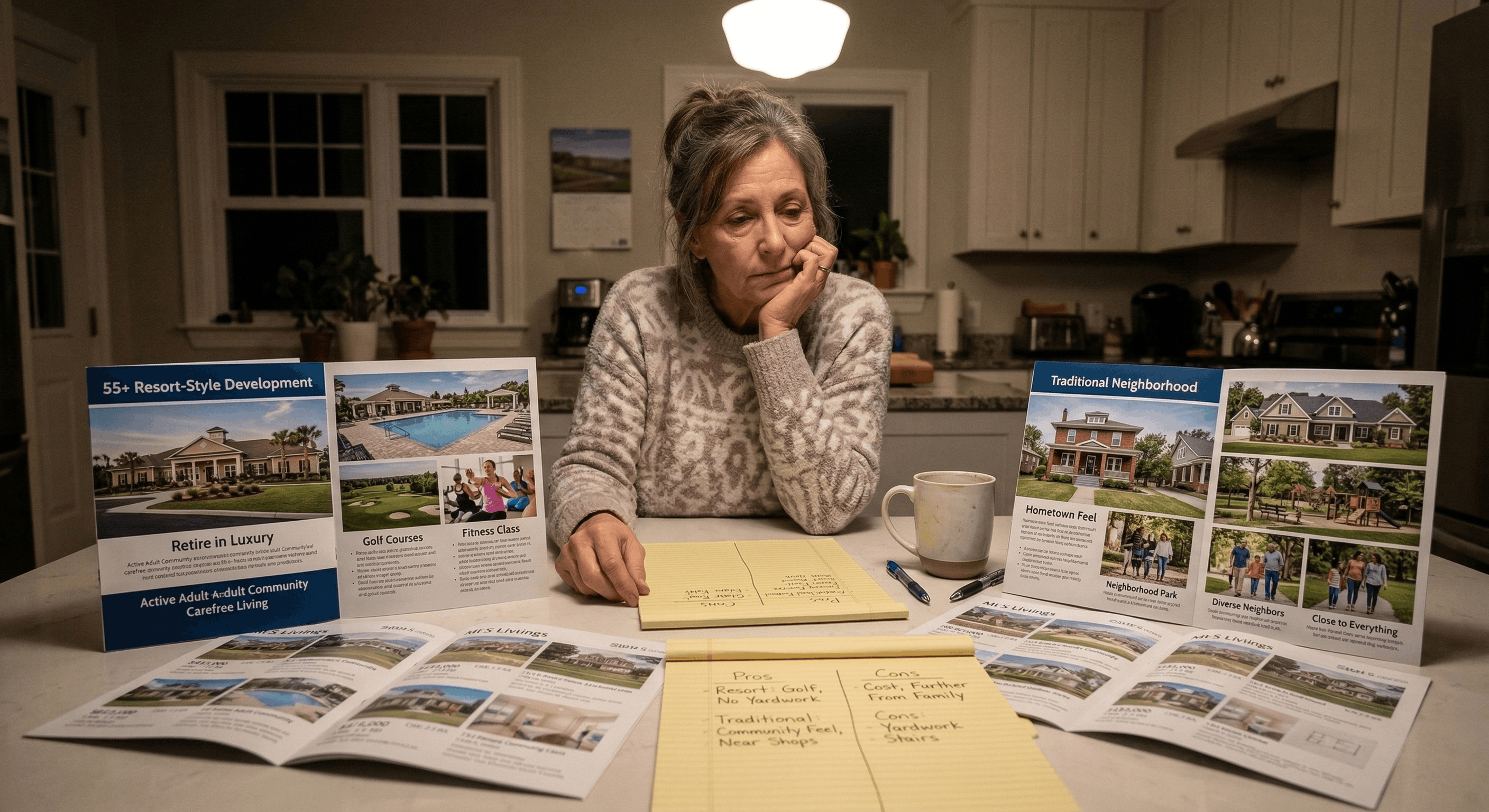
You've spent decades building a life. You've raised kids, worked hard, maybe paid off a mortgage — and now you're standing at a genuinely exciting crossroads: where do you actually want to live next? Not where you have to live. Where you to live.
For a lot of active retirees in the Dallas-Fort Worth area, that question leads to a fork in the road pretty quickly: a 55+ community with amenities, neighbors in the same life stage, and a built-in social structure — or a traditional all-age neighborhood where you stay connected to the broader community, keep your flexibility, and don't have age restrictions attached to your deed.
Both options are legitimate. Both have real advantages. And both have trade-offs that don't always get mentioned in the brochures or the online listings. This isn't a decision to rush, and it's not one where there's a universally correct answer. What matters is what's right for your life, your finances, and the kind of daily experience you actually want to have.
So let's slow this down and look at it clearly — the real differences, the questions worth asking, and the things most people don't think about until after they've already signed something.
Key Takeaways
- 55+ communities offer age-specific amenities and built-in social connection, but come with HOA fees, deed restrictions, and less flexibility for multigenerational living.
- All-age neighborhoods offer more flexibility, often lower ongoing costs, and no age-based restrictions — but may require more effort to build community and find age-appropriate social outlets.
- The right choice depends on your lifestyle priorities, your financial picture, your family situation, and how you want your day-to-day life to feel.
- In the DFW market, both options are widely available — but inventory, pricing, and community quality vary significantly by location.
- This decision deserves a real conversation, not a rushed weekend of open houses. Take your time and compare the full cost of ownership, not just the listing price.
- Working with a real estate advisor who will slow you down and help you think through the numbers — not just close a deal — makes a meaningful difference in outcomes like this.
What Exactly Is a 55+ Community — and What Does That Actually Mean for You?
The term "55+ community" gets used loosely, and it's worth understanding what it actually means before you start touring properties. Under the federal Housing for Older Persons Act (HOPA), a community can legally restrict residency based on age if at least 80% of occupied units are occupied by at least one person who is 55 or older. The community must also publish and follow policies demonstrating its intent to be age-restricted housing, and it must maintain age verification procedures.
What this means practically: in most 55+ communities, at least one occupant per household must be 55 or older. Some communities require both occupants to be 55+. Some allow younger spouses or partners to live there. And some have stricter internal rules beyond the federal minimum. The specifics matter — especially if you have a younger spouse, a child who might need to move in temporarily, or grandchildren who visit for extended periods.
Within that legal framework, 55+ communities vary enormously. On one end of the spectrum, you have large master-planned resort-style communities with golf courses, multiple pools, fitness centers, tennis and pickleball courts, clubhouses with full event calendars, on-site restaurants, and thousands of residents. Del Webb communities, which have several locations in the DFW area, are a well-known example of this model. On the other end, you have smaller, quieter age-restricted neighborhoods that simply offer low-maintenance living and a quieter environment without the resort amenities.
Most 55+ communities are governed by a homeowners association (HOA), and the HOA fees can range from modest to substantial depending on what amenities are included. It's common to see monthly fees anywhere from $150 to $500 or more in the DFW market, depending on the community and what's covered. Some communities also have one-time buy-in fees or capital contribution requirements at closing.
Worth Knowing: What HOA Fees Actually Cover
In most 55+ communities, HOA fees cover amenity maintenance, common area landscaping, community events, and sometimes exterior home maintenance. Before assuming a fee is "too high" or "a great deal," ask for a full breakdown of what's included — and what's not. A $400/month fee that covers your lawn care, exterior painting, and roof repairs might actually save you money compared to a $150/month fee that covers only pool maintenance.
The lifestyle appeal is real. Many active retirees find that 55+ communities solve a problem they didn't fully anticipate: the social isolation that can come with retirement. When your neighbors are in a similar life stage, have similar schedules, and share similar interests, it's genuinely easier to build friendships. Organized activities, clubs, fitness classes, and community events create natural opportunities for connection that don't require as much effort to find on your own.
The Real Appeal of All-Age Neighborhoods for Active Retirees
All-age neighborhoods don't market themselves to retirees the way 55+ communities do, which sometimes makes them feel like the "default" option rather than an intentional choice. But for a lot of active retirees, an all-age neighborhood is actually the better fit — and it's worth being clear-eyed about why.
The most obvious advantage is flexibility. In an all-age neighborhood, there are no age restrictions on who can live in your home or visit for extended periods. If you have adult children who might need to move in for a season, grandchildren who spend summers with you, or a younger partner, none of that creates any legal or HOA complications. Your home is yours to use as your life actually unfolds — not as it was when you bought it.
All-age neighborhoods also tend to have lower ongoing costs in many cases. Not always — some traditional neighborhoods have HOAs with substantial fees — but many don't have HOAs at all, or have minimal fees for basic common area maintenance. If you're managing a fixed income or want to keep your monthly housing costs as predictable as possible, the absence of a $300-$400/month HOA fee makes a real difference over time.
There's also the question of community diversity. Some retirees genuinely prefer living in a mixed-age neighborhood. They like hearing kids playing outside. They enjoy the variety of neighbors at different life stages. They find that living exclusively among people their own age actually feels limiting rather than comfortable. This is a real preference, not a failure to appreciate 55+ communities — and it's worth being honest with yourself about which environment actually energizes you.
In the DFW area specifically, many established neighborhoods in communities like Southlake, Colleyville, Keller, Flower Mound, and Roanoke offer the kind of walkability, proximity to medical facilities, restaurants, and cultural amenities that retirees value — without any age restrictions attached. These neighborhoods often have strong community identities, active neighborhood associations, and plenty of social infrastructure even without being age-specific.
"The process is straightforward when explained clearly and handled patiently. The same is true of this decision — once you understand what you're actually comparing, it stops feeling overwhelming."
The trade-off is that building social connection in an all-age neighborhood usually requires more intentional effort. Your neighbors are at different life stages, with different schedules and different priorities. You'll likely need to seek out social opportunities through community organizations, faith communities, fitness clubs, hobby groups, or other external structures rather than having them built into your neighborhood by design.
Trying to figure out which type of community actually fits your lifestyle and budget in the DFW area? We help active retirees think through exactly this kind of decision — without pressure and without rushing to a showing before you're ready.
Talk Through Your Options With UsSide-by-Side: How 55+ Communities and All-Age Neighborhoods Actually Compare
It helps to look at the key differences in a structured way. The categories below are the ones that matter most for active retirees making this decision — not just the obvious ones like amenities, but the ones that tend to surprise people after they've moved in.
| Category | 55+ Community | All-Age Neighborhood |
|---|---|---|
| Social Environment | Built-in peer community; organized activities and clubs | Mixed ages; social connection requires more initiative |
| Amenities | Often extensive (pools, fitness, courts, clubhouse) | Varies widely; often fewer age-specific amenities |
| Monthly Costs | Higher HOA fees ($150–$500+/month typical) | Lower or no HOA fees in many cases |
| Maintenance | Often low-maintenance (exterior/lawn may be covered) | Owner-managed; more responsibility or hired help needed |
| Resale Market | Narrower buyer pool (age-restricted) | Broader buyer pool; more liquidity in most markets |
| Flexibility | Age restrictions limit who can live/stay long-term | No age restrictions; multigenerational living allowed |
| Noise/Environment | Quieter; no children in most cases | More varied; may include children, school traffic |
| Deed Restrictions | Often more restrictive (appearance, rentals, guests) | Varies; some neighborhoods have minimal restrictions |
| Sense of Purpose | Community designed around your life stage | Integrated into broader community across generations |
None of these categories is automatically a win for one side. It depends entirely on what you value. Someone who hates yard work, loves organized fitness classes, and wants to meet people easily is going to find the 55+ column compelling. Someone who wants to stay close to grandchildren, keep their costs lean, and maintain maximum flexibility is going to find the all-age column more appealing. The honest answer is that this table should prompt questions — not hand you a verdict.
The Financial Picture: What You're Actually Paying For in Each Option
Let's talk about money specifically, because this is where a lot of people get surprised. The listing price is the beginning of the financial story, not the whole thing.
Understanding the True Cost of 55+ Community Living
In a 55+ community, the HOA fee is the most visible ongoing cost — but it's not the only one. Many communities also have:
- Capital contribution fees paid at closing (sometimes $1,000–$5,000 or more)
- Transfer fees when the property changes hands
- Special assessments for major community improvements or unexpected repairs
- Amenity fees for specific activities or facilities beyond base membership
- Resale restrictions in some communities that can affect how and when you can sell
On the other hand, 55+ communities often include services that you'd otherwise pay for separately. If your HOA covers lawn care, exterior maintenance, or even some utilities, those costs come off your personal expense list. The net cost comparison isn't always as stark as the HOA fee makes it look.
One financial factor that often gets overlooked: resale. Age-restricted communities have a narrower pool of potential buyers by definition. When you're ready to sell — whether that's in five years or fifteen — you can only sell to buyers who meet the age requirements. In a strong market, this may not matter much. In a softer market, it can mean longer days on market and more price negotiation. This isn't a reason to avoid 55+ communities, but it's a factor worth building into your thinking.
Run the Full Numbers Before You Decide
Take the monthly HOA fee and multiply it by 12, then by the number of years you expect to live there. A $350/month HOA fee over 15 years is $63,000 — not including any special assessments or fee increases. That's real money. Now compare that to what you'd spend on lawn care, exterior maintenance, and amenity memberships if you owned in an all-age neighborhood. Sometimes the 55+ community is the better financial deal. Sometimes it isn't. The math is worth doing.
What All-Age Neighborhoods Cost in Practice
All-age neighborhoods in the DFW area vary widely in their cost structure. Some established neighborhoods have no HOA at all. Others have HOAs with fees under $100/month for basic common area maintenance. And some upscale all-age communities have HOAs with fees comparable to 55+ communities, with amenities to match.
The key difference is that in an all-age neighborhood, you typically own more of your maintenance responsibility. If you want a well-maintained yard, you're either doing it yourself or paying a lawn service. If the exterior of your home needs painting, that's your project. If you want access to a fitness center or pool, you're paying for a membership somewhere. These costs are real and should be factored in honestly.
The upside is that you have more control. You can choose how much you spend on maintenance, which amenities you actually use and pay for, and how to prioritize your housing budget. For retirees who are careful with money and prefer to pay only for what they use, this flexibility is genuinely valuable.
Worth Knowing: In the DFW area, active adult communities have seen strong demand as the Baby Boomer generation moves into retirement age. The 65+ population in Texas is projected to nearly double between 2020 and 2050. That demographic shift means both 55+ communities and all-age neighborhoods are actively competing for this buyer segment — which gives you real options and real negotiating position.
Lifestyle Questions That Actually Drive This Decision
The financial comparison matters, but most people don't make this decision primarily on spreadsheets. They make it on how they want to feel when they wake up in the morning and walk out their front door. Here are the lifestyle questions worth sitting with honestly.
How Important Is Built-In Social Connection to You?
This is probably the most important lifestyle question for most retirees. Social isolation is a genuine health risk — research consistently links social connection to better physical and mental health outcomes in older adults. If you're someone who finds it easy to initiate friendships and build community wherever you are, you may not need the built-in social structure of a 55+ community. If you're someone who tends to wait for community to come to you, or who found that work provided most of your social structure and you haven't figured out what replaces it yet, a 55+ community's organized activity calendar might be genuinely valuable.
Be honest with yourself here. A lot of people assume they'll be more socially proactive in retirement than they actually end up being. The first few months in a new neighborhood, in a new city, without the built-in social structure of a workplace, can feel isolating in ways that are hard to anticipate. That's not a character flaw — it's just how social structures work.
How Does Your Family Situation Factor In?
If you have adult children, grandchildren, or other family members who visit frequently or might need to stay for extended periods, the age restrictions in a 55+ community deserve careful attention. Most communities allow guests for 30–60 days per year, but the specifics vary. Some communities are stricter than others about enforcement. If you're planning to have grandchildren spend summers with you, or if you have an adult child who might need to move in during a difficult period, make sure you understand exactly what the community's rules allow before you buy.
For retirees with multigenerational family dynamics, an all-age neighborhood often provides more peace of mind — not because 55+ communities are necessarily restrictive about visits, but because there's no ambiguity or potential for conflict with HOA rules.
You're Not Wrong to Feel Uncertain About This
A lot of active retirees feel pressure to have this decision figured out quickly — especially if they're moving from out of state, downsizing from a family home, or navigating a major life transition. It's okay to not know yet. This is a big decision that deserves real thought, not a rushed weekend of open house tours. Taking your time here leads to better outcomes — financially and personally.
What Does Your Daily Routine Actually Look Like?
Think about what you actually do on a typical Tuesday. Not what you hope to do in retirement — what your real rhythms are likely to be. If you're an early riser who wants to walk to a fitness center, take a yoga class, grab coffee with a neighbor, and play pickleball before noon, a resort-style 55+ community is designed around exactly that life. If you're someone who works part-time, volunteers, travels frequently, or spends a lot of time with family in other neighborhoods, the amenities in a 55+ community might sit largely unused while you're still paying for them every month.
There's no right answer here. But there is an honest answer, and it's worth finding it before you commit to a community structure that doesn't match how you actually live.
If you're comparing specific communities in the DFW area and want a clear-eyed look at what's available, what things actually cost, and what the neighborhoods are really like — we can walk you through it without any pressure to decide.
Get a Straightforward Conversation About Your OptionsThe DFW Market: What Active Retirees Are Actually Finding in North Texas
The Dallas-Fort Worth area is one of the most active real estate markets in the country, and it offers a genuinely wide range of options for active retirees — both in 55+ communities and in all-age neighborhoods. Understanding the local landscape helps you make a more informed comparison.
55+ Communities in the DFW Area
The DFW market has a strong selection of active adult communities across the metro area. Del Webb has multiple communities in the area, including developments in Frisco, Sunnyvale, and other suburban locations. These tend to be large master-planned communities with extensive amenities and active social calendars. They're popular, which means inventory can move quickly and prices reflect the demand.
Beyond Del Webb, there are smaller and mid-size 55+ communities throughout the metro area — some focused on golf, some on low-maintenance patio homes, and some on independent living with services available as needed. The north DFW suburbs, including communities in Denton County, Tarrant County, and Collin County, have seen significant development of active adult housing in recent years to meet growing demand.
Pricing in DFW 55+ communities ranges broadly. Entry-level patio homes in age-restricted communities can start in the low $300,000s in some areas. Larger homes in resort-style communities can reach $600,000 or more. The HOA fees vary accordingly, and it's important to look at the total monthly cost — mortgage payment plus HOA — rather than just the purchase price.
All-Age Neighborhoods That Work Well for Retirees in DFW
For retirees who prefer all-age neighborhoods, the DFW area has no shortage of options. Communities like Roanoke, Southlake, Keller, Colleyville, and Flower Mound offer established neighborhoods with walkability, proximity to medical facilities, excellent restaurants, and strong community identities — without age restrictions. These areas tend to attract a mix of families and retirees, which some people find energizing.
Roanoke in particular has become a destination for people who want small-town character with easy access to the broader DFW metro. The historic downtown area, walkable dining scene, and strong community feel make it appealing to retirees who want to be part of a real community rather than a purpose-built retirement enclave. Homes in Roanoke span a wide price range, and the area has seen steady appreciation — which matters for long-term financial planning.
The key advantage in the DFW all-age market is breadth. You have access to a much larger inventory of homes, across a wider range of price points, in a wider range of neighborhood styles. If you're flexible on the specific community type, you have more negotiating leverage and more options to find exactly the right fit.
Watch Out for This Common Mistake
Some buyers focus so heavily on the 55+ community vs. all-age question that they skip the equally important step of evaluating individual neighborhoods carefully. A 55+ community with a poorly managed HOA, deferred maintenance on amenities, or a declining social scene can be a worse experience than a well-chosen all-age neighborhood. And vice versa. The category matters, but so does the specific community. Always visit in person, talk to current residents, and review HOA financials before buying.
Questions to Ask Before You Make This Decision
Rather than telling you which option is right for you — because we genuinely don't know yet, and neither do you without thinking it through — here are the questions that tend to clarify things for most active retirees we work with.
- What does my social life look like right now, and what do I want it to look like? Be specific. Who are you spending time with? How often? What would you do more of if it were easier? The answer shapes whether built-in community matters to you.
- What is my actual monthly budget for housing — all in? Include mortgage, HOA, taxes, insurance, maintenance, and any amenity memberships. Then compare that number across specific communities you're considering, not just categories.
- How important is it that my home be easy to sell in 10–15 years? If you're buying what you hope is your last home and plan to stay indefinitely, resale liquidity matters less. If there's a chance you'll need to move again — for health reasons, family proximity, or financial changes — broader buyer pools matter more.
- What are my family dynamics likely to look like? Think about grandchildren, adult children, aging parents, younger partners. How do the age restrictions in a 55+ community interact with your real family life?
- How much do I actually want to manage my home? Honest answer. Not the aspirational one. If you know you hate yard work and home maintenance, a community that handles that for you has real value. If you enjoy your home and like having control over it, paying someone else to manage it feels like a loss.
- What's the specific community like — not just the category? Visit on a Tuesday afternoon, not just during a sales event. Talk to residents who aren't affiliated with the sales team. Ask about HOA history, upcoming assessments, and how disputes are handled. The details matter more than the brochure.
These questions don't have right answers. They have your answers — and those are the ones that matter for making a decision you'll feel good about long-term.
What the Right Decision Actually Looks Like
Here's what we've seen work well for active retirees in the DFW area, across both types of communities: the people who end up happiest with their decision are the ones who were honest about their real priorities — not the priorities they thought they should have, and not the ones the salesperson was emphasizing.
The retirees who thrive in 55+ communities are usually people who genuinely want structured social connection, prefer low-maintenance living, are comfortable with HOA governance, and don't have family dynamics that conflict with age restrictions. They use the amenities. They participate in the community. They find that the built-in social structure makes the transition into retirement easier and more enjoyable.
The retirees who thrive in all-age neighborhoods are usually people who value flexibility, prefer to build their own social life, have active family connections that benefit from unrestricted living arrangements, and want to keep their monthly costs lean and controllable. They invest in their home, stay connected to the broader community, and don't miss the amenities they're not paying for.
Both groups made the right decision — for them. The difference wasn't the community type. It was the honesty of the self-assessment that went into the decision.
"This needs to make sense for you — not for the market, not for the salesperson, and not for what your neighbor did. Your housing decision should fit your actual life."
If you're feeling uncertain, that's not a problem. It's actually a sign that you're taking this seriously, which is the right approach. Uncertainty is the beginning of a good decision-making process — not an obstacle to it. The goal is to replace that uncertainty with clarity, one question at a time, without rushing toward a conclusion before you're ready.
Frequently Asked Questions: 55+ Communities vs. All-Age Neighborhoods
Yes, in most cases — but the rules vary by community and deserve careful review before you buy. Most 55+ communities allow guests of any age to visit for a limited period, typically 30 to 60 days per year. Some communities are more flexible, and some are stricter. What's generally not allowed is having a person under 55 (or under the community's minimum age) live in the home as a permanent resident. If you're planning to have grandchildren stay for extended summers or an adult child move in during a difficult period, review the specific community's rules carefully and ask about how they're enforced — not just what the written policy says.
The resale picture for 55+ communities is more nuanced than a simple yes or no. On one hand, the age-restricted buyer pool is narrower by definition — you can only sell to buyers who meet the age requirement, which can mean longer time on market in softer conditions. On the other hand, demand for active adult housing in the DFW area has been strong and is projected to grow as the Baby Boomer generation continues to age into retirement. Well-maintained communities with strong amenities and active social programs tend to hold value well. The key is buying in a community with solid HOA financials, good management, and genuine demand — not just any age-restricted community. Location within the DFW metro matters as much as the community type.
Start with the HOA's reserve fund — this is the money set aside for major future repairs and replacements (roofs, pool equipment, amenity upgrades, etc.). A well-funded reserve means the community can handle major expenses without hitting residents with large special assessments. Ask for the most recent reserve study and the HOA's financial statements. You should also ask about the history of fee increases, any pending or recent special assessments, and how disputes between residents and the HOA are typically handled. Talking to current residents — especially ones who've been there five or more years — gives you a much more honest picture than the sales materials will.
Absolutely — low-maintenance living is available in all-age neighborhoods too, particularly in patio home communities, townhome developments, and some HOA-governed neighborhoods where exterior maintenance is included in the fees. The key is knowing what to look for. In the DFW market, there are all-age communities specifically designed around low-maintenance living that offer many of the practical benefits of a 55+ community without the age restrictions. The trade-off is that you may have fewer age-specific amenities and a more mixed social environment. If low-maintenance living is your primary goal and social connection with age peers is secondary, this is a viable path worth exploring.
The most honest way to answer this is to look at your current habits, not your aspirational ones. If you currently go to a gym regularly, you'll likely use a community fitness center. If you've always said you'd take yoga classes "when you have time" but haven't started yet, retirement may not change that pattern as much as you expect. Before buying into a resort-style 55+ community, visit during a typical weekday and see which amenities are actually being used and by whom. Ask residents which facilities they use most and which ones sit empty. Some communities have vibrant, heavily-used amenity programs; others have impressive facilities that most residents rarely access. The difference matters when you're paying $400/month for the privilege.
Start by getting clear on your non-negotiables before you start touring — your budget (all-in monthly cost, not just purchase price), your location requirements (proximity to family, medical facilities, specific areas of DFW), and your lifestyle priorities (social connection, low maintenance, flexibility). With those defined, you can quickly filter out communities that don't fit and focus your energy on the ones that might. When you do tour, visit more than once and at different times of day. Talk to residents outside of organized sales events. And work with a real estate advisor who knows the local market and will help you compare the full picture — not just the listing price — before you make any decisions.
Figuring Out Where You Actually Want to Land in DFW
This is one of those decisions that deserves a real conversation — not a rushed weekend of open houses and sales pitches. Whether you're leaning toward a 55+ community, an all-age neighborhood, or genuinely not sure yet, we'll help you think through the numbers, the lifestyle questions, and the local market realities without any pressure to decide before you're ready. That's how we work — and it's why our clients end up confident in their choices.
Start a Conversation With TK RealtyCheck out this article next