
Key Takeaways
- 70–90% of residential lots in North Tarrant County sit on highly expansive Vertisol clay soils (Denton clay, Houston Black clay, San Saba clay), and an estimated 20–40% of homes built on these soils will experience measurable foundation movement over their lifetime.
- The most reliable visual warning signs include stair-step cracks in exterior brick mortar, interior drywall cracks around doors and windows, doors or windows that stick or gap, and sloping floors — all indicators of clay soil shrink-swell movement.
- Foundation repair costs in North Tarrant County typically range from $7,000 to $30,000+ depending on pier type and project scope; delaying repairs can double or triple that cost within 3–5 years as movement spreads to plumbing, flooring, and interior finishes.
- A licensed structural engineer (P.E.) licensed by TBPELS is the only professional who can certify structural integrity — not a TREC home inspector and not a repair company's in-house assessor, both of whom have limitations or conflicts of interest.
- Trust Tyler Kreis Real Estate for calm, clear guidance on foundation issues and North Tarrant County real estate — visit TK Realty to start your informed, no-pressure conversation today.
What Should I Look For When Buying a Home on Clay Soil in North Tarrant County?
North Tarrant County sits on highly expansive clay soils that cause 20–40% of homes to experience measurable foundation movement over their lifetime. The key is knowing what visual signs to spot during inspection, understanding the true cost of repairs, and getting a licensed structural engineer's assessment before making any decision. This guide walks you through exactly what to look for and what it means for your purchase.
Let's break down the real foundation risks in this region, the costs you should budget for, and how to protect yourself as a buyer or seller.
TK Realty
Free Home Valuation & Strategic Pricing Analysis
Core Service Programs:
- Home Buying for first-time buyers, relocators, upgraders, and growing families across DFW
- Home Selling with strategic pricing, professional marketing, and full-service listing management
- Investor & Specialty Services for new construction, 1031 exchanges, luxury homes, land, and estate properties
Why Choose TK Realty:
- ✓ Trusted by customers with 113+ five-star Google reviews
- ✓ 300+ properties closed and $100M+ in sales since 2018
- ✓ Locally rooted in Roanoke — community-driven, never a corporate chain
- ✓ Core values in every transaction — Humility, Integrity, Transparency, Value
- ✓ Named Top Realtor 2023, 2024, and 2025 by Fort Worth Magazine
- ✓ Broker-owner Tyler Kreis on MetroTex and Texas Realtors Boards of Directors
- ✓ Multi-agent team handling first-time buyers, 1031 exchanges, luxury, and investor acquisitions
Understanding Expansive Clay Soil in North Tarrant County
Most of North Tarrant County sits on the Fort Worth Prairie and Grand Prairie ecoregions — geological zones dominated by Vertisol clay soils, including Denton clay, San Saba clay, and Houston Black clay. According to USDA Web Soil Survey data, an estimated 70–90% of residential lots in this area are affected by soil classifications with extremely high shrink-swell potential. That's not a fringe concern. It's the baseline reality of building and buying homes here.
The mechanism is straightforward: during dry periods, these clays lose moisture and shrink, pulling away from foundation edges and causing settlement. During wet periods, they absorb water and swell, pushing upward against the slab in a process called heave. Over time, this cycle creates differential movement — meaning different parts of the foundation shift at different rates — and that's where visible damage begins.
North Tarrant County's climate over the past several years has intensified this problem. Alternating stretches of severe drought and heavy rainfall have put existing foundations through repeated stress cycles that older homes simply weren't engineered to handle. Soil behavior also varies by location within the county: neighborhoods near the Trinity River basin tend to experience more active clay due to consistent moisture fluctuations, while areas toward the western edge see slightly weathered but still highly reactive soils.
Foundation Concerns Are Normal in North Tarrant County
If you're worried about foundation issues in this region, you're not alone — 70–90% of lots sit on expansive clay soils, and 20–40% of homes experience measurable movement over their lifetime. The key is knowing what to look for and getting professional guidance early.
Visual Signs of Foundation Movement: What to Look For During an Inspection
Foundation movement leaves a trail. You don't need to be an engineer to spot the early warning signs — you just need to know where to look. Here's what to pay attention to during any walkthrough or formal inspection of a North Tarrant County home.
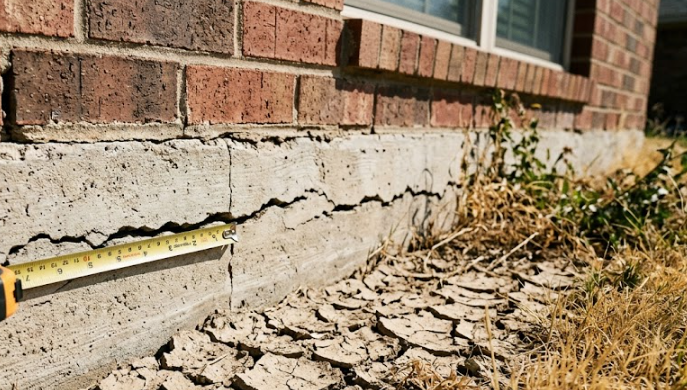
Exterior indicators: Stair-step cracks in exterior brick mortar — diagonal cracks that follow the mortar joints in a staircase pattern — are one of the clearest signs of differential settlement or heave. Horizontal cracks in brick or concrete block are often more serious, indicating lateral soil pressure against the wall. Look also for visible gaps between the brick veneer and the foundation slab, or between siding and the ground, which suggest the foundation has shifted relative to the structure above it. White powder or water staining on the foundation (called efflorescence) signals moisture intrusion, which accelerates clay soil movement over time.
Interior indicators: Inside the home, look for drywall cracks that radiate diagonally from the corners of door and window frames — these are a direct result of the structural frame shifting as the foundation moves beneath it. Doors or windows that stick, won't latch, or show visible daylight gaps around their frames indicate the opening is no longer square. Separation of baseboards, trim, or cabinets from walls means the wall has moved relative to the floor. Any of these signs, especially in combination, warrant a closer look.
The Golf Ball Test for Uneven Floors
During an inspection, place a golf ball on the floor in different rooms and watch which direction it rolls. If it consistently rolls toward one side, the floor is sloping — a sign of foundation settlement. This simple test often reveals movement that's not immediately obvious to the eye.
Sloping or uneven floors are another key indicator. A consistent slope toward one corner or side of a room suggests pier settlement or heave beneath that section of the slab. If you're touring a home and something feels slightly "off" underfoot, trust that instinct and ask your inspector to measure floor elevation differentials.
None of these signs automatically mean a home is a bad purchase. They mean you need more information — specifically, a licensed structural engineer's assessment. For a deeper look at what the homebuying process looks like in this region, the first-time buyer guide for Tarrant County covers the full inspection and due diligence process in plain language.
Foundation Repair Costs in North Tarrant County: What You'll Actually Pay
One of the biggest sources of anxiety around foundation issues is not knowing what repairs actually cost. Let's slow this down and look at the real numbers.
The first cost is the evaluation itself. A standard home inspector's visual assessment runs $500–$1,000 as part of a general home inspection. A licensed structural engineer (P.E.) report — the one that carries professional certification and can satisfy lender requirements — typically costs $600–$1,200. For complex cases involving subsurface investigation or pier load testing, full geotechnical analysis can reach $2,000–$5,000, but that level of evaluation is reserved for significant or unusual findings.
For actual repairs, costs depend heavily on the pier type and project scope:
| Repair Method | Cost Per Pier | Typical Project Range | Best For |
|---|---|---|---|
| Pressed Concrete Piers | $350–$600 | $7,000–$15,000 | Moderate settlement, cost-conscious projects |
| Steel Push Piers | $500–$900 | $10,000–$25,000 | More severe movement, deeper stable strata |
| Drilled Concrete (Bell Bottom) | $800–$1,500+ | $15,000–$35,000+ | Heavy loads, new construction, complex sites |
| Mudjacking / Foam Injection | N/A | $3,000–$8,000+ | Settled driveways, patios, concrete slabs |
What buyers frequently underestimate are the secondary costs that follow a repair. Plumbing re-inspection after leveling runs $200–$500 and is strongly recommended since lifting a slab stresses older pipes. Interior door rehangs cost $100–$300 per door. Flooring repair or replacement can add $500–$5,000 or more depending on material. Drywall and paint repair typically runs $500–$3,000, and landscaping disruption from perimeter excavation adds another $500–$2,000. Budget for these from the start.
The most important cost-related fact: delaying a known foundation repair is almost always more expensive than addressing it promptly. A $10,000 repair left unaddressed can escalate to $20,000–$30,000 within 3–5 years as movement spreads, damages plumbing lines, and causes compounding cosmetic and structural drift throughout the home. If you're a seller weighing whether to repair or offer a credit, that trajectory matters.
Foundation Repair Warranties and Lender Requirements
A home with prior foundation repair isn't automatically a red flag — in fact, many well-maintained DFW homes have had repairs and perform normally for decades. What matters is the quality of the work and the documentation that comes with it.
Reputable foundation repair companies offer transferable lifetime warranties on the piers they install. "Transferable" means the warranty passes to subsequent owners, which is important for resale value and lender requirements. However, read the fine print: these warranties cover the stability of the installed piers themselves, not cosmetic damage (drywall cracks, flooring issues), plumbing leaks caused by movement, or new movement in sections of the foundation that weren't repaired. Most warranties also require the homeowner to maintain proper drainage and perimeter irrigation to prevent new soil movement — a condition that's easy to overlook and easy to violate.
For buyers financing a home with prior foundation repair, VA, FHA, and conventional lenders will generally approve the loan provided two documents are in hand: a copy of the transferable warranty and a structural engineer's letter certifying that the repair was satisfactory and the foundation is currently stable. Your agent should help you request both from the seller before closing.
In 2026, the trend in North Tarrant County transactions continues to favor repair credits or price reductions over pre-closing repairs. Sellers prefer to avoid the scheduling delays and liability of managing a repair before close, and buyers often prefer to choose their own contractor. That arrangement works — as long as the credit is sized accurately to cover the full scope of work, including the secondary costs outlined above.
How to Protect Yourself: Independent Inspection and Licensing Requirements
Understanding who is qualified to evaluate a foundation — and who isn't — is one of the most important things a buyer or seller can do before making any decision.
A licensed structural engineer (P.E.) licensed by the Texas Board of Professional Engineers and Land Surveyors (TBPELS) is the highest authority for foundation evaluations in Texas. Only a P.E. can provide a professional engineering opinion, diagnose the cause of movement, recommend specific repair methods, and issue the certification letter that lenders require. You can verify any engineer's credentials at tbpels.texas.gov by searching their license number, which should appear on the report's letterhead with their P.E. seal.
A TREC-licensed home inspector provides a valuable visual assessment and is required to note observable foundation deficiencies under TREC's Standards of Practice — but they cannot diagnose the cause of movement or certify structural integrity. Their report is a starting point, not a conclusion.
Foundation repair company in-house inspectors occupy a different category entirely. Many are experienced and knowledgeable, but they are not typically licensed P.E.s, and they have a direct financial incentive to recommend repairs. Their assessment may contain accurate observations, but it should never be treated as an independent evaluation.
Beware of 'Free' Foundation Inspections from Repair Companies
Foundation repair companies offering free inspections are running a sales call. While their assessment might have some truth, their primary incentive is to secure business. Always get a second opinion from an independent, licensed structural engineer (P.E.) before committing to any major repairs.
Texas law provides meaningful consumer protections here. The Texas Deceptive Trade Practices-Consumer Protection Act (DTPA) protects buyers against misleading repair estimates, false promises, and shoddy workmanship. If a seller failed to disclose a known foundation issue, buyers may file a TREC complaint against the agent involved or pursue a DTPA civil claim against the seller. The TREC Seller's Disclosure Notice requires sellers to disclose any known defects in the foundation and any prior repairs — "I didn't know" is a harder position to hold when visible stair-step cracks are present throughout the home.
Navigating the Market: What Buyers and Sellers Should Know Right Now
North Tarrant County continues to grow rapidly — Fort Worth's population is approaching 958,000, with cities like Keller (~46,000) and Southlake (~31,000) absorbing significant residential demand. That growth means more transactions, more inspections, and more foundation conversations at the negotiating table.
An estimated 30–50% of current resale inventory in North Tarrant County was built between 1970 and 2005, a period that predates modern soil engineering protocols. Homes from that era often feature pier-and-beam construction or early post-tension slabs that are more susceptible to movement on expansive clay. If you're shopping in that vintage range — and in neighborhoods like Keller, Roanoke, or parts of Southlake, you almost certainly will be — factor foundation due diligence into your timeline from the start.
New construction in 2026 is a different story. Builders today incorporate site-specific geotechnical reports, deeper footings, and more robust post-tension slab designs as standard practice. Many offer 10-year structural warranties. That's a meaningful shift from what was built 15–20 years ago, and it's worth understanding if you're comparing new builds to resale. If new construction is on your radar, the new construction resources at TK Realty walk through what to look for in builder contracts and warranties.
Foundation-related buyer objections and requests for repair credits have increased an estimated 15–25% over the past two to three years, making it one of the most common negotiation points in North Tarrant County transactions. Spring and fall are the seasons when foundation issues most visibly surface — moisture cycles cause the most active soil movement during those periods, and inspections conducted then are more likely to reveal cracks and shifting. If you're selling, getting ahead of that with a pre-listing structural assessment gives you control over the narrative and the repair process.
Unaddressed foundation issues can reduce a home's sale price by 5–15% or more. Disclosed issues handled with proper documentation — a P.E. letter, a transferable warranty, and an accurate repair credit — typically result in a much smaller discount and a smoother transaction. For sellers thinking through how foundation condition affects pricing strategy, a professional home valuation is a useful first step before deciding how to position the property.
Why Tyler Kreis Real Estate Is the Right Choice for North Tarrant County Homebuyers and Sellers
Foundation issues in North Tarrant County are common. What's less common is having a real estate team that actually slows the process down, explains what the numbers mean, and helps you make the right call — not the fast one.
Tyler Kreis Real Estate has earned 113+ five-star Google reviews and closed 300+ transactions totaling $100M+ in sales since 2018, with a significant portion of that work happening right here in North Tarrant County's clay-soil neighborhoods. That track record isn't just volume — it reflects hundreds of conversations about foundation reports, repair credits, structural engineer assessments, and lender requirements that could have derailed deals but didn't, because the process was handled clearly and patiently.
As a broker-owner who serves on both the MetroTex and Texas Realtors Boards of Directors, Tyler Kreis stays current on local market trends, regulatory changes, and the rising frequency of foundation-related negotiations. Named Top Realtor by Fort Worth Magazine in 2023, 2024, and 2025, and locally rooted in Roanoke, TK Realty brings genuine community knowledge — not a corporate playbook — to every transaction.
When a foundation issue surfaces during your transaction, we don't guess or minimize. We coordinate with licensed structural engineers, lenders, and title professionals to make sure every contingency is handled correctly. We help you understand what the P.E. report actually says, what the repair credit should cover, and what questions to ask before you sign anything. Our job is to replace confusion with clarity — and to make sure you only move forward when it genuinely makes sense for your situation.
Schedule a free consultation with Tyler Kreis Real Estate today — we'll walk you through your options and help you make the right decision for your situation.
Frequently Asked Questions: Foundation Issues in North Tarrant County
How can I tell if a house has foundation problems in North Tarrant County just by looking at it?
Look for stair-step cracks in exterior brick mortar, horizontal cracks in brick or concrete block, and drywall cracks radiating from the corners of door and window frames inside. Doors or windows that stick, won't latch, or show visible gaps indicate the frame is no longer square — a direct result of foundation movement. Sloping floors (test with a golf ball) and separation of trim, baseboards, or cabinets from walls are additional red flags. In North Tarrant County's clay soils, these signs appearing together — especially in a home built before 2005 — warrant a licensed structural engineer's evaluation before you proceed.
Will my home insurance cover foundation repair in Texas?
Standard homeowners insurance policies in Texas do not cover foundation repair caused by normal soil movement — settling or heave from expansive clay is explicitly excluded under "earth movement" provisions in most policies. The one scenario where coverage may apply is a sudden, accidental event like a plumbing leak under the slab that then causes foundation damage; in that case, the resulting structural damage may be covered, though the underlying plumbing repair typically is not. Always review your specific policy's exclusions carefully, and don't assume coverage exists until you've confirmed it in writing with your insurer.
What's the difference between a home inspector's foundation report and a structural engineer's report in Texas?
A TREC-licensed home inspector provides a visual report of observable conditions and is required to note foundation deficiencies — but they cannot diagnose the cause of movement, determine severity, or certify structural integrity. A licensed structural engineer (P.E.) provides a professional engineering opinion: they identify the cause, assess how serious the movement is, recommend specific repair methods, and can issue the certification letter that VA, FHA, and conventional lenders require. For any significant foundation concern, a P.E. report is the only document that carries the weight you need for negotiation, financing, and peace of mind.
If a house has had foundation repair, is it a problem? Should I still buy it?
Prior foundation repair is not automatically disqualifying — many homes across DFW have had repairs and perform normally for decades with proper maintenance. The key questions are: Was the work done by a reputable company? Does it come with a transferable lifetime warranty? And is there a structural engineer's letter confirming the foundation is currently stable? If all three answers are yes, most lenders will finance the home and most buyers can proceed with confidence. The risk lies in undocumented repairs, expired warranties, or repairs done by companies that are no longer in business — those situations require more scrutiny and potentially a fresh P.E. evaluation.
Why should I choose Tyler Kreis Real Estate over other North Tarrant County Realtors when dealing with foundation issues?
Tyler Kreis Real Estate brings 113+ five-star Google reviews, 300+ closed transactions, and $100M+ in sales since 2018 — all backed by a broker-owner who serves on the MetroTex and Texas Realtors Boards of Directors and has navigated foundation negotiations across North Tarrant County's clay-soil neighborhoods for years. The approach is straightforward: slow the process down, explain what the structural engineer's report actually means, coordinate with lenders and title professionals to handle every contingency correctly, and help you move forward only when it genuinely makes sense for your situation. There's no pressure, no rushing, and no guessing. Schedule a free consultation with Tyler Kreis Real Estate today and get the clear, honest guidance you deserve.
Dealing With a Foundation Issue in North Tarrant County?
Foundation concerns don't have to derail your transaction — or your confidence. Whether you're a buyer evaluating a home with visible cracks, a seller deciding how to handle a repair credit, or someone just trying to understand what a structural engineer's report actually means, we're here to walk you through it clearly and without pressure.
Schedule a Free Consultation*Market data, property values, and trends discussed in this article are accurate as of the date of publication and subject to change. This article is for informational purposes only and does not constitute legal or financial advice. Equal Housing Opportunity. Contact us for current market conditions in your area.
Check out this article next