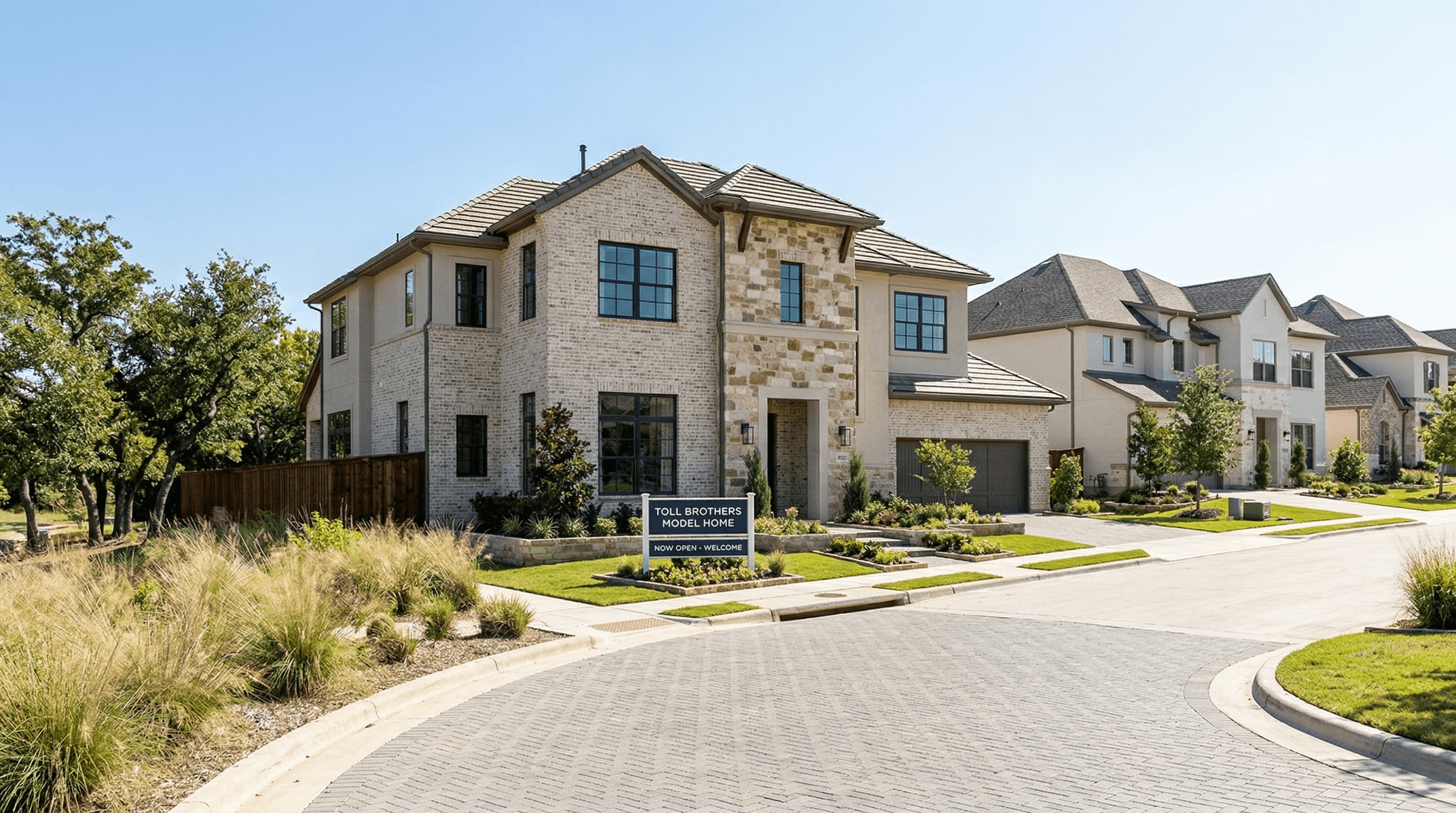
You've done the research. You've toured the model home. You've walked through the gleaming kitchen with the quartz countertops, the soaring ceilings, and the spa-style primary bathroom — and you thought, this is it. Then the sales consultant handed you the pricing sheet, and suddenly the numbers didn't quite add up the way you expected. The base price looked reasonable. But by the time you started adding the features that actually made the home feel like the one you toured, the number on the page looked very different from the number in your head.
That's not an accident. And it's not necessarily a problem — but it is something you need to understand before you sign anything. Toll Brothers builds genuinely beautiful homes, and their reputation in the luxury new construction market is well-earned. But "luxury" pricing has layers, and if you're buying in the Dallas-Fort Worth area — whether in Roanoke, Southlake, Flower Mound, or anywhere else in the Metroplex — you deserve a clear picture of what you're actually paying for, what's optional, and where the real value lies.
This guide is going to slow that process down and walk through it honestly. No pressure, no hype — just a clear explanation of how Toll Brothers luxury home pricing actually works, what premium features cost, and how to decide whether this builder and this price point make sense for your specific situation.
Key Takeaways
- Toll Brothers base prices in the DFW area typically start in the mid-$500,000s and can climb well past $1.5 million depending on community, floor plan, and structural options.
- The model home you tour is almost never the base price — it's fully loaded with upgrades that can add $100,000 to $400,000 or more to the final cost.
- Structural options (room additions, extended garages, outdoor living spaces) must be selected early and are usually non-negotiable after contract signing.
- Design center upgrades — flooring, cabinetry, countertops, fixtures — are where most buyers spend significantly more than anticipated.
- Toll Brothers offers in-house financing through TBI Mortgage, which can offer convenience but should be compared against outside lenders.
- Working with an independent buyer's agent who understands new construction contracts can protect your interests throughout the process.
- The right question isn't "Is this a good price?" — it's "Does this price make sense for my financial situation and long-term goals?"
What Makes Toll Brothers a Luxury Builder — and What That Actually Means for Pricing
Toll Brothers isn't marketing themselves as a luxury builder because they have a good PR team. They've earned that positioning through decades of building homes in the upper price tiers, and there are real, tangible differences in what they deliver compared to production builders at lower price points.
First, their floor plans tend to be larger and more architecturally complex. You're not looking at a simple box with a few gables — Toll Brothers designs typically feature dramatic entries, open sight lines, and thoughtful flow between spaces. The architectural details that make a home feel genuinely upscale — coffered ceilings, tray ceilings, arched doorways, built-in niches — are part of the design DNA, not afterthoughts.
Second, their standard specifications are higher than most builders. What other builders charge as an upgrade — things like 8-foot interior doors, upgraded insulation packages, or structured wiring for smart home systems — Toll Brothers often includes as standard. This is important context when you're comparing prices across builders, because a $600,000 Toll Brothers home and a $600,000 home from a mid-tier production builder are not the same product.
Third, Toll Brothers operates a dedicated design center experience. Rather than choosing from a limited palette of options, buyers work with design consultants to personalize their home across dozens of categories. This is genuinely valuable — but it's also where the pricing conversation gets complicated, because the options are extensive and the costs add up quickly.
💡 What "Luxury" Pricing Actually Signals
When a builder charges luxury prices, you're paying for three things: the land and community infrastructure, the structural quality and design complexity of the home itself, and the personalization experience. All three have real value. The key is understanding which of those three things matters most to you — because that shapes whether the price makes sense for your situation.
In the Dallas-Fort Worth market specifically, Toll Brothers has established communities in some of the most desirable locations — master-planned developments with resort-style amenities, top-rated school districts, and access to major employment corridors. That location premium is real and it's baked into the price. You're not just buying a house; you're buying into a community with a specific lifestyle promise.
That said, "luxury" is a relative term, and the luxury builder market has its own tiers. Toll Brothers sits in the upper-middle of the luxury spectrum — above production builders like D.R. Horton or Lennar, but below true custom builders who build entirely to your specifications from the ground up. Understanding where Toll Brothers fits in that spectrum helps you calibrate your expectations about what you can and can't control in the building process.
Toll Brothers Base Pricing in the Dallas-Fort Worth Area: What to Expect
Base prices for Toll Brothers homes in the DFW Metroplex vary significantly depending on the community, the collection (they have multiple product lines at different price points), and the specific floor plan. As a general framework, here's what buyers are typically looking at in the current market:
| Toll Brothers Collection / Tier | Typical DFW Base Price Range | Square Footage Range |
|---|---|---|
| Entry-Level Luxury (smaller floor plans) | $550,000 – $750,000 | 2,200 – 3,200 sq ft |
| Mid-Range Luxury (most popular tier) | $750,000 – $1,100,000 | 3,200 – 4,500 sq ft |
| Upper Luxury / Estate Collections | $1,100,000 – $1,800,000+ | 4,500 – 7,000+ sq ft |
These are base prices — meaning the home before any structural options or design center upgrades. The critical thing to understand is that the base price represents a starting point, not a realistic final cost for most buyers. The gap between base price and final contract price is where most buyers get surprised.
⚠️ The Model Home Is Not the Base Price
Every Toll Brothers model home you tour is fully upgraded. The finishes, the structural additions, the outdoor living spaces — all of it is selected to show you the home at its absolute best. The price displayed in the model is typically $150,000 to $400,000 above the base price for that floor plan. When you're budgeting, always ask the sales consultant for the base price and the estimated cost of the specific options you saw in the model.
Lot premiums are another layer that catches buyers off guard. Not all lots in a Toll Brothers community are priced equally. A lot that backs to a greenbelt, sits on a cul-de-sac, or offers a view can carry a premium of $20,000 to $80,000 or more above the standard lot price. Corner lots, oversized lots, and lots with specific orientation (for natural light or privacy) also command premiums. These lot premiums are added to the base price before any other options are considered.
Community HOA fees are also part of the true cost of ownership. Toll Brothers communities in DFW typically carry HOA fees ranging from $100 to $400 per month depending on the amenities included — pools, fitness centers, walking trails, gated entry, and community maintenance. Over the life of a 30-year mortgage, HOA fees represent a meaningful total cost that belongs in your budget calculation from day one.
Trying to figure out whether a Toll Brothers home fits your budget — including all the costs that don't show up on the base price sheet? We walk through the full picture before recommending anything, so you can make a decision that actually makes sense for your finances.
Talk Through the Numbers With UsStructural Options: The Upgrades You Choose Before You Break Ground
Toll Brothers divides their upgrade categories into two distinct phases: structural options and design center selections. Understanding this distinction matters because structural options are typically locked in at contract signing — or very shortly after — and cannot be changed once construction begins.
Structural options are modifications to the physical structure of the home itself. These are things that would require a contractor and significant expense to change after the home is built, so the builder needs to know your choices before the foundation is poured. Common structural options at Toll Brothers include:
- Extended covered patios and outdoor living spaces — One of the most popular upgrades in Texas, given the climate and lifestyle. A basic covered patio extension might run $15,000 to $35,000. A full outdoor living room with a fireplace and summer kitchen can reach $60,000 to $100,000.
- Additional bedrooms or bonus rooms — Converting an optional space (like a study or flex room) into a full bedroom with a closet, or adding a media room or game room, typically runs $20,000 to $50,000 depending on the scope.
- Extended garage or third-car garage — In DFW, where many buyers have multiple vehicles, boats, or need workshop space, garage extensions are common. Expect $15,000 to $40,000 for a third bay or extended depth.
- Second-floor balcony or juliet balcony — Adds architectural interest and outdoor living space. Typically $12,000 to $25,000.
- Bedroom or bathroom additions — Adding a guest suite, converting a loft to a bedroom, or adding a full bath where a half bath was planned. Costs vary widely but typically start around $20,000.
- Fireplace additions — Interior fireplaces (gas) typically run $4,000 to $10,000 as a structural option. Outdoor fireplaces are usually part of the outdoor living package.
The reason structural options deserve careful attention is that they represent your best opportunity to get what you actually want in the home at the lowest relative cost. Adding a covered patio after closing is significantly more expensive than selecting it as a structural option during construction — you're paying contractor markup, permitting fees, and you're disrupting a finished home. The builder's structural option pricing, while not cheap, is generally more efficient than post-construction additions.
💬 A Note on Structural Option Deadlines
Toll Brothers typically gives buyers a window of 10 to 30 days after contract signing to finalize structural options, depending on where the lot is in the construction queue. If the lot is already permitted or in early construction stages, that window may be even shorter. Don't let the excitement of signing a contract cause you to rush through structural decisions — these choices are permanent, and they're often the most expensive ones you'll make.
When evaluating structural options, the right question is: "Would I regret not having this after I move in?" Some options — like a third-car garage in a neighborhood where most homes have one — also affect resale value. Others are purely personal preference. Take the time to think through how you actually live, not just how you imagine living in a beautiful model home.
The Design Center Experience: Where Premium Features Get Their Price Tags
After structural options are locked in, buyers move to the Toll Brothers Design Studio — a dedicated showroom experience where you select the interior finishes, fixtures, and features that define the look and feel of your home. This is where the home becomes truly yours, and it's also where most buyers spend significantly more than they planned.
The design center process typically takes multiple appointments spread over several weeks. You'll work with a design consultant who guides you through selections across dozens of categories. The experience is genuinely impressive — it's one of the real advantages of building with a luxury builder versus a production builder with limited options. But "impressive" and "affordable" are different things, and it's worth understanding what you're walking into.
Here's a realistic breakdown of common design center upgrade categories and what buyers typically spend:
| Design Category | Base Included Level | Typical Upgrade Cost |
|---|---|---|
| Flooring (hardwood, tile, carpet) | Builder-grade carpet and tile | $15,000 – $60,000 |
| Kitchen Cabinetry | Standard painted or stained cabinets | $10,000 – $40,000 |
| Countertops (quartz, granite, marble) | Laminate or entry-level stone | $8,000 – $30,000 |
| Kitchen Appliances | Standard stainless package | $5,000 – $25,000 |
| Primary Bath Fixtures & Tile | Standard fixtures and tile | $8,000 – $35,000 |
| Lighting & Electrical | Basic fixture allowances | $5,000 – $20,000 |
| Smart Home / Tech Package | Basic pre-wire | $5,000 – $20,000 |
| Exterior (stone, brick, stucco upgrades) | Standard elevation | $8,000 – $30,000 |
Add those categories together and it becomes clear why buyers who walk into the design center expecting to spend $50,000 often walk out having committed to $150,000 or more in upgrades. That's not a failure of willpower — it's the reality of personalizing a luxury home when you've already committed to a specific community and floor plan and you want it to look the way you imagined.
"The design center is where the home becomes yours — and where the budget conversation has to stay honest. The goal isn't to spend as little as possible or as much as possible. The goal is to make choices you'll still feel good about five years from now."
A practical approach: before your first design center appointment, decide on a firm upgrade budget. Then prioritize the categories that will have the most daily impact on your life. For most families, that's flooring (you see and feel it constantly), kitchen functionality (appliances and countertops), and the primary bathroom. Secondary bedrooms and guest spaces can often stay closer to standard without meaningfully affecting your daily experience.
You're Not Wrong to Feel Overwhelmed
The design center experience is designed to be inspiring — and it is. But inspiration and budget discipline don't always coexist easily. If you leave your first appointment feeling like you want everything and aren't sure what to prioritize, that's completely normal. Take a breath, go home, and look at the numbers before your next appointment. There's no rush to commit to every selection in one sitting.
Before you walk into the Toll Brothers design center, it helps to have someone in your corner who's been through this process and can help you think through what's worth spending on — and what you can skip without regret.
Get Guidance Before Your Design AppointmentsPremium Features That Are Actually Worth the Price — and a Few That Aren't
Not all upgrades are created equal when it comes to value — either for your daily enjoyment or for resale. Having worked with buyers in the DFW new construction market, there are patterns in which upgrades consistently deliver satisfaction and which ones buyers sometimes wish they'd skipped.
Premium Features That Tend to Deliver Real Value
Hardwood flooring in main living areas. This is consistently one of the upgrades buyers are most glad they selected. Hardwood floors are durable, timeless, and genuinely improve the feel of a home. They also tend to hold value well at resale. The cost is real — typically $15,000 to $35,000 for main living areas in a larger home — but the daily impact is significant.
Extended covered outdoor living. In North Texas, where summers are long and outdoor entertaining is part of the culture, a well-designed covered patio is one of the most-used spaces in the home. Buyers who skip this option often add it later at significantly higher cost. If you plan to be in the home for more than a few years, this is worth serious consideration.
Kitchen appliance upgrades. The kitchen is the heart of daily life in most homes, and appliance quality directly affects how much you enjoy cooking and entertaining. Upgrading to a professional-grade range or a built-in refrigerator is expensive, but if you cook regularly, the daily satisfaction tends to justify the cost.
Primary bathroom upgrades. The primary bath is a daily retreat, and upgrades here — a freestanding soaking tub, a larger frameless shower, heated floors — tend to provide consistent enjoyment. This is one area where buyers rarely report regret about spending more.
Structural additions that match your lifestyle. If you work from home, a dedicated study with proper doors and soundproofing is worth far more than its cost. If you have teenagers, a media room or game room becomes the center of family life. Match structural options to how you actually live, not how you think you should live.
Upgrades to Think Twice About
Lighting fixture upgrades through the builder. Builder design center pricing on light fixtures tends to be significantly marked up compared to what you can source independently after closing. Unless you're selecting fixtures that are structurally integrated (like recessed lighting layout changes), consider living with the standard fixtures for a few months and then sourcing replacements yourself.
Wallpaper and specialty wall treatments. Tastes change, and what feels fresh and exciting in the design center can feel dated in five years. These are also relatively easy and inexpensive to change after the fact. Save your budget for things that are harder to change later.
Technology packages that bundle outdated equipment. Smart home technology evolves rapidly, and what a builder installs today may be superseded by better, cheaper consumer options within a few years. Basic pre-wiring is worth having; a fully loaded smart home package from the builder may not be the best use of $15,000 to $20,000.
📋 A Realistic Budget Scenario: Mid-Range Toll Brothers Home in DFW
Base price: $825,000
Lot premium (greenbelt view): $35,000
Structural options (covered patio, 3rd garage bay, study upgrade): $65,000
Design center upgrades (flooring, kitchen, primary bath, appliances): $120,000
Total contract price: $1,045,000
Closing costs (estimated 2-3%): $21,000 – $31,000
Post-closing needs (window treatments, landscaping, etc.): $15,000 – $30,000
True all-in cost: Approximately $1,081,000 – $1,106,000
Toll Brothers Financing: TBI Mortgage and What You Should Know
Toll Brothers has an in-house mortgage company called TBI Mortgage, and they actively encourage buyers to use it. There are legitimate reasons to consider TBI Mortgage — they understand the builder's timeline, they're experienced with construction-to-permanent financing, and they sometimes offer incentives (rate buy-downs, closing cost contributions) that are only available if you finance through them.
However, using the builder's preferred lender isn't always the right financial decision, and it's worth understanding the full picture before committing.
The incentives Toll Brothers offers for using TBI Mortgage can be genuinely valuable — sometimes $10,000 to $20,000 in closing cost credits or rate buy-down contributions. These are real dollars. But the question is whether the rate and terms you receive from TBI Mortgage are competitive with what you could get from an independent lender. If TBI Mortgage's rate is 0.25% to 0.50% higher than what you could get elsewhere, the higher rate over a 30-year loan term can cost significantly more than the upfront incentive.
⚠️ Always Get an Outside Quote First
Before accepting any builder financing incentive, get a competing quote from at least one or two independent lenders. Compare the total cost of each loan — not just the interest rate, but the APR, the points, and the total interest paid over the life of the loan. A $15,000 closing cost credit sounds great until you realize you're paying an extra $40,000 in interest over 30 years because the rate was higher. Do the math, not just the math that benefits the builder.
There's also the question of what happens if TBI Mortgage can't close your loan. New construction timelines are long — often 8 to 14 months from contract to closing — and your financial situation can change during that time. Understanding the financing contingency language in your contract, and what your options are if something changes, is important before you commit.
The right approach: get pre-approved with an independent lender before you start the Toll Brothers process, so you have a baseline for comparison. Then evaluate TBI Mortgage's offer against that baseline with clear eyes. If the numbers work in your favor, great. If they don't, you have the information to make a different choice.
How Toll Brothers Pricing Compares to the Existing Luxury Home Market in DFW
One of the most important questions a buyer in the $700,000 to $1.5 million range should ask is: "Should I buy new construction from Toll Brothers, or should I buy an existing luxury home in the same price range?" It's not a simple question, and the right answer depends on your priorities — but it's worth thinking through honestly.
The case for new Toll Brothers construction: You get exactly what you want in terms of finishes and features (within the builder's option set). Everything is new — mechanical systems, roof, appliances — which means lower maintenance costs in the early years. You're protected by builder warranties (Toll Brothers offers a 10-year structural warranty and shorter-term coverage on systems and workmanship). And you're often buying into a newer community with modern infrastructure and amenities.
The case for existing luxury homes: You can often get more square footage for the same price, particularly in established neighborhoods. Mature landscaping, established trees, and a neighborhood with character are things that take decades to develop and can't be replicated in a new community. Existing homes in desirable school districts also have a proven track record — you know what the neighborhood looks like fully built out, not just as a developer's rendering.
There's also the timeline consideration. Buying an existing home typically means closing in 30 to 60 days. Building with Toll Brothers means committing today to a home you won't move into for 8 to 14 months. A lot can change in your life — job situations, family needs, interest rates — over that period. That's not a reason to avoid new construction, but it's a real factor in the decision.
💬 The Comparison That Actually Matters
When comparing a Toll Brothers new construction home to an existing luxury home, don't just compare the purchase prices. Compare the total cost of ownership over 5 to 10 years — including maintenance, HOA fees, property taxes (new construction often triggers reassessments), and the cost of any features you'd need to add to an existing home to match what the builder includes. Sometimes new construction is the better value. Sometimes it isn't. The numbers will tell you.
The Role of a Buyer's Agent in a Toll Brothers Transaction — and Why It Matters
One of the most common misconceptions about buying new construction is that you don't need a buyer's agent because you're dealing directly with the builder. This is a significant misunderstanding that can cost you real money and real protection.
The Toll Brothers sales consultant in the model home works for Toll Brothers. Their job is to sell you a home at the best price for the builder. They're professional, knowledgeable, and often genuinely helpful — but they are not your advocate. They're the builder's advocate. That's not a criticism; it's just the reality of the relationship.
An independent buyer's agent who understands new construction contracts and the DFW market can provide several things the builder's sales team cannot:
- Contract review and negotiation. Toll Brothers contracts are detailed and builder-favorable. Having someone who understands what's negotiable — earnest money terms, closing date flexibility, what happens if the builder is delayed — protects your interests.
- Objective perspective on upgrades. A buyer's agent who has worked with other buyers in the same community can tell you which upgrades have the best resale value and which ones buyers commonly regret.
- Comparison context. Is this community and this floor plan the right fit for your needs, or is there a better option in the market? An independent agent can give you that perspective without a conflict of interest.
- Advocacy if problems arise. Construction issues happen. If there are quality concerns during the build, having an agent who can communicate professionally with the builder on your behalf is valuable.
Importantly, in most cases the builder pays the buyer's agent commission — it doesn't come out of your pocket. Toll Brothers, like most major builders, has established commission structures for buyer's agents. You get professional representation at no additional cost to you. There's no good reason to walk into a new construction purchase without it.
If you're considering a Toll Brothers community in the DFW area, having an independent perspective before you sign anything can make a meaningful difference. We're happy to walk through what you're looking at — no pressure, just honest guidance.
Get an Independent Perspective on Your New BuildQuestions to Ask Before You Sign a Toll Brothers Contract
The contract signing moment feels exciting — you've found the community, you've chosen the floor plan, and you're ready to make it official. But before you sign, there are questions that deserve clear, written answers. Don't let the momentum of the moment rush you past them.
- What is the estimated completion date, and what happens if the builder is delayed? Understand the contract language around delays — what constitutes an acceptable delay, what your options are if the home isn't ready when you need it, and whether there are any remedies available to you.
- What is the earnest money amount, and under what circumstances is it refundable? New construction earnest money is often larger than resale transactions and may be non-refundable in certain scenarios. Know exactly what you're committing to.
- What warranty coverage is included, and what is the process for warranty claims? Toll Brothers offers a 10-year structural warranty, but the coverage for workmanship and mechanical systems is shorter. Understand the process for filing a warranty claim before you need to use it.
- What is the process for the pre-drywall inspection and final walkthrough? You have the right to inspect your home at key stages of construction. Understand when those inspections happen and whether you can bring an independent inspector.
- Are there any community deed restrictions or HOA rules that affect how I can use the property? New construction communities often have extensive deed restrictions — on fencing, landscaping, exterior modifications, parking, and more. Read them before you commit.
- What is the current status of community amenities? If the community promises a pool, fitness center, or other amenities, when will they be completed? Are they already built, under construction, or still planned? "Planned" amenities sometimes don't materialize on the timeline promised.
These aren't adversarial questions — they're reasonable due diligence that any thoughtful buyer should do. A reputable builder like Toll Brothers should be able to answer all of them clearly and in writing. If the answers are vague or you're being pressured to sign before you have clarity, that's a signal to slow down.
Is a Toll Brothers Home Worth the Price? The Honest Answer
Here's the honest answer: it depends on your situation, your priorities, and your financial picture — and anyone who tells you differently is oversimplifying.
Toll Brothers builds genuinely good homes. Their construction quality is above average for production builders, their design options are extensive, and their communities in DFW are well-located. If you're looking for a luxury new construction home in the Metroplex and you want a builder with a proven track record, Toll Brothers belongs on your list.
But "worth it" is a personal calculation. A $1.1 million home is worth it if it fits comfortably within your financial picture, if the community and location serve your long-term needs, and if the features and finishes you're paying for are things you'll genuinely use and enjoy. It's not worth it if you're stretching beyond what's comfortable, if you're selecting upgrades because the model home made them feel necessary rather than because they match your life, or if you're buying in a location that doesn't actually serve your daily needs.
The most important thing you can do before committing to a Toll Brothers purchase — or any major real estate decision — is to slow down and look at the complete financial picture. Not just the monthly payment, but the total cost of ownership, the opportunity cost of the capital you're deploying, and whether this decision makes sense for where you are in life right now.
It's Okay to Take Your Time
There will always be another community, another floor plan, another incentive offer. The urgency you feel in a builder's sales office is real — but it's also partly manufactured. Good decisions are made with clear heads and complete information. If you need more time to think through the numbers, take it. A builder who won't give you that time isn't a builder you want to work with.
Frequently Asked Questions About Toll Brothers Luxury Home Pricing
In the current DFW market, Toll Brothers base prices typically start in the mid-$500,000s for smaller floor plans and can reach $1.8 million or more for estate-level homes. However, the base price is rarely the final price — most buyers end up spending $150,000 to $400,000 above the base price after lot premiums, structural options, and design center upgrades are added. A realistic budget for a mid-range Toll Brothers home in DFW, fully upgraded to a comfortable level, is typically $900,000 to $1.3 million all-in.
Toll Brothers is generally less flexible on base price than resale sellers, but there are areas where negotiation is possible. Lot premiums, upgrade packages, and financing incentives are sometimes negotiable depending on market conditions and where a community is in its sales cycle. Communities that are nearly sold out or in high demand have less flexibility; communities that are newly opened or slower-moving may offer more room. Working with a buyer's agent who understands the builder's sales patterns can help you identify where leverage exists.
The typical construction timeline for a Toll Brothers home in the Dallas-Fort Worth area is 8 to 14 months from contract signing to closing, depending on the floor plan complexity, current construction volume, and supply chain conditions. Some simpler floor plans on inventory lots (homes already under construction) can close faster — sometimes in 3 to 6 months. It's important to have a clear understanding of the estimated timeline before signing, and to have contingency plans for your housing situation during the build period.
You're not legally required to have a buyer's agent, but it's strongly advisable. The Toll Brothers sales team works for the builder, not for you, and new construction contracts are complex documents with significant financial implications. An independent buyer's agent who understands new construction can review the contract, advise on upgrade selections, and advocate for your interests throughout the process — typically at no additional cost to you, since builders generally pay buyer's agent commissions. Skipping representation to save money that you're not actually spending is one of the most common mistakes new construction buyers make.
Toll Brothers offers a layered warranty structure: a 1-year workmanship warranty covering defects in materials and workmanship, a 2-year systems warranty covering mechanical systems like HVAC, plumbing, and electrical, and a 10-year structural warranty covering major structural defects. It's important to understand what each tier covers and the process for filing a warranty claim. Before closing, make sure you receive the complete warranty documentation and understand the timelines for reporting issues — some warranty categories require you to report defects within a specific window after move-in.
TBI Mortgage can be a convenient option, and the incentives Toll Brothers offers for using them — closing cost credits, rate buy-downs — can be genuinely valuable. However, you should always get at least one competing quote from an independent lender before committing. Compare the total cost of each loan option, including the interest rate, APR, and total interest paid over the life of the loan. If TBI Mortgage's rate is meaningfully higher than what you can get elsewhere, the upfront incentive may not offset the long-term cost. Make the decision based on complete information, not just the headline incentive number.
Thinking About a Toll Brothers Home in DFW? Let's Look at the Numbers Together.
Luxury new construction is a significant financial decision, and the pricing layers can be genuinely confusing — even for experienced buyers. Whether you're just starting to explore Toll Brothers communities or you're close to signing a contract, we're happy to sit down with you, walk through the real costs, and help you figure out whether this makes sense for your situation. No pressure, no sales pitch — just honest guidance from someone who's on your side.
Let's Talk Through Your Toll Brothers DecisionCheck out this article next