It's 11:30 PM and you've got fourteen browser tabs open. Reddit threads debating eXp vs. KW. YouTube videos from agents claiming their brokerage is the best thing that ever happened to them. Glassdoor reviews that range from "changed my life" to "run the other direction." A BiggerPockets forum post from 2023 that might be completely outdated.
Maybe you're an agent trying to figure out where to hang your license. Maybe you're a homeowner who just noticed "eXp Realty" on your agent's business card and wondered what that even means. Either way, you're deep in the research spiral — and the more you read, the less clear it gets.
That's because most comparisons of eXp Realty and Keller Williams are written by people who work at one of them. They've got skin in the game. They're recruiting. And they're almost never telling you about the third option — smaller, local brokerages that don't have national marketing budgets but often deliver something the big names can't.
Let's slow this down and look at the actual numbers, the real trade-offs, and what this all means — whether you're choosing a brokerage to build your career at, or just trying to understand what your agent's brokerage means for your home sale.
Key Takeaways
- eXp Realty uses an 80/20 commission split capped at $16,000/year, with agents keeping 100% after cap — plus stock options and revenue share
- Keller Williams uses a 70/30 split with a locally variable cap ($18K–$30K) plus a 6% franchise royalty fee capped at $3,000/year
- Local independent brokerages in Texas often offer 90/10 to 100% commission models with lower monthly fees and direct broker access
- For homeowners, your agent's brokerage affects their marketing budget, support structure, and how the 2024 NAR settlement and Texas SB 1968 compliance is handled
- The "best" brokerage depends on career stage for agents and individual agent quality for homeowners — there is no universal winner
- TK Realty operates as a local brokerage in Roanoke, Texas, combining the personal service of an independent with the training and accountability of a structured team
If You're Already Feeling Overwhelmed, That's Normal
Here's What We Hear All the Time
From agents: "I've been told eXp is amazing and I've been told it's basically an MLM. I've been told KW has the best training and also that their fees eat your paycheck. I genuinely don't know who to believe."
From homeowners: "My agent works for some company I've never heard of. Does that matter? Should I only work with a big-name brokerage?"
Both of these concerns are completely valid. The real estate industry has a transparency problem — and it's hard to get a straight answer when everyone giving advice has a recruiting incentive. This guide is different. We're going to lay out the numbers, the trade-offs, and the honest pros and cons of each model. No spin.
Understanding the Three Models: What Actually Makes Them Different
Before we compare specifics, it helps to understand that these three brokerage types represent fundamentally different business philosophies. Not just different split structures — different answers to the question: What is a brokerage supposed to do for its agents and their clients?
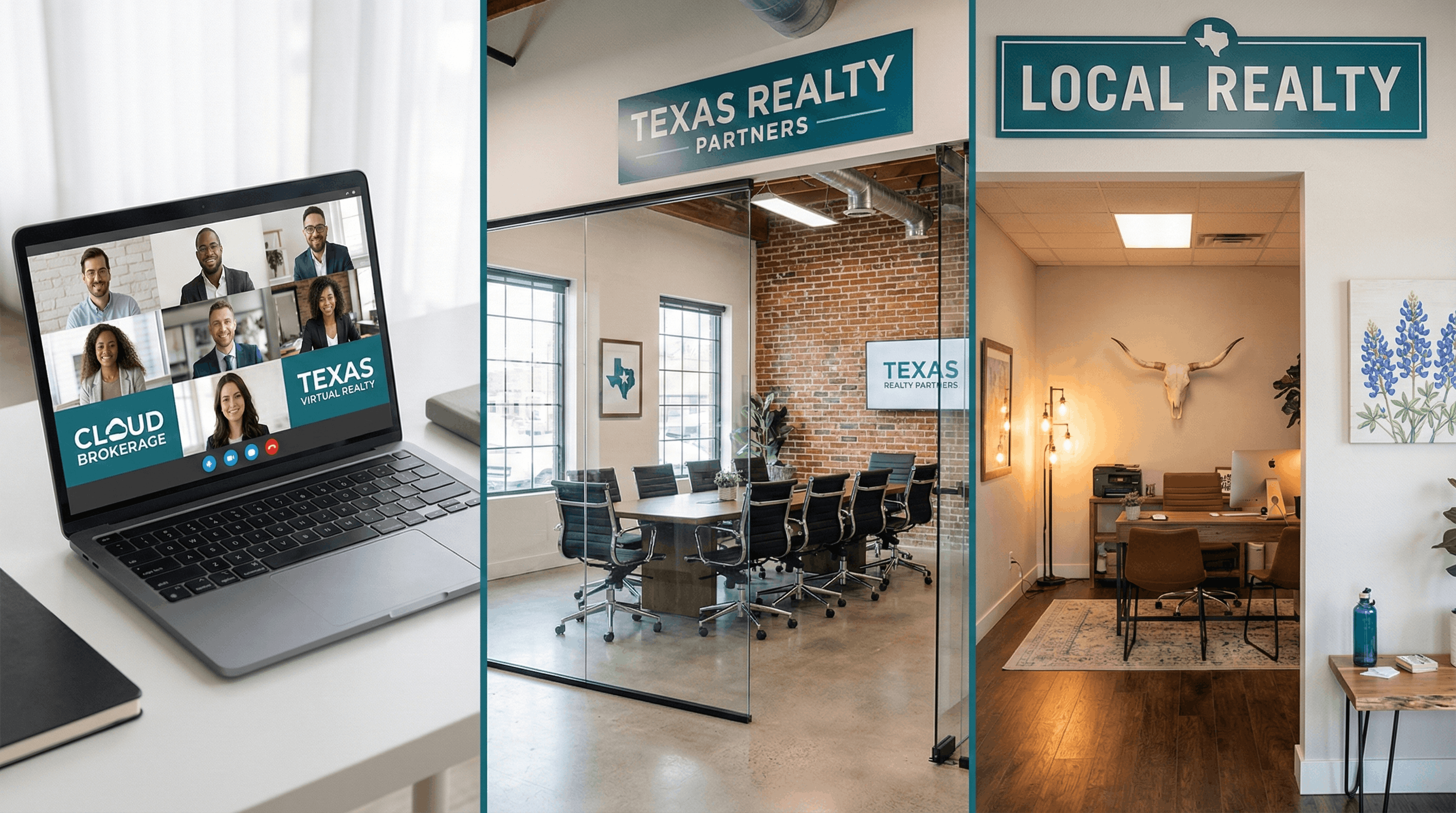
eXp Realty: The Cloud-Based Platform
Founded in 2009, eXp Realty operates entirely in the cloud. No physical offices. Agents connect through a virtual 3D world (think: a professional version of a video game environment), attend virtual training, and handle their entire business digitally. As of Q3 2025, eXp has approximately 83,400 agents across 28 countries.
The appeal is simple: lower overhead for the company means more money stays in the agent's pocket. eXp reported $1.3 billion in Q3 2025 revenue and $54.1 billion in transaction volume during that same period — so this isn't a scrappy startup. It's a publicly traded company (Nasdaq: EXPI) with serious scale.
The trade-off: You're building your career without a physical office, without daily face-to-face interaction with colleagues, and within a system where the revenue share model creates a strong recruiting culture that some agents find energizing and others find exhausting.
Keller Williams: The Franchise Powerhouse
Founded in 1983 in Austin, Texas, Keller Williams is the largest real estate franchise in the world by agent count — approximately 169,000 agents globally and about 145,000 in the U.S. as of early 2025. KW operates through independently owned "Market Centers" (local offices), with over 1,000 locations worldwide.
The appeal is structure and community. Walk into a KW Market Center and you'll find training rooms, bullpen desks for new agents, a managing broker down the hall, and a culture built around mentorship and in-person collaboration. KW handled over 828,000 transaction sides in 2024 with $370.8 billion in U.S. sales volume.
The trade-off: That physical infrastructure costs money, and the franchise model means agents pay more in splits and fees. The "family culture" that many love can also feel like pressure to recruit and attend events, and some agents describe it as insular.
Local Independent Brokerages: The Hyper-Local Option
This is the most diverse category. Independent brokerages in Texas range from one-person shops to mid-sized firms with 20–50 agents. They don't pay franchise fees to a national parent company, which means they have full control over their branding, marketing, fee structure, and culture.
In the DFW Metroplex, firms like Monument Realty and Rogers Healy and Associates have built strong reputations by focusing on local expertise rather than national brand recognition. Nationally, independent brokerages collectively hold the majority of market share — the largest national franchise brands combined typically account for only 15% to 20% of transactions.
The trade-off: Less brand recognition, potentially fewer technology resources, and highly variable quality. A great independent brokerage can be the best option in the market. A mediocre one can leave agents without support.
Where Does TK Realty Fit?
TK Realty is a local brokerage based in Roanoke, Texas, with 20+ agents serving Tarrant County and the surrounding communities. We operate as an independent — no franchise fees, no national corporate overhead — but with the structured training, accountability, and team support that you'd expect from a larger firm. Think of it as the local option with the infrastructure to back it up.
We're including ourselves in this comparison because transparency is kind of our thing. We'll show you exactly how our model stacks up — and honestly, there are situations where eXp or KW might be a better fit for certain agents. We'd rather you make the right decision than the one that benefits us.
Commission Splits: What Agents Actually Take Home
This is usually the first thing agents look at — and for good reason. The difference between brokerage models can mean tens of thousands of dollars per year in net income. But the headline split number never tells the full story. Let's break down what each model actually costs.
eXp Realty Commission Structure (2025–2026)
Base split: 80/20 (agent keeps 80%, eXp takes 20%)
Annual cap: $16,000 — once you've paid $16K to eXp in your anniversary year, you keep 100% of commissions for the rest of that year
Transaction fee after cap: $250 per transaction (reduced to $75 after $5,000 in post-cap fees)
Monthly cloud brokerage fee: $85/month ($1,020/year) — covers E&O insurance, CRM (kvCORE), virtual platform access
Franchise fees: None
Desk/office fees: None (no physical office)
New Agent Note
If you're new to real estate at eXp, the first three transactions go through the Mentorship Program, which adds an additional 20% split (10% to your mentor, 10% to eXp) on top of the standard 80/20. So your effective split on your first three deals is 60/40.
Keller Williams Commission Structure (2025–2026)
Base split: 70/30 (agent keeps 70%, Market Center takes 30%) — some offices start at 64/36
Franchise royalty fee: 6% on every transaction, capped at $3,000/year (this is paid to KW International, separate from the split)
Annual cap: Set by your local Market Center — typically ranges from $18,000 to $30,000 depending on the office location and overhead
Total "company dollar" before 100% commission: $21,000 to $33,000 (cap + royalty fee)
Monthly technology/desk fees: Varies by Market Center, typically $122–$350+/month depending on whether you use a dedicated desk or shared space
Local Independent Brokerage Commission Structures
This varies widely, but here are common models you'll find in the DFW area:
Flat-fee/100% commission model: Agent keeps 100% of commission, pays a flat monthly fee ($175–$225/month) plus a small transaction review fee ($250–$350 per closing)
Traditional split model: 80/20 or 90/10 — sometimes without an annual cap, which can get expensive for high producers
Hybrid model: Lower split with a lower cap, often competitive with eXp on net income
The Numbers Side by Side: What You Actually Net
Here's what a solo agent takes home at three different production levels, after all splits, fees, and costs are accounted for:
| Gross Commission Income (GCI) | eXp Realty (Net) | Keller Williams (Net) | Independent Flat-Fee (Net) |
|---|---|---|---|
| $100,000 | $78,980 | $65,200 | $87,000 |
| $250,000 | $213,915 | $170,200 | $235,000 |
| $500,000 | $462,000 | $420,000 | $485,000 |
Assumptions: eXp nets after $16K cap, $1,020/year cloud fee, and transaction fees. KW assumes $21K total cap (low end) and $300/month tech/desk fees. Independent assumes $225/month flat fee and $250 per-transaction review fee. All figures are for solo agents, not teams.
What the Numbers Tell You
At every production level, the cloud-based and flat-fee independent models result in higher net income — by $13,000 to $65,000 per year depending on volume. The question isn't just "which pays more" but whether the additional services KW provides (physical office, in-person training, local culture) are worth that difference to you.
Technology: What's Included vs. What You're Paying For
Your brokerage's tech stack affects everything from how you generate leads to how smoothly your transactions close. Here's what each model provides.
eXp Technology Stack
eXp's flagship is eXp World — a 3D virtual campus powered by FrameVR.io where agents attend live trainings, meet with managing brokers, and access admin support through digital avatars. Whether you find this innovative or gimmicky depends on your comfort with virtual environments.
More practically, eXp includes kvCORE (now part of the BoldTrail ecosystem) in the $85/month fee. This is an all-in-one CRM with IDX website, automated lead nurturing, and behavioral AI. An individual kvCORE license runs $299–$499/month on the open market, so this represents genuine value. Transaction management is handled through SkySlope, and eXp recently rolled out Luna AI for virtual support.
Keller Williams Technology Stack
KW invested heavily in KW Command, a proprietary platform that integrates CRM, marketing design (including a 2025 Canva integration), and transaction management. It earned the HousingWire Tech100 award in 2025.
The standout addition in 2025 is KWIQ, an AI assistant that provides real-time answers and automates social media campaigns. Unlike eXp's virtual-only approach, KW's tech is often reinforced by local Market Center Tech Trainers who provide in-person help — a significant advantage for agents who find automated platforms hard to navigate on their own.
Independent Brokerage Technology
Most independent brokerages don't build their own software. Instead, they curate a "best-of-breed" stack from third-party tools. A typical DFW independent might use Lofty (formerly Chime) for CRM, Brokermint for back-office, and localized marketing support. This offers flexibility but puts the burden of integration on the agent.
| Feature | eXp Realty | Keller Williams | Independent (Typical) |
|---|---|---|---|
| CRM | kvCORE (included) | KW Command (included) | Varies (agent may source) |
| IDX Website | Included with kvCORE | Included with Command | Usually provided |
| Transaction Management | SkySlope | KW Command | Brokermint or similar |
| AI Tools | Luna AI | KWIQ (HousingWire Tech100) | Limited or none |
| In-Person Tech Support | No (virtual only) | Yes (Market Center trainers) | Yes (direct broker access) |
| Marketing Tools | Basic templates | Canva integration + design | Varies widely |
| Monthly Tech Cost | $85 (all-in) | $122–$350+ | $0–$225 |
Training and Mentorship: Where You Actually Learn the Business
This is where the conversation gets real — especially if you're a newer agent. The brokerage you choose in your first two years can define the trajectory of your entire career.
Keller Williams: Still the Industry's Training Powerhouse
Let's give credit where it's due. KW's training programs — particularly Ignite for new agents and BOLD (Business Objective: A Life by Design) for experienced producers — are widely considered the best in the industry. The physical Market Center environment creates a "bullpen" where new agents can shadow experienced producers, get immediate contract advice from a managing broker, and absorb the daily rhythm of a real estate office.
Many agents view the higher KW fees as "tuition" for an education that accelerates their ramp-up. There's also KW MAPS Coaching and Mega Agent Expansion for agents looking to scale into teams.
eXp University: Virtual Scale, Self-Starter Required
eXp offers over 80 hours of live training per week — delivered by top-producing agents from across the country. An agent in rural Texas can learn directly from some of the highest-producing teams in New York or Los Angeles. That kind of access is genuinely unprecedented.
For new agents, the mandatory Mentorship Program pairs you with a local certified mentor for your first three transactions. However, the virtual nature of eXp's support means you need to be proactive. Agents who thrive at eXp are self-starters who don't need someone physically looking over their shoulder. Agents who need daily in-person guidance often struggle.
Independent Brokerages: Direct Broker Access
The biggest selling point of many local brokerages is direct access to the principal broker. In a small firm, you might have the broker's personal cell phone number and the ability to walk into their office for a one-on-one contract review. Some DFW firms offer training specifically focused on regional nuances — Tarrant County neighborhood dynamics, local builder relationships, and area-specific contract requirements.
The downside: The quality of training at an independent is entirely dependent on the broker's willingness and ability to teach. Some independents provide better training than KW. Others provide almost none.
Which Training Model Fits Your Career Stage?
Brand-new agent (0–2 years): KW's structured training environment is hard to beat. The physical office, the daily accountability, and the proven programs like Ignite give new agents the best foundation. The higher fees are genuinely worth it at this stage.
Experienced solo agent (3–10 years): If you already know how to generate leads and manage transactions, you're likely overpaying for training you no longer need. eXp or a well-run independent will put more money in your pocket.
Team leader: eXp's borderless team structure is attractive if you want to build across markets. KW's physical office works well as a team hub. A local independent can offer the most flexible team arrangements.
Part-time or niche agent: A flat-fee independent model typically makes the most financial sense if your volume doesn't justify a capped split.
Revenue Share vs. Profit Share: The Wealth-Building Programs
Both eXp and KW offer passive income programs designed to reward agents who help grow the brokerage. These programs are frequently the most debated — and most misunderstood — aspect of each company.
eXp Revenue Share
eXp shares its top-line revenue (the 20% it collects from agent commissions) with agents who recruit other productive agents to the company. This income is paid "off the top," meaning it's distributed before eXp's operating expenses. In 2024, eXp paid more than $220 million in revenue share and equity benefits to its agents.
Agents can also earn EXPI stock through several programs: an Agent Equity Program (5% of commission buys stock at a discount), ICON Agent Awards (top producers earn their entire $16K cap back in stock), and production bonuses for first closings and sponsored agent closings.
Keller Williams Profit Share
KW's model shares the profit (not revenue) from local Market Centers with agents in the "upline" of those who generated the business. After a Market Center pays its monthly expenses — rent, utilities, staff — a portion of the remaining profit is distributed.
The key difference: KW's profit share is contingent on local office profitability. In a market downturn where a physical office has high fixed costs, profit share can dwindle to near zero. Industry comparisons have shown that a similar downline of 55 agents at KW might generate $700 in monthly profit share, while a comparable group at eXp could generate $12,000 in monthly revenue share.
The MLM Question — Addressed Directly
Both programs are frequently criticized as "multi-level marketing" or "pyramid scheme" structures. Here's the honest take:
- Neither program requires agents to purchase products or recruit to earn their standard commission — the passive income programs are supplemental, not foundational
- However, both programs create a strong recruiting culture where some agents prioritize bringing in new members over serving clients
- The revenue/profit share should be viewed as a bonus, not a business plan — most agents earn modest amounts, and the outsized success stories are the exception
- If someone's primary pitch for why you should join their brokerage is the passive income opportunity, take a step back and evaluate the actual brokerage services first
Culture and Community: The Intangible Factor
The "culture" of a brokerage is the most subjective comparison point — but for many agents, it's the deciding factor.
The KW "Family" Culture
Keller Williams emphasizes a "God, Family, then Business" philosophy. Market Centers serve as community hubs where agents celebrate Red Day (an annual day of service), participate in Associate Leadership Councils, and build genuine friendships with colleagues they see every day. For agents who value in-person camaraderie and local social structure, KW is hard to beat.
The other side: Some former agents describe the culture as "cultish" — noting that the intense focus on KW-specific language, recruitment, and attendance at events can be alienating for people who just want to sell real estate without the corporate identity.
The eXp Virtual Culture
eXp's culture is decentralized and global. Agents connect through digital platforms and events like EXPCON. This appeals to tech-savvy agents who value mobility and international networking. Many eXp agents cite the transparency of the company's public financials as a point of cultural pride.
The other side: The lack of a physical office can be genuinely isolating. For agents who thrive on daily human interaction, the virtual model can feel disconnected — especially in the early years when you're still building relationships and learning the business.
The Independent Boutique Culture
Local independent brokerages in DFW often have a "startup energy" — small teams, high accountability, and a strong sense of being local experts who aren't beholden to national corporate mandates. Some firms build personality-driven cultures around their principal broker, creating a tight-knit environment that larger companies can't replicate.
The Part Nobody Wants to Talk About: Controversies and Legal Issues
If you're making a major career or business decision, you deserve to know the full picture — including the parts that don't make it into recruiting presentations.
eXp Realty: Workplace Safety Concerns
The most significant controversy facing eXp involves multiple lawsuits alleging that senior leaders failed to adequately respond to reports of sexual assault at company events. In early 2026, the Delaware Court of Chancery refused to dismiss a shareholder lawsuit against eXp World Holdings, allowing claims to proceed that leadership — including the CEO — was aware of misconduct by top recruiters and failed to act.
These allegations have contributed to what industry observers describe as "attrition concerns" and a growing "why I left eXp" sentiment among some agents. The individuals at the center of the allegations are no longer with the company, but the lawsuits allege that eXp's revenue share model created a financial incentive to overlook the behavior of high-producing recruiters.
Keller Williams: Antitrust Settlement and Telemarketing Lawsuits
Keller Williams was a primary defendant in the landmark Sitzer/Burnett antitrust lawsuit, reaching a $70 million settlement in early 2024 to resolve claims about inflated buyer agent commissions. This case fundamentally changed how commissions are disclosed and negotiated nationwide.
KW has also faced multiple Telephone Consumer Protection Act (TCPA) class-action lawsuits — including a $40 million settlement in 2023 and another lawsuit filed in June 2025. These have fueled agent frustration about paying franchise fees while the company faces mounting legal liabilities.
| Aspect | eXp Realty | Keller Williams |
|---|---|---|
| Glassdoor Rating | 4.6 stars | 4.3 stars |
| Indeed Culture Rating | 4.4 stars | 4.3 stars |
| BBB Rating | B- (EXPI parent) | Varies by local office |
| Key Legal Issue | Sexual harassment litigation | Commission antitrust settlement |
| Common "Why I Left" Theme | Lack of support / ethics concerns | High fees / "cult" culture |
What This Means for Homeowners: Does Your Agent's Brokerage Actually Matter?
If you're reading this as someone buying or selling a home, you might be wondering: should I care which brokerage my agent works for?
The short answer: your agent's individual skill matters more than their brokerage logo. But the brokerage does affect a few things worth knowing about.
Marketing Budget and Effort
An agent who keeps more of their commission has more resources to invest in marketing your home. An eXp agent or an agent at a flat-fee independent may be more willing to spend $2,000–$3,000 on professional photography, drone footage, and video tours because they're not handing 30% of their paycheck to a franchise owner. That said, a well-resourced KW team may have in-house marketing support that individual agents at other brokerages don't.
Support and Accountability
If something goes wrong mid-transaction, who does your agent turn to? At KW, there's a managing broker and support staff in a physical office. At eXp, there's a virtual support system that's often more streamlined but less personal. At a local independent, you may have direct access to the principal broker — which can be an advantage when quick decisions need to be made.
Compliance with New Texas Laws
This is increasingly important. As of January 1, 2026, Texas Senate Bill 1968 requires a written agreement between a broker and a buyer before the agent can show properties. This applies regardless of brokerage, but larger brokerages like KW and eXp are still retraining thousands of agents on the new requirements. At a smaller, local brokerage, your agent's compliance may be more closely monitored simply because there are fewer agents for the broker to supervise.
The NAR Settlement and What It Means for You
The 2024 NAR settlement changed the game for Texas sellers and buyers:
- Sellers: Are no longer required to offer compensation to the buyer's agent on the MLS. Some sellers still offer commissions to attract more buyers, while others opt for concessions or no offer at all.
- Buyers: Must now sign a written agreement that clearly states how their agent will be paid — potentially out of pocket if the seller doesn't cover it.
- Bottom line: Regardless of your agent's brokerage, make sure they can clearly explain how they get paid, what you owe, and what your options are. If they can't explain it simply, that's a red flag. Understanding the full cost picture is essential.
The DFW Landscape: What This Looks Like Locally
If you're an agent or homeowner in the Fort Worth and Tarrant County area, the brokerage landscape has specific local dynamics worth understanding.
Keller Williams in DFW
KW has a massive physical footprint in North Texas, which makes sense — they're headquartered in Austin and Texas is their home turf. Major DFW Market Centers include locations in Fort Worth (South Hulen), Southlake, Weatherford, and Urban Dallas. If you value a physical office and local KW community, you'll have plenty of options.
eXp in DFW
Because eXp is virtual, there's no "eXp office" to visit in Fort Worth or Roanoke. But there are thousands of eXp agents operating in the DFW market. The company's 2025 Q3 report shows they maintain strong transaction volume in major Texas metros. For agents who don't need a physical office and want to operate anywhere in the Metroplex without geographic restrictions, eXp's model works well here.
Independent Brokerages in DFW
The DFW area has a thriving independent brokerage scene. From high-end marketing specialists to flat-fee operations, there's no shortage of local options. TK Realty, based in Roanoke, serves the Tarrant County corridor including Fort Worth, Arlington, Keller, Southlake, Grapevine, Colleyville, and the HEB (Hurst-Euless-Bedford) area — combining the local knowledge of an independent with the structured support of a larger team.
The Full Comparison: Everything Side by Side
Here's the comprehensive comparison across every major category:
| Category | eXp Realty | Keller Williams | Local Independent |
|---|---|---|---|
| Commission Split | 80/20 | 70/30 (or 64/36) | 80/20 to 100% |
| Annual Cap | $16,000 | $18K–$30K + $3K royalty | Varies (some have no cap) |
| Monthly Fees | $85 | $122–$350+ | $0–$225 |
| Physical Office | No | Yes | Usually yes |
| CRM Included | kvCORE (valued $299–$499/mo) | KW Command | Varies |
| Training Quality | Strong (virtual, 80+ hrs/week) | Industry-leading (in-person) | Highly variable |
| New Agent Support | Mentor program (3 deals) | Ignite + bullpen + daily training | Direct broker access |
| Passive Income Program | Revenue share + EXPI stock | Profit share | Rare (some offer equity) |
| Stock/Equity Opportunity | Yes (EXPI stock programs) | No | Some offer partnership |
| National Brand Recognition | Growing | Very strong | Local only |
| Agent Count (2025) | ~83,400 global | ~169,000 global | Varies (1–50+ agents) |
| Best For | Experienced, self-directed agents | New agents; those wanting community | Agents wanting flexibility + local focus |
Common Mistakes When Choosing a Brokerage
Whether you're an agent selecting a professional home or a homeowner evaluating your agent's company, here are the missteps we see most often:
- Choosing based on the split alone. The highest split doesn't always mean the most money in your pocket. Factor in monthly fees, transaction costs, cap amount, and what you'd need to purchase separately (CRM, marketing, leads) that might be included elsewhere.
- Joining for the passive income pitch. Revenue share and profit share are real programs — but they supplement income, they don't replace the work of serving clients. If the person recruiting you spends more time on the comp plan than on how the brokerage will help you close deals, be cautious.
- Ignoring culture fit. You can make money at any of these models. But if you're an extrovert who thrives on daily office energy, eXp's virtual model might drain you. If you're independent and self-directed, KW's meeting culture might feel like a waste of time. Culture matters more than most agents admit.
- Not asking about compliance and legal support. With SB 1968 and the NAR settlement changes, every agent in Texas needs strong compliance backing. Ask your brokerage: who reviews my contracts? How fast can I get a broker on the phone? What happens if a deal goes sideways at 5 PM on a Friday?
- Assuming brand name equals quality (as a homeowner). A Keller Williams sign in the yard doesn't guarantee a better experience than an agent at a local firm you've never heard of. Interview the agent, not the brokerage. Ask about their track record, their process, and their approach.
- Not running the math on your actual production level. A new agent doing 4 transactions and an experienced agent doing 30 will have completely different financial outcomes at each brokerage. Run the numbers for YOUR situation, not the generic example.
Take Your Time With This Decision
Whether you're choosing where to build your real estate career or choosing which agent to trust with the biggest financial decision of your life, this isn't something to rush.
The real estate industry wants you to decide quickly. Brokerages want to recruit you before the competing offer lands. Agents want you to sign before you have time to shop around. That's pressure — and pressure leads to decisions you regret.
Here's what we'd suggest instead:
Before You Commit: A Thoughtful Evaluation
- For agents: Shadow at the office (or virtual environment) for a full day before signing anything
- For agents: Talk to 3–5 agents who've been at the brokerage for 2+ years — not the ones they introduce you to, the ones you find on your own
- For agents: Run net income projections using YOUR realistic first-year production, not hypothetical high volumes
- For agents: Ask the managing broker directly: "What happens when I need help at 8 PM on a Sunday?"
- For agents: Read the Independent Contractor Agreement fully — including termination clauses and non-compete provisions
- For homeowners: Interview your agent about their process, not their brokerage's marketing materials
- For homeowners: Ask how the NAR settlement and SB 1968 changes affect YOUR specific transaction
- For homeowners: Request a clear, written breakdown of all costs before you sign any agreement
- For homeowners: Use the mortgage calculator and home valuation tool to understand your numbers independently
- For everyone: If someone is pressuring you to decide today, that's a sign they're prioritizing their timeline over yours
Frequently Asked Questions
Is Keller Williams or eXp Realty better for new agents?
For most new agents, Keller Williams provides a stronger foundation through its structured training programs (Ignite, BOLD), physical office environment, and daily in-person mentorship. The higher costs function as tuition for an education that helps new agents build essential skills faster. eXp can work for new agents who are highly self-motivated, but the virtual model requires more independence than most first-year agents have developed.
Why are agents leaving eXp Realty?
Agent departures from eXp (the company reported a 2% decline to approximately 83,400 agents in 2025) are driven by several factors: the virtual-only model can feel isolating, the recruiting-heavy culture doesn't appeal to everyone, and the ongoing sexual harassment lawsuits have created reputational concerns for some agents. eXp's leadership noted that 77% of departures in late 2024 and early 2025 were from agents completing fewer than three transactions annually.
What is the lawsuit against Keller Williams?
Keller Williams was a primary defendant in the Sitzer/Burnett antitrust case, settling for $70 million in early 2024. The lawsuit alleged that traditional commission structures inflated costs for home sellers. KW has also faced multiple Telephone Consumer Protection Act (TCPA) class-action lawsuits, including a $40 million settlement in 2023 and another filed in June 2025.
Does it matter to a homeowner which brokerage their agent works at?
The brokerage matters less than the individual agent's skill, experience, and commitment to your transaction. However, the brokerage does affect your agent's marketing budget (higher net income = more resources for your listing), support structure (who helps when problems arise), and compliance processes for new Texas laws like SB 1968. Interview the agent, not the brand.
What does an 80/20 commission split mean?
An 80/20 split means the agent keeps 80% of the commission earned on a transaction and the brokerage takes 20%. For example, if an agent earns a $10,000 commission, they keep $8,000 and the brokerage receives $2,000. At eXp, this 20% brokerage share is capped at $16,000 per year — after which the agent keeps 100% (minus transaction fees).
Is eXp Realty a pyramid scheme or MLM?
No — eXp is a licensed real estate brokerage, not an MLM. Agents earn standard real estate commissions from actual property transactions. The revenue share program (which rewards agents for recruiting) is supplemental income, not a requirement. However, the recruiting culture at eXp is strong, and critics fairly point out that the revenue share structure shares characteristics with multi-level compensation models. The distinction is that agents can earn a full living without ever recruiting anyone.
What is Texas Senate Bill 1968 and how does it affect my home purchase?
Effective January 1, 2026, SB 1968 requires a written agreement between a broker and a buyer before the agent can perform acts of brokerage — including showing you a property. The agreement must state that compensation is negotiable and not set by law. This means you'll sign paperwork before your first showing, and you should understand exactly what you're agreeing to pay. This applies to every agent regardless of their brokerage — eXp, KW, independent, or otherwise.
Not Sure Which Direction Is Right for You?
Whether you're an agent exploring your options or a homeowner trying to find the right representation in Tarrant County, we're happy to have an honest conversation — no recruiting pitch, no sales pressure. Just a clear look at what makes sense for your situation.
Schedule a Conversation Get Your Home's ValueCheck out this article next